A Meiko that throws a message in the middle of service leaves the kitchen with one question: can we keep washing, or not?
Meiko answers it in its own operating instructions, more directly than most manufacturers. There is a colour system, and there is a published list of message numbers that mean stop. National Appliance Repairs services Meiko warewashing equipment across Melbourne, Sydney, Brisbane, Adelaide and Perth.
First, which Meiko do you have?
Meiko runs several machine families, and their messages are not interchangeable.
- M-iClean U: undercounter glass and dishwashers. The most common Meiko in Australian cafés, bars and restaurants, and the machine this guide is based on.
- M-iClean H: hood-type pass-through machines.
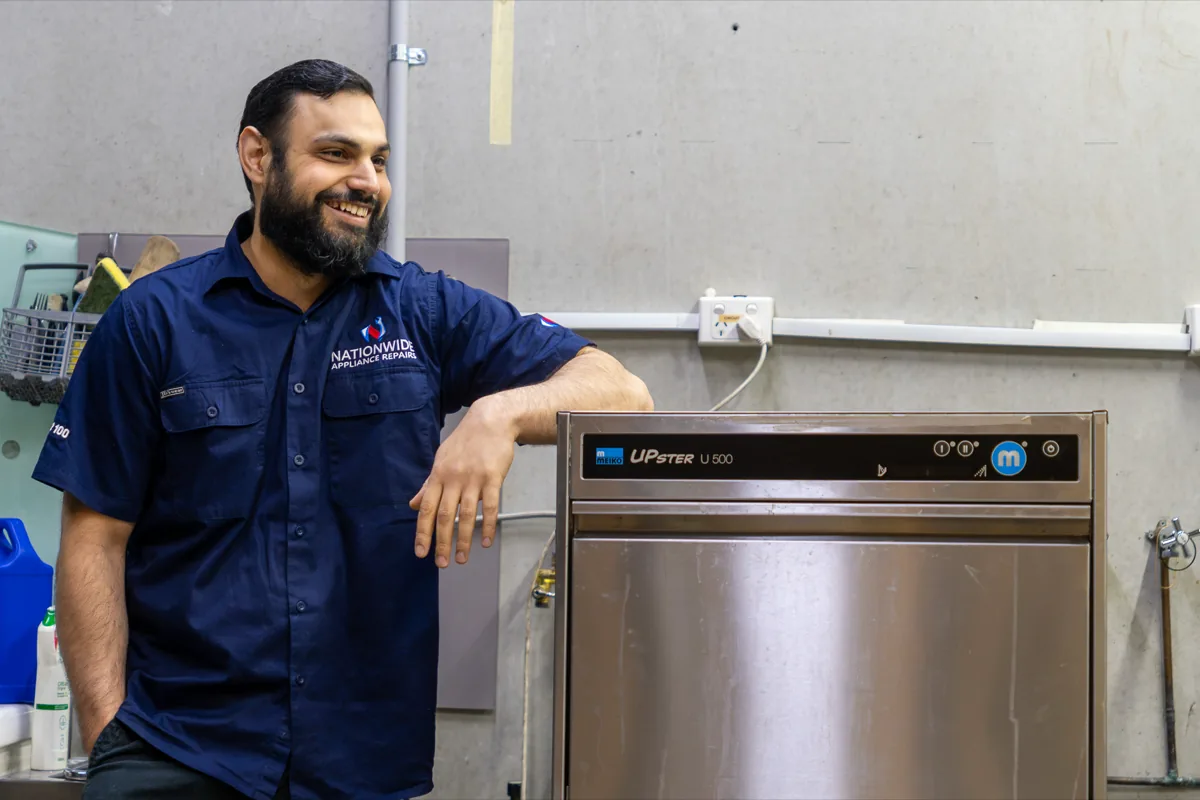
- UPster: Meiko’s more compact range.
- M-iQ: large conveyor and flight-type systems.
The model name is on the rating plate. On the M-iClean U it is on the inside of the lower front panel. If your machine is not an M-iClean U, check its own operating instructions before acting on the numbers below.
Need This Fixed Today?
Our licensed technicians repair this exact fault every week – fast, reliable, and backed by a workmanship guarantee.
- Licensed & insured
- Workmanship guarantee
- No fix, no fee
Grey messages and red messages
When a Meiko detects a malfunction, it shows a message in one of two colours.
- Grey messages can be acknowledged with the confirmation key. They report something your team can deal with.
- Red messages usually require an authorised service technician.
That distinction alone settles most mid-service decisions.
The messages that mean stop
For the M-iClean U, Meiko publishes a specific list. If any of these message numbers appear, it is not possible to continue working:
1, 100, 102, 104, 107, 108, 109, 110, 150, 201, 203, 204, 206, 207, 208, 209, 330, 420, 425, 427, 880, 901/902, 931 to 945, and 960.
Meiko’s instruction for all of them is the same:
- Switch off the on-site power supply to the machine.
- Close the on-site water supply.
- Call a service technician.
Do not keep restarting the machine to force it through a cycle. On the hood-type M-iClean H, message 1 is Leakage in floor tray. That is flood protection, the same float-in-a-tray system behind the Bosch E15 error on domestic dishwashers.
The messages your team can clear
| Message | What it means | What to do |
|---|---|---|
| 6: Programme cancelled prematurely | The cycle was interrupted | Start the wash cycle again |
| 7: Door not closed | The door is open or not latched | Close the door |
| Any grey message | A condition staff can resolve | Deal with the cause, then acknowledge with the confirmation key |
| Any number on the stop list above | A fault that stops the machine | Power off, water off, call a technician |
Faults with no message
Meiko’s manual also covers problems that show up in the wash before any message appears. These are worth knowing, because most are fixed in minutes.
- The machine doesn’t fill: Check the on-site shut-off valve is open, clean the dirt trap, and make sure the door is closed.
- The final rinse doesn’t spray: No water supply or a clogged dirt trap. Open the valve and clean the trap.
- Streaks or smears on glassware: Unsuitable rinse aid, the wrong dosing quantity, or a problem with the water treatment. Change the product, adjust the dose, or have the water treatment checked.
- Heavy foam in the wash tank: Meiko is explicit on this one: never use a foaming manual dishwashing detergent for pre-cleaning or for cleaning the machine. Foam causes malfunctions and a poor wash. Unsuitable detergent and heavily soiled water also cause it, so change the tank water more often during a busy service.
Anything not covered in Meiko’s list of occasional malfunctions, the manual says, generally needs an authorised technician.
Why a stopped machine is a compliance problem
Standard 3.2.2 of the Australia New Zealand Food Standards Code requires a food business to make sure eating and drinking utensils and food contact surfaces are clean and sanitised. A warewasher that has stopped, or is being forced through cycles it cannot complete, is not doing that.
If a red message ends the shift, move to a compliant manual wash and sanitise process until the machine is repaired, and record the downtime. Your Environmental Health Officer may ask.
When to book
Book on any message in the stop list, on any red message, and on a grey message that keeps returning after your team has dealt with its cause.
Our commercial warewasher and glasswasher service and commercial dishwasher repairs cover Meiko across all five capitals. We offer priority scheduling for urgent commercial breakdowns, planned preventative maintenance, and service reports with job photography for your compliance records. See our full range of commercial appliance repairs.
Call:
- Melbourne 03 9123 0548
- Sydney 02 9621 5988
- Brisbane 07 3166 9770
- Adelaide 08 7123 4027 or,
- Perth 08 9470 4450
B2B office support is available until 6:30 PM weekdays.
Have the model from the rating plate, the message number and its colour. If you also run Hobart or Winterhalter machines, our guides to Hobart E0 to E6 errors and Winterhalter error codes cover those platforms.
Frequently asked questions
What is the difference between a grey and a red message on a Meiko?
Grey messages can be acknowledged with the confirmation key and cleared by staff. Red messages usually need an authorised service technician.
Which Meiko messages mean I have to stop using the machine?
On the M-iClean U, Meiko lists 1, 100, 102, 104, 107 to 110, 150, 201, 203, 204, 206 to 209, 330, 420, 425, 427, 880, 901/902, 931 to 945 and 960. Switch off the power, close the water supply and call a technician.
What does message 6 mean on a Meiko?
The programme was cancelled prematurely. Start the wash cycle again.
Why is my Meiko foaming?
Usually foaming manual dishwashing detergent used for pre-cleaning or cleaning the machine, which Meiko says never to use. Unsuitable detergent and heavily soiled tank water also cause it.
Do these codes apply to every Meiko?
No. This guide covers the M-iClean U undercounter range. Hood-type, UPster and M-iQ machines have their own message lists, so check your model’s operating instructions.
The short version
Meiko gives you the answer in two ways. The colour tells you who deals with it: grey for your team, red for a technician. The stop list tells you which numbers mean power off, water off and call now.
Most of the faults without a message, like no fill, streaks and foam, are supply, dosing and detergent problems your team can fix. National Appliance Repairs services Meiko warewashers nationally, with priority commercial scheduling. Enquire about commercial services or call your nearest office.
Call Us:
or leave a message using the form below