How to Clean a Dishwasher Filter

How to Clean a Dishwasher Filter

If your dishes come out with bits of food still stuck to them, or if there is a persistent bad smell after a cycle, the filter is almost certainly to blame. It does a lot of quiet work--trapping food particles to stop the drain blocking--but gets very little attention until something goes wrong.

Cleaning the dishwasher filter is one of the quickest, highest-impact maintenance tasks you can do. Takes about five minutes once you know how. No tools. No special products. And it makes a noticeable difference to both how clean your dishes come out and how the machine smells.

Here at National Appliance Repairs, we service dishwashers across Sydney, Melbourne, Brisbane, Adelaide, and Perth. A blocked or neglected filter is one of the most common reasons customers call us. Before you reach for the phone, check whether a simple filter clean solves the problem.

What Does a Dishwasher Filter Actually Do?

The filter sits at the base of the dishwasher tub, right under the lower spray arm. Its job is to catch food particles, grease, and debris during a wash cycle. That way they do not recirculate back onto your dishes or clog the drain pump.

Most modern Australian dishwashers--including popular brands like Bosch, Fisher & Paykel, Miele, Smeg, and Electrolux--use a manual filter system. That is a cylindrical mesh filter you have to clean by hand. Older dishwashers sometimes had self-cleaning filters built in, but you do not see those much anymore.

CHOICE Australia says grease and food scraps collecting in the filter cause most dishwasher odour and hygiene problems. A filter full of old, rotting food residue also makes the machine underperform. Your dishes come out less clean than they should be.

How Often Should You Clean the Dishwasher Filter?

For a typical Australian household using the dishwasher daily:

  • Inspect: Once a week (just a visual check takes 30 seconds)
  • Rinse under water: Every one to two weeks if used heavily
  • Full clean (soak and scrub): Once a month

If you have a large household, frequently wash heavily soiled pots and pans, or run the dishwasher multiple times per day, increase the cleaning frequency. In a rental property context, filters often go uncleaned for months at a time -- getting into a monthly habit prevents the machine from deteriorating.

What You'll Need

  • Hot water
  • Dish soap (a few drops)
  • A soft-bristled brush or old toothbrush
  • White vinegar (optional, for stubborn build-up)
  • A bowl or sink basin large enough to submerge the filter
  • Rubber gloves (recommended -- it's not a glamorous job)

Step-by-Step: How to Clean a Dishwasher Filter

Step 1: Remove the Bottom Rack

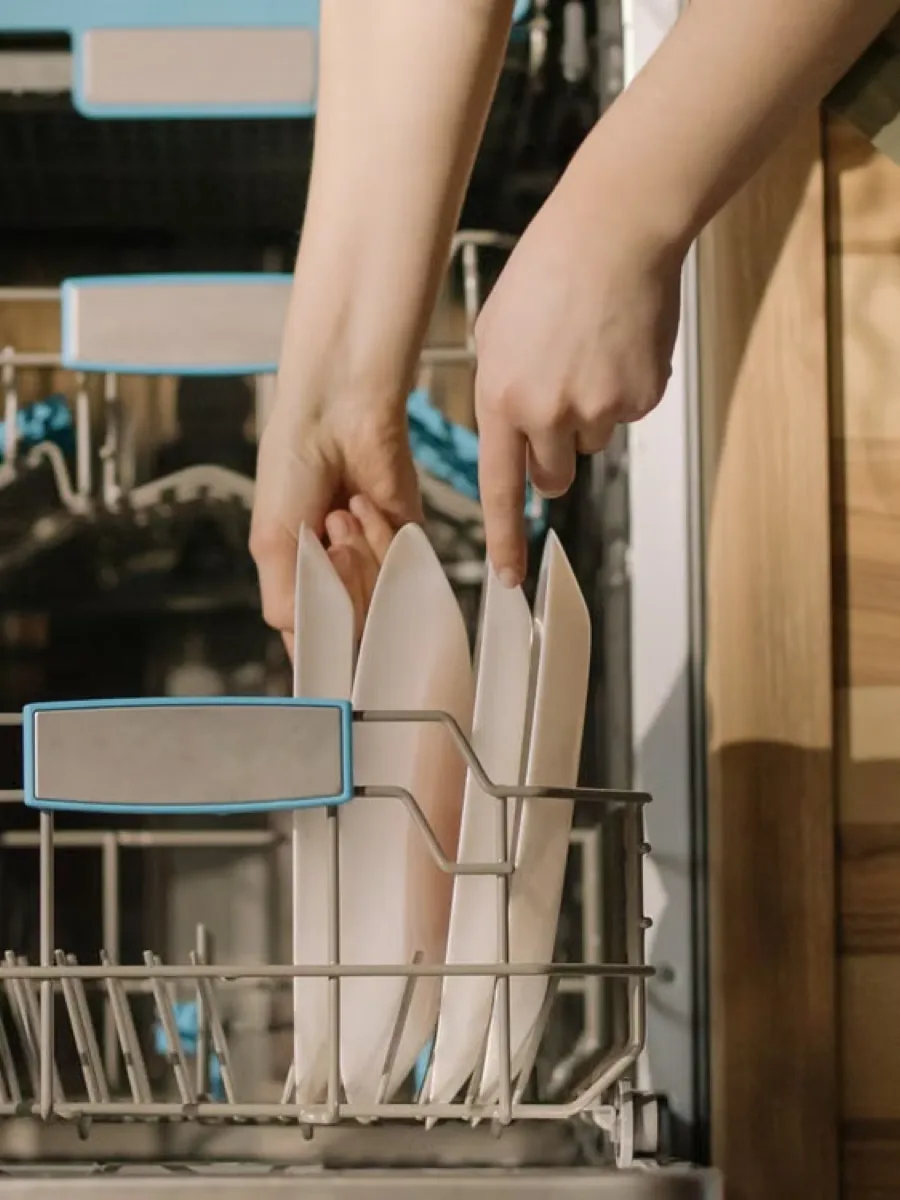
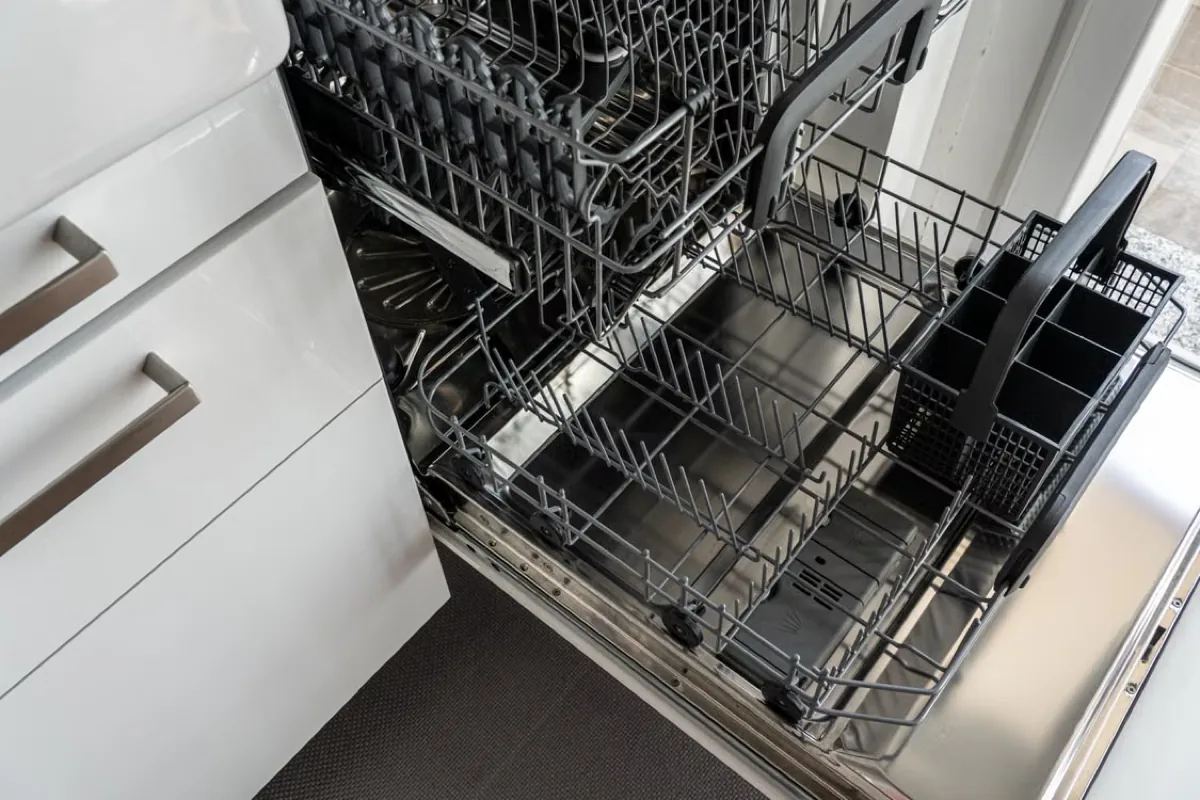
Pull out the bottom dish rack. Set it aside. Now you can actually see the base of the dishwasher where the filter lives.

Step 2: Locate and Remove the Filter

Look for a round opening in the centre or rear of the dishwasher floor. That is where the filter assembly sits. It usually has two parts: a cylindrical upper filter and a flat mesh plate underneath (the lower filter). Together they trap particles of different sizes.

Here is how to remove them.

Twist the upper cylinder anticlockwise until it unlocks. That is usually about a quarter-turn. Lift it out. Then lift out the flat lower filter from the surrounding housing.

Not sure how your specific model comes apart? Check the user manual. Or search online for your dishwasher model. For dishwasher repairs or questions about a particular model, we are happy to help.

Step 3: Rinse Under Hot Water

Hold both filter pieces under the hot tap. Rinse away loose food particles. A lot of the debris will wash off right away. If you cleaned the filter recently, this might be all you need.

Still see grease, a slimy film, or food stuck in the mesh? Move to the next step.

Step 4: Soak in Soapy Water (or Vinegar)

Fill your sink or a large bowl with hot water. Add a few drops of dish soap. Drop both filter pieces in. Let them soak for five to ten minutes. This loosens grease and softens any dried-on food.

Has it been a while since the last clean? Significant build-up? Add half a cup of white vinegar to the soak water instead of--or in addition to--the dish soap. The acetic acid in vinegar breaks down grease and mineral deposits really well.

Step 5: Scrub the Mesh

After the soak, grab a soft-bristled brush or an old toothbrush. Gently scrub the mesh on both filters. Pay extra attention to the fine mesh screen on the flat lower filter. Food particles love getting lodged in that weave.

Do not use anything abrasive. No steel wool. No scouring pad. That damages the mesh and makes it worse at trapping particles.

Step 6: Rinse Thoroughly

Rinse both parts under hot running water. Keep going until the water runs clear and no soap or debris remains.

Hold each filter up to the light. Look at the mesh. Still looks clogged? Repeat the soak and scrub.

Step 7: Clean Around the Filter Housing

Before you put the filter back, take a damp cloth or your toothbrush and wipe around the filter housing in the base of the dishwasher. Food and grease collect there too. Leave it dirty and you are wasting half the benefit of a clean filter.

Step 8: Reinstall the Filter

Place the flat lower filter back into the housing. Insert the cylindrical upper filter. Twist it clockwise to lock it in place. It should sit flush and turn smoothly. If it feels stiff or will not lock, pull it out and check the seating. Then replace the bottom rack. Done.

Common Filter Problems and What They Mean

SymptomLikely CauseAction
Dishes have food bits after washingFilter cloggedClean filter; check spray arms
Dishwasher smells badBacteria and mould in filterFull filter soak and vinegar clean
Water pooling at bottom after cycleFilter or drain blockedClean filter; inspect drain area
White film on dishesHard water scale in machineDescale with vinegar; check salt level
Filter won't come outIncorrect twist directionTurn anticlockwise; check manual

When the Filter Isn't the Problem

If you've cleaned the filter thoroughly and your dishwasher still:

  • Isn't draining properly
  • Leaves dishes dirty or wet
  • Makes unusual grinding or rattling noises
  • Shows an error code on the display

...then the issue has moved beyond simple maintenance and likely involves a component fault -- a blocked drain pump, a failing spray arm, a water inlet valve issue, or a sensor problem. These aren't DIY fixes.

We provide dishwasher repairs across all major Australian cities, with same-day service available for urgent faults. Our technicians carry parts for the most common brands and models, so many repairs can be completed in a single visit.

Frequently Asked Questions (FAQs)

How do I know if my dishwasher has a manual or self-cleaning filter?

Look at the bottom. See a mesh thing you can twist out by hand? That is manual. Clean it regularly. No removable filter? Check your manual. Some old models have self-cleaning filters. They are noisier but need less attention from you.

Can I put the filter in the dishwasher to clean it?

You can. But do not bother. The spray arms will not hit the fine mesh properly. And any gunk on the filter just ends up back on your dishes. Hand-clean with a brush. Takes a few minutes. Works better.

Filter looks clean but dishwasher still smells. Now what?

Check the door seal. Mould hides there. Wipe with a vinegar-dampened cloth. Check the spray arm holes too. Still stinky? Run a hot cycle with a cup of vinegar in the top rack--empty dishwasher. Then a baking soda cycle.

Is there a special product for cleaning filters?

No. Dish soap and hot water. That is it. White vinegar for grease and scale. Commercial cleaners are fine for the machine itself. But they do not clean your filter for you.

How long does a filter last?

The life of the machine. If you are gentle with it. No steel wool. No hard scrubbing. If the mesh is torn or warped, get a new one. A technician can supply the right filter for your model.

Conclusion

Here is the truth. Cleaning the dishwasher filter is the most effective maintenance task you will ever do for this machine. Five minutes a month. That is all it takes. No smells. No pump failures. Just properly clean dishes, cycle after cycle.

If filter cleaning doesn't solve your dishwasher's issues, or if you'd like a professional to run a full service on the machine, National Appliance Repairs is here to help. We service all major dishwasher brands across Australia -- call 1300 434 380 for a free phone consultation.

How to Clean a Dishwasher

How to Clean a Dishwasher

Your dishwasher cleans your dishes every day. When did you last return the favour?

Most Australian households run their machine several times a week. But they never think about maintaining it. That catches up with you. Food particles pile up. Grease hardens. Hard water leaves its mark. Soap scum settles in. Spray arms clog. The filter turns into a science experiment. Bacteria and mould start growing. Next thing you know, your dishes come out dirty, your machine smells bad, and you have a fault that was totally preventable.

According to CHOICE Australia, most dishwasher problems start with a dirty filter. And the mould or bacteria that build up inside, in addition to being unpleasant, are genuine hygiene issues and potential health hazards. Regular cleaning keeps the machine running smoothly. It also genuinely extends its life. Worth the ten minutes.

National Appliance Repairs does dishwasher repairs across all major Australian cities. Truth is, many of the calls we get could have been avoided with routine maintenance. So here is how to do it properly.

How Often Should You Clean a Dishwasher?

  • Filter: Inspect weekly, clean monthly (or as needed)
  • Interior drum cycle (vinegar or commercial cleaner): Monthly
  • Door seal and edges: Monthly
  • Spray arms: Every three months
  • Exterior: As needed

If your dishwasher is used heavily -- in a busy family home, a rental property, or a commercial setting -- increase the filter cleaning frequency to every two weeks.

What You'll Need

  • White vinegar (1--2 cups)
  • Bicarbonate of soda (half a cup)
  • Dish soap
  • An old toothbrush or soft-bristled scrubbing brush
  • Microfibre cloths
  • A toothpick (for clearing spray arm holes)
  • Rubber gloves

Step-by-Step: How to Clean a Dishwasher

Step 1: Clean the Filter

Pull out the bottom rack. Look at the floor of the dishwasher. That cylinder? That's the filter. Most twist anticlockwise and lift out. Check your manual if it resists.

What you'll find inside: old food, grease film, sometimes black mould. Rinse it under hot water. Then fill a bowl with hot water and a squirt of dish soap. Soak it for five minutes. Scrub the mesh parts with an old toothbrush. Rinse again. Set it somewhere to dry.

Step 2: Clear the Spray Arms

Those little holes in the spray arms collect gunk over time. Remove the arms--they usually click off or unscrew by hand. Hold each arm under the tap. Poke a toothpick through every blocked hole you see.

If the holes are crusted with white scale, soak the whole arm in white vinegar for 15 minutes first. Then poke, rinse, and click them back in.

Step 3: Wipe the Door Seal and Edges

Run your finger along that black rubber strip around the door. Feels gritty? That is moisture, old food, and sometimes mould hiding in the folds. Grab a damp microfibre cloth and wipe every inch of that seal. Got dark spots? Dip the cloth in undiluted white vinegar and scrub them out.

While you are at it, wipe the door edges and the control panel. Grease splatter lands there more often than you realise.

Step 4: Clean the Interior with Vinegar

Put the racks back in. Leave the dishwasher empty. Set a heatproof cup or bowl with 1–2 cups of white vinegar upright on the top rack. No detergent. Run the hottest cycle your machine has got.

Vinegar cuts grease and dissolves mineral buildup. But here is the catch. Only do this once a month. Vinegar wears down rubber seals over time. Need to freshen things up weekly? Buy a dishwasher cleaning tablet instead. Much gentler on the machine.

Step 5: Deodorise with Baking Soda

When the vinegar cycle finishes, skip the detergent. Sprinkle half a cup of bicarbonate of soda across the dishwasher floor. Run a short hot cycle. The bicarb kills any leftover smells and gives the inside a mild scrub.

One rule: never put vinegar and baking soda in the same cycle. They react and neutralise each other. Separate cycles only.

Step 6: Replace the Clean Filter

Once everything has air-dried for a few minutes, put the clean filter back in. Replace the bottom rack. Then leave the dishwasher door slightly open--just a crack. That last step stops mould from coming back.

Dishwasher Cleaning Schedule

TaskFrequency
Inspect and rinse filterWeekly
Full filter clean (soak and scrub)Monthly
Vinegar wash cycleMonthly
Bicarb deodorising cycleMonthly
Wipe door seal and edgesMonthly
Check and clear spray armsEvery 3 months
Full exterior wipe-downAs needed

Common Signs Your Dishwasher Needs Cleaning (Or a Repair)

Regular cleaning stops most problems before they start. But if you notice any of the following, your dishwasher needs attention now.

  • Cloudy, greasy, or still-dirty dishes. That usually means a blocked filter or spray arm.
  • A bad smell coming from inside. Food trapped in the filter. Or mould hiding in the door seal.
  • Visible mould around the seal or inside the drum.
  • White film or mineral deposits on the walls. That's hard water scale--common in Adelaide, Melbourne, and Perth.
  • Water pooling at the bottom after a cycle finishes. Could be a drain issue. Could be a blocked filter.

If cleaning doesn't fix dirty dishes, standing water, or strange noises during a cycle, you're probably looking at a mechanical fault. In that case, you’ll need to have it looked at professionally.

Tips to Keep Your Dishwasher Cleaner for Longer

  • Scrape (but don't necessarily rinse) dishes before loading -- food particles are the primary source of filter blockages and bad smells
  • Use the correct type and amount of dishwasher detergent for your water hardness -- excess detergent leaves residue
  • Run the dishwasher on hot cycles regularly, especially if you normally use an eco or low-temperature setting
  • If you have hard water, use dishwasher salt (if your model has a salt reservoir) to prevent mineral scale build-up -- this is particularly relevant in cities like Adelaide, which has notoriously hard water
  • Leave the door ajar between uses where practical; this prevents moisture from sitting stagnant inside

FAQ

Why does my dishwasher smell even though I use it every day?

Using it every day actually makes the smell worse if you never clean the filter. Think about it. Every cycle dumps more food residue into that filter. That residue rots. Bacteria love it. Pull the filter out. It will probably look disgusting. Clean it. Then run a vinegar cycle. Smell will be gone.

Can I use bleach to clean my dishwasher?

Please don't. Bleach is terrible for stainless steel--it corrodes the metal over time. It also chews up rubber seals. You want a leaking dishwasher? Because that's how you get one. Stick with vinegar and baking soda. They are safer and they actually work.

How do I deal with hard water stains inside my dishwasher?

White vinegar does the job on light scale. Pour it in a cup, run a hot cycle. But if your dishwasher looks like a limestone cave, vinegar alone won't cut it. Get a commercial descaler. Use it every three to six months. And for the love of clean dishes, use dishwasher salt regularly. That stops new scale from forming.

Is it worth cleaning a dishwasher that's already several years old?

Absolutely. A clean old dishwasher runs better than a dirty new one. The seals last longer. The pump lasts longer. The spray arms actually spin instead of just dribbling water. Cleaning costs you maybe ten minutes. Replacing a pump costs you a few hundred dollars.

My dishwasher isn't draining after I cleaned the filter. What's wrong?

Stop cleaning. You have done what you can. If the filter is spotless and water is still sitting at the bottom, the problem is somewhere else. Could be a blockage in the drain hose. Could be the drain pump died. Either way, you cannot fix it with a toothbrush or a bottle of vinegar. Call someone who does this for a living.

Conclusion

The secret to a well-performing dishwasher is literally just spending 30 minutes cleaning it every month. Do the steps above consistently, and you’ll be able to catch most issues before they even start.

If your machine has developed a fault that cleaning hasn't resolved -- dishes coming out dirty, water not draining, or error codes appearing -- National Appliance Repairs is ready to help. Our qualified technicians service all major brands across Australia. Call 1300 434 380 for a free phone consultation.

Bosch Dishwasher E15 Error: Causes, Fixes, and When to Call a Technician

Bosch Dishwasher E15 Error: Causes, Fixes, and When to Call a Technician

“Water where it shouldn't be” – that's what the E15 code on the display of your Bosch dishwasher is telling you. Specifically, the sensor in the base tray of your Bosch dishwasher has detected moisture -- and as a result, the machine's AquaStop flood protection has kicked in, cut off the water supply, and left everything at a standstill.

It won't clear on its own. The error stays until the source of the water is found and dealt with.

National Appliance Repairs sees this fault regularly across homes in Melbourne, Sydney, Brisbane, Adelaide, and Perth. Some are straightforward. Some aren't. Here's how to tell the difference.

What AquaStop Actually Does

The AquaStop system is standard on most Bosch dishwashers. It’s a double-walled inlet hose that sits at the back of the machine, plus a float switch lives in the base pan. The moment water touches that float switch -- even a small amount -- it sends a signal to the control board to close off the inlet and hold the drain pump running. The E15 code appears on the display.

Bosch describes this as lifelong flood protection. The trade-off is that it's sensitive by design, so even minor seepage that has pooled over time will trigger it.

What Causes the E15 Error

Several different failure points can let water into the base pan:

  • Worn door seal: Daily use degrades the rubber gasket around the door edge. Water begins escaping during the wash cycle and runs down into the base. This is the most common cause.
  • Loose or cracked inlet hose: The connection points where the hose meets the machine can loosen over time, or the hose itself can crack. Water drips into the base rather than the tub.
  • Leaking sump seal: The sump sits at the very base of the tub. Its seal wears gradually and is one of the more frequent E15 culprits in older Bosch machines.
  • Inlet valve not closing fully: A valve that sticks open allows water to continue trickling in after the fill phase ends. Over multiple cycles, enough accumulates in the base to trip the float.
  • Cracked tub: Less common, but physical damage to the dishwasher's interior can allow water to bypass the tub entirely.
  • Faulty float switch: Occasionally the switch itself is the problem -- stuck or corroded, it reads a leak that isn't there. A technician can test this quickly.

What Not to Do First

One piece of advice that circulates in Australian home improvement forums is to tilt the dishwasher forward to drain the base pan. Don't do this. Tilting shifts the pooled water toward the machine's electrical components at the back, which can turn a manageable repair into a far more expensive one.

When E15 appears:

  • Switch the machine off at the power point
  • Turn off the water supply tap behind the dishwasher
  • Leave the machine upright -- do not run another cycle
  • Put towels down if there's visible moisture on the floor around the base

What You Can Check Yourself

A few checks are worth doing before calling anyone out:

  • Run your finger along the door seal, looking for tears, flat spots where the rubber has lost its shape, or food and detergent residue preventing a full seal
  • Follow the inlet hose from the back of the machine and check for kinks, cracks, or loose connections at either end
  • Look around the base of the machine for any sign of where moisture is originating

That's roughly where DIY ends for E15. Accessing the sump seal, testing the inlet valve, or replacing the float switch all require removing machine panels and working near live electrical components. Under Australia's Model Work Health and Safety Laws, this work should be handled by a licensed technician.

What a Technician Does on an E15 Job

StageWhat Happens
Initial inspectionHoses, door seal, and base pan are checked for moisture and obvious damage
Dry-outAny remaining water in the base pan is carefully removed
Component testingFloat switch, inlet valve, and sump seal are tested individually
Leak identificationWater is run through the machine to locate the exact leak point
RepairThe faulty part -- seal, hose, valve, or switch -- is replaced
Test cycleA full cycle confirms the leak is gone and E15 doesn't return

Keeping E15 Away

Regular habits that make E15 less likely:

  • Wipe the door seal periodically to stop detergent and food residue from degrading the rubber
  • Run a hot maintenance cycle monthly with a dishwasher cleaner -- it flushes mineral deposits from hoses and the inlet valve
  • Every six months, pull the machine out slightly and check the inlet hose connection at the back for loosening, particularly if the dishwasher vibrates noticeably during operation
  • If the machine gets heavy daily use, a service check every two years is worth doing before a fault develops

FAQ

What does E15 mean on a Bosch dishwasher?

The AquaStop flood protection has detected water in the base pan. The water inlet shuts off automatically. The error won't clear until the source of the water is identified and fixed.

Can I reset E15 and keep using the dishwasher?

Resetting clears the display, not the leak. Running the machine again will almost certainly retrigger E15 and risks more water reaching your floor and cabinetry. Get the leak fixed first.

Is E15 always an actual leak?

Usually. In rare cases a faulty or stuck float switch triggers E15 with no real leak present. A technician can confirm this by testing the switch directly.

How long does a Bosch E15 repair take?

If the technician has the right part -- door seals and inlet hoses are commonly stocked on the van -- the repair is typically done on the same visit. Parts that need to be ordered may mean a return visit within a few days.

Does Australian consumer law cover an E15 repair?

It depends on the cause. Manufacturing defects are covered under the Australian Consumer Law, which requires goods to be of acceptable quality and last a reasonable time. Normal seal wear on a heavily used older machine is generally a maintenance matter rather than a warranty claim.

Conclusion

E15 is one of the Bosch dishwasher faults you shouldn't put off. The AquaStop system stopped the flooding -- but the leak is still there, and the next cycle will just trigger it again. Get the door seal, hoses, and sump inspected before the machine runs again.

If you're in Sydney, Melbourne, Brisbane, Perth, or Adelaide, National Appliance Repairs can have a qualified technician to your door the same day, with upfront pricing and a 12-month warranty on all parts.

Bosch Dishwasher E22 Error: What It Means and How to Fix It

Bosch Dishwasher E22 Error: What It Means and How to Fix It

You open the dishwasher after a cycle and find water sitting in the bottom of the tub, E22 on the display. Nine times out of ten, the fix is cleaning a filter that hasn't been touched in months. This one you can usually handle yourself.

Here's what's happening and how to sort it out. For repairs that go beyond a blocked filter, National Appliance Repairs services Bosch dishwashers across Australia's major cities, with same-day availability and a 12-month parts warranty.

What E22 Actually Means

The E22 code fires when the pressure sensor detects standing water in the sump -- the basin at the base of the tub beneath the filter -- after the drain phase. The machine stops the cycle rather than keep running with water it can't shift.

It's worth knowing how this differs from other drainage codes. E22 points squarely at the filter and sump area. E24 is a drain path issue -- a kinked hose, blocked connection, or check-valve problem. If you're seeing E24, the filter clean below won't fix it.

Start With the Filter

This clears E22 in most cases.

Turn the dishwasher off at the power outlet. Pull out the bottom rack. At the base of the tub you'll find two filters: a cylindrical coarse filter on top and a flat fine mesh filter beneath it. Rotate the coarse filter anti-clockwise and lift it out, then remove the mesh filter underneath.

Rinse both under warm running water and scrub with a soft brush -- an old toothbrush is fine. White chalky deposits are mineral scale. If there's significant buildup, soak both filters in warm water with a splash of white vinegar for 20 minutes before scrubbing. Reseat the mesh filter first, then the cylindrical one, turning it clockwise until it locks.

Run a short cycle and see if the code clears.

If the Filter Was Clean

A clean filter with a returning E22 narrows things down:

  • Non-return valve: A small rubber or plastic flap near the drain outlet. If it's jammed open by a food fragment, water backflows into the sump after each drain attempt. Check it moves freely.
  • Drain hose: Trace the hose from the back of the machine to the connection under the sink. Look for kinks, sharp bends, or compression against cabinetry. Also check the hose end isn't sitting submerged in water under the sink -- that creates a siphon that blocks drainage.
  • Pump area: With the filters removed, shine a torch into the sump cavity. Glass fragments and small plastic pieces sometimes get past the filter and jam the pump impeller. If you can see debris, remove it carefully with needle-nose pliers before reassembling.

Why Some People Get E22 Repeatedly

Two things make E22 a recurring problem rather than a one-off:

Water hardness. Mineral content in Australian tap water varies considerably by region. Adelaide and Perth sit at the harder end, and homes there tend to see scale accumulate in filters and drain components faster than the manufacturer's maintenance schedule accounts for. The Australian Drinking Water Guidelines outline hardness ranges across the country -- if your area runs hard, clean the filter more often than the manual suggests and run a descale cycle monthly. Running the spray arms under the tap when you do the filter clean is worth doing too; the holes block with the same mineral deposits.

Detergent and rinse aid habits. Too much detergent leaves residue that accumulates on the filter mesh. Skipping rinse aid in a hard-water area accelerates scale buildup on both the filter and the pump. Neither fix is expensive.

Maintenance to Keep E22 Away

TaskFrequencyWhy
Clean filterMonthly (fortnightly in hard-water areas)Prevents food and scale blockages
Run a cleaner or descale cycleEvery 1--2 monthsClears mineral buildup from filter, pump, and hoses
Check drain hose for kinksEvery 6 monthsRestricted hoses cause slow or incomplete drainage
Top up rinse aidEvery 1--2 monthsReduces scale on filter mesh and pump
Inspect sump areaMonthlyCatches debris before it reaches the pump

When to Call a Technician

Clean filter, clear drain hose, no visible blockage in the sump -- and E22 is still there. At that point the fault is in a component: the non-return valve may have failed outright rather than just being blocked, the pump chamber clip may need reseating, or the drain pump itself is struggling. Any of these needs a technician. Working near the pump with the machine live is an electrocution risk, and the Australian Consumer Law is worth knowing about if the fault turns out to be a manufacturing defect on a machine that isn't old.

Unusual sounds during the drain cycle -- grinding, rattling, a pump that hums but doesn't shift water -- are useful information for the technician and worth noting before they arrive.

FAQ

Can I run the dishwasher with E22 showing?

No. The cycle is locked until drainage is restored. Running it won't override the error.

How long does clearing E22 take?

Cleaning the filter is 10 to 15 minutes. Checking the drain hose and sump adds another 20 to 30. If none of that works, it's time to book a technician.

Will vinegar dissolve the scale on the filter?

Yes. Soak the filter in white vinegar for 20 to 30 minutes and most scale comes off with light scrubbing. It won't damage the mesh.

How do I know if it's E22 or E24?

E22 is standing water in the sump with the filter as the primary suspect. E24 means water can't exit through the drain line -- kinked hose, improper installation, or a drain pump or check-valve fault. Different parts of the system.

Does the 12-month parts warranty cover E22 repairs?

National Appliance Repairs backs all repair work with a 12-month parts warranty and 3-month labour warranty. If a replaced part fails within that period, it's covered.

Conclusion

Most E22 errors come down to a filter that's overdue for a clean. Pull it out, scrub it, check the sump for debris, reseat everything, and run a cycle. If the code returns, the non-return valve or drain pump needs a look. National Appliance Repairs has Bosch-experienced technicians across Sydney, Melbourne, Brisbane, Perth, and Adelaide -- call 1300 434 380 to book, same-day where available.

Bosch Dishwasher Error Codes Explained

Bosch Dishwasher Error Codes Explained

If your Bosch dishwasher has suddenly stopped mid-cycle and is showing a flashing code on its display panel, you're not alone. Error codes are one of the most common reasons Australians reach out to us at National Appliance Repairs for help with, and Bosch dishwashers are some of the most popular models in homes across Sydney, Melbourne, Brisbane, Perth, and Adelaide.

These error codes are how your dishwasher’s communicating exactly what’s wrong, and if you can read them, you can understand what caused it and, for the handier folks out there -- decide if it’s a DIY job or something to leave to a professional technician.

How Bosch Dishwasher Error Codes Work

Modern Bosch dishwashers are fitted with sensors that continuously monitor water levels, temperature, drainage, and door seals. When something falls outside expected parameters, the control board logs a fault and shows an alphanumeric error code -- usually beginning with "E" -- on the display. This system makes fault-finding much more straightforward than it was on older appliances that simply stopped working without explanation.

Some errors are minor and resolve after a simple reset. Others point to a failing component that needs professional attention before the problem causes further damage to the machine or your home.

Bosch Dishwasher Error Codes: Complete Reference Table

Error CodeMeaningDIY Fixable?
E01 / E1Control board faultNo -- requires technician
E09 / E9Heating element failureNo -- component replacement needed
E15Water in base pan / AquaStop activatedSometimes -- see below
E16Water inlet fault (overfill)Sometimes
E17Water temperature too high on intakeSometimes
E22Filter blocked / water not drainingYes -- clean filter first
E23Drain pump faultNo -- pump replacement likely needed
E24Drain hose / pump blockageSometimes
E25Drain pump cover loose or blockedSometimes
E27Low voltage supplyCheck power supply

The Most Common Bosch Dishwasher Error Codes

E15: Water in the Base Pan

The E15 error is one of the most frequently seen Bosch dishwasher faults in Australian homes. It means the AquaStop flood protection system has been triggered because water has collected in the base tray of the machine. When the float switch in the base pan detects moisture, it shuts off the water supply and displays E15 to prevent water damage to your kitchen floor and cabinetry.

Common causes include:

  • A worn or damaged door seal allowing water to seep out
  • A cracked or loose water inlet hose
  • A leaking sump seal at the base of the machine
  • A faulty water inlet valve

Some guides suggest tilting your dishwasher to drain the base pan -- this is not recommended, as it can cause the water to spread further into the machine's electrical components. A technician should inspect and dry the base, then identify the source of the leak before the machine is run again.

E22: Blocked Filter

The E22 code indicates that water is left sitting in the sump because the fine filter is clogged and preventing proper drainage. This is the most user-serviceable error on the list. Bosch recommends cleaning the dishwasher filter at least once a month, and Australian hard water conditions -- particularly common in Perth and Adelaide -- can accelerate calcium and mineral buildup. According to the Australian Drinking Water Guidelines, water hardness varies significantly by region, which directly affects appliance maintenance needs.

To clear an E22 error:

  • Remove the bottom rack and unscrew the cylindrical filter
  • Rinse the filter under warm water and scrub away debris with a soft brush
  • Check the flat mesh filter underneath for buildup
  • Inspect the drain hose and non-return valve for blockages
  • Run a short cycle and see if the code clears

If the filter is clean and E22 persists, the drain pump or non-return valve may need professional attention.

E23: Drain Pump Fault

Where E22 usually means a blocked filter, E23 points to a fault with the drain pump itself. This typically means the pump motor has failed or its electrical connection has become faulty. This is not a DIY repair -- the pump needs to be tested with a multimeter and replaced if it has failed.

E24 / E25: Drainage Blockage

E24 and E25 both relate to drainage problems but are slightly further along the system than a simple filter blockage. E24 usually points to a kinked or blocked drain hose, while E25 often means the pump cover inside the machine is loose or that a foreign object -- a broken piece of crockery, for example -- is jamming the pump impeller. Check that the drain hose has no sharp bends and that the pump cover at the bottom of the tub is properly seated.

E09: Heating Element Failure

A Bosch dishwasher showing E09 has detected a fault with the heating element, which is responsible for heating water to the correct wash temperature. According to the CHOICE appliance testing methodology, inadequate water temperature is one of the leading causes of poor dishwasher cleaning performance. An E09 error means your dishes are likely coming out not fully sanitised. This is a component-level repair that requires a qualified technician.

When to Call a Professional

You should contact a qualified appliance technician if:

  • The error code returns immediately after a reset
  • You see E01, E09, or E23, which all relate to components that cannot safely be repaired without specialist tools
  • There is visible water under or around the dishwasher (especially with E15)
  • The machine is still under warranty and you don't want to void it by opening panels yourself

FAQ

What does E15 mean on a Bosch dishwasher?

E15 means the AquaStop flood protection sensor has detected water in the base of the machine. The water supply is automatically shut off. A technician should identify and fix the source of the leak before the machine is used again.

Can I fix a Bosch dishwasher E22 error myself?

In most cases, yes. Remove and clean the filter under the bottom rack, check the drain hose for blockages, and run a short cycle. If the error returns after cleaning, a professional inspection is recommended.

Why does my Bosch dishwasher keep showing error codes?

Recurring error codes usually mean the underlying fault hasn't been fully resolved. A reset clears the display but not the problem. A qualified technician can diagnose whether a sensor, pump, or component needs replacing.

How do I reset a Bosch dishwasher after an error code?

Turn the machine off at the power point, wait 30 seconds, then turn it back on. If the error returns, the fault is still present and needs to be addressed.

Are Bosch dishwasher repairs covered by warranty in Australia?

New Bosch appliances sold in Australia come with a manufacturer's warranty. Under the Australian Consumer Law, all appliances must also be of acceptable quality and last a reasonable length of time, regardless of warranty status.

Conclusion

Understanding your Bosch dishwasher's error codes takes the mystery out of breakdowns and helps you make smarter decisions about whether to attempt a fix or call in help. Codes like E22 are often straightforward to resolve, while others like E15 and E09 point to faults that genuinely need a trained eye. If you're anywhere in Melbourne, Sydney, Brisbane, Perth, or Adelaide and your Bosch dishwasher is showing an error code that isn't clearing, National Appliance Repairs can send a qualified technician to your door -- often on the same day you call -- with a 12-month warranty on all parts used in the repair.

Bosch Dishwasher E22 Error: What It Means and How to Fix It

Bosch Dishwasher E24 Error: Drainage Fault Explained (And How We Actually Fix It)

An E24 error on your Bosch dishwasher is a drainage fault. The machine is reporting that water should have drained during a particular phase of the cycle, but it detected water still present in the tub.

After 15+ years of Bosch service calls across Australia, we can tell you this: Bosch's error codes are accurate. If your Bosch is showing E24, there's a genuine drainage issue. Bosch machines aren't prone to false positives like some brands.

The good news? The fix is usually straightforward.

What Makes Bosch E24 Different From Other Drainage Errors

Bosch uses different pressure sensing technology than many competitors. The E24 code specifically indicates the machine has detected water at a point in the cycle where drainage should be complete.

This is more precise than a generic "drainage problem" error. Bosch is telling you: "Drainage started but didn't finish. Something is blocking the water from leaving."

In our experience, this points to one of three specific issues:

  • A blockage in the dishwasher's internal drain path (filter, pump, or internal hose).
  • A blockage or obstruction in the external drain hose or your home's plumbing.
  • A failing pump that can't generate enough pressure to move water out.

We can usually diagnose which one over the phone by asking about when the error appears and how the machine sounds.

E24 Error Diagnosis Table

Error PatternMost Likely CauseSuccess RateCost to Fix
E24 always at same cycle pointClogged filter or kinked hose65% filter blockage$100–150 (filter cleaning)
E24 varies between cyclesPump wearing out or partial blockage20% pump wear$250–350 (pump replacement)
E24 + humming sound but no waterPump running, but blockage preventing flow60% filter/hose issueFree-$150 (DIY or pro cleaning)
E24 + silence (no pump sound)Pump not engaging electrically5% electrical issue$400–600 (pump replacement)
E24 + sink drains slowlyYour home's plumbing backed up15% plumbing issueCall plumber (not dishwasher problem)

What We Actually Find When We Service Bosch E24 Errors

The internal pump filter clogged. This is the #1 culprit in Bosch dishwashers, accounting for roughly 65% of E24 errors we diagnose. Bosch filters are fine-mesh, designed to catch small particles. They're effective -- maybe too effective, because they get blocked easily.

We open Bosch machines and find filters absolutely packed with debris. Food particles, bits of broken glass (from broken dishes), fibers from sponges, sand from vegetables. In an Adelaide home, we found a filter so clogged with mineral deposits (hard water buildup) that water could barely trickle through.

The filter looks small and innocent from the outside. But internally, it's working hard and accumulating everything.

The pump itself impaired or worn. Bosch pumps are robust, but after 10+ years of constant use, they wear. The impeller (the spinning part) can become less efficient, moving water more slowly. This might not cause an immediate failure, but it can cause partial drainage that triggers the E24 code.

We've found pumps where the impeller had visible wear grooves from years of pushing water and debris.

The drain hose kinked or blocked. Bosch machines route the drain hose in a specific way. If it's been moved, renovated around, or if something has come loose, the hose can kink right where you can't see it.

We regularly find the hose twisted at an angle inside the cabinet space, restricting flow.

A partially blocked non-return valve. Some Bosch models (especially older ones) have a one-way valve in the drain circuit. If this valve has debris caught in it or mineral deposits restricting the opening, water backs up.

Your home's drain system. This accounts for about 15% of E24 errors we see. The dishwasher is trying to drain, but your sink is clogged or your home's plumbing is backed up. The dishwasher can't push water into an already-full pipe, so water backs up into the tub.

What We Do to Fix E24

1. Remove Standing Water

First, we drain any water still in the tub. We locate the emergency drain hose (usually at the bottom of the machine, bottom-left), place a bucket underneath, and let it flow.

2. Access the Pump Filter

We open the service panel and locate the pump filter chamber. This varies by model, but it's usually accessible from the bottom front.

3. Inspect and Clean the Filter

This is where we almost always find the problem. We remove the filter, and if it's blocked, we clean it thoroughly.

For stubborn blockages, we soak the filter in hot water for 15 minutes, then use a soft brush to clear debris. We never use harsh scrubbing that could damage the fine mesh.

4. Test the Pump

If the filter is clean, we run water through the pump chamber to ensure it's flowing. We listen for the pump to engage and verify water is actually moving.

5. Check the Drain Hose Path

We follow the entire drain hose from the machine to where it connects to your plumbing. We straighten any kinks and ensure it's routed correctly.

6. Run a Test Cycle

After addressing the blockage (or replacing the pump if necessary), we run a short cycle to verify drainage works. No error code means it's fixed.

When You Can Handle E24 Yourself

If you're mechanically inclined and comfortable accessing your dishwasher's internal components:

Consult your Bosch manual (available online for most models). Locate the pump filter. Remove it carefully. Rinse it thoroughly under warm water, paying special attention to clearing the fine mesh.

If the filter was visibly blocked and clogged, cleaning it alone might solve the E24 error. Run a test cycle.

If the filter was clean or cleaning didn't solve it, stop there and call us. The problem is the pump, the valve, or your home's plumbing -- all requiring professional diagnosis.

Don't attempt:

  • Disassembling the pump itself
  • Cleaning the internal drain hose without proper tools
  • Forcing anything apart to access components
  • Testing the pump's electrical connections

These require proper equipment and training.

Avoiding E24 Errors

These habits keep Bosch dishwashers draining properly:

  • Pre-rinse or scrape dishes thoroughly -- Less debris reaching the filter means fewer blockages
  • Clean the pump filter quarterly if you run the machine frequently
  • Use rinse aid -- Bosch recommends this, and it helps water flow cleanly, reducing sediment
  • Run the machine with full loads -- Partial loads create uneven water distribution
  • Don't overload excessively -- It affects circulation and drainage
  • In hard-water regions, descale monthly -- Use a commercial dishwasher descaling product to prevent mineral buildup
  • Have the machine serviced every 3-5 years -- Professional maintenance catches problems early

Frequently Asked Questions

What's the difference between Bosch E24 and other brand drainage errors?

Bosch codes are very specific. E24 means drainage was attempted but didn't complete. This precision helps us diagnose quickly. Most E24 errors are filter blockages, not pump failures.

How much does it cost if the filter is clogged vs. if the pump failed?

Filter cleaning: just a service call ($100-150). Pump replacement: $400-600 total. It's worth doing the filter check first since it solves 65% of E24 errors.

Can hard water cause E24 errors more frequently?

Yes. In Adelaide and hard-water regions, mineral deposits accumulate faster in the filter. We recommend descaling your Bosch monthly in hard-water areas and having the filter professionally cleaned annually.

Is it safe to run the dishwasher if it's showing an E24 error?

We don't recommend it. Each cycle adds water that won't drain, risking overflow, water damage, or worse blockages. Troubleshoot first, then run a test cycle.

Can E24 be a plumbing problem, not a dishwasher problem?

Yes, about 15% of the time. If your sink drains slowly or your home's plumbing is backed up, the dishwasher can't drain even if it's working fine. Check your sink first.

The Bosch Advantage

Bosch machines are built to last. The E24 error, while frustrating, usually indicates a fixable problem -- not a catastrophic failure. In our experience, most E24 errors are resolved with filter cleaning or a drain hose adjustment.

The machine itself is fine. Something is just blocking the water's path.

Call National Appliance Repairs for Bosch dishwasher E24 service.

Call 1300 434 380 to book service in your area (Melbourne, Sydney, Brisbane, Perth, Adelaide). Our office team is available Monday-Friday 8:30 AM–7:00 PM, Saturday 8:30 AM–4:30 PM.

We service all Bosch dishwasher models and can usually diagnose an E24 error over the phone. Often it's a simple fix. And with our 12-month parts warranty, you're covered if anything fails after repair.