
Your dishwasher cleans your dishes every day. When did you last return the favour?
Most Australian households run their machine several times a week. But they never think about maintaining it. That catches up with you. Food particles pile up. Grease hardens. Hard water leaves its mark. Soap scum settles in. Spray arms clog. The filter turns into a science experiment. Bacteria and mould start growing. Next thing you know, your dishes come out dirty, your machine smells bad, and you have a fault that was totally preventable.
According to CHOICE Australia, most dishwasher problems start with a dirty filter. And the mould or bacteria that build up inside, in addition to being unpleasant, are genuine hygiene issues and potential health hazards. Regular cleaning keeps the machine running smoothly. It also genuinely extends its life. Worth the ten minutes.
National Appliance Repairs does dishwasher repairs across all major Australian cities. Truth is, many of the calls we get could have been avoided with routine maintenance. So here is how to do it properly.
How Often Should You Clean a Dishwasher?
- Filter: Inspect weekly, clean monthly (or as needed)
- Interior drum cycle (vinegar or commercial cleaner): Monthly
- Door seal and edges: Monthly
- Spray arms: Every three months
- Exterior: As needed
If your dishwasher is used heavily — in a busy family home, a rental property, or a commercial setting — increase the filter cleaning frequency to every two weeks.
What You’ll Need
- White vinegar (1—2 cups)
- Bicarbonate of soda (half a cup)
- Dish soap
- An old toothbrush or soft-bristled scrubbing brush
- Microfibre cloths
- A toothpick (for clearing spray arm holes)
- Rubber gloves
Step-by-Step: How to Clean a Dishwasher
Step 1: Clean the Filter
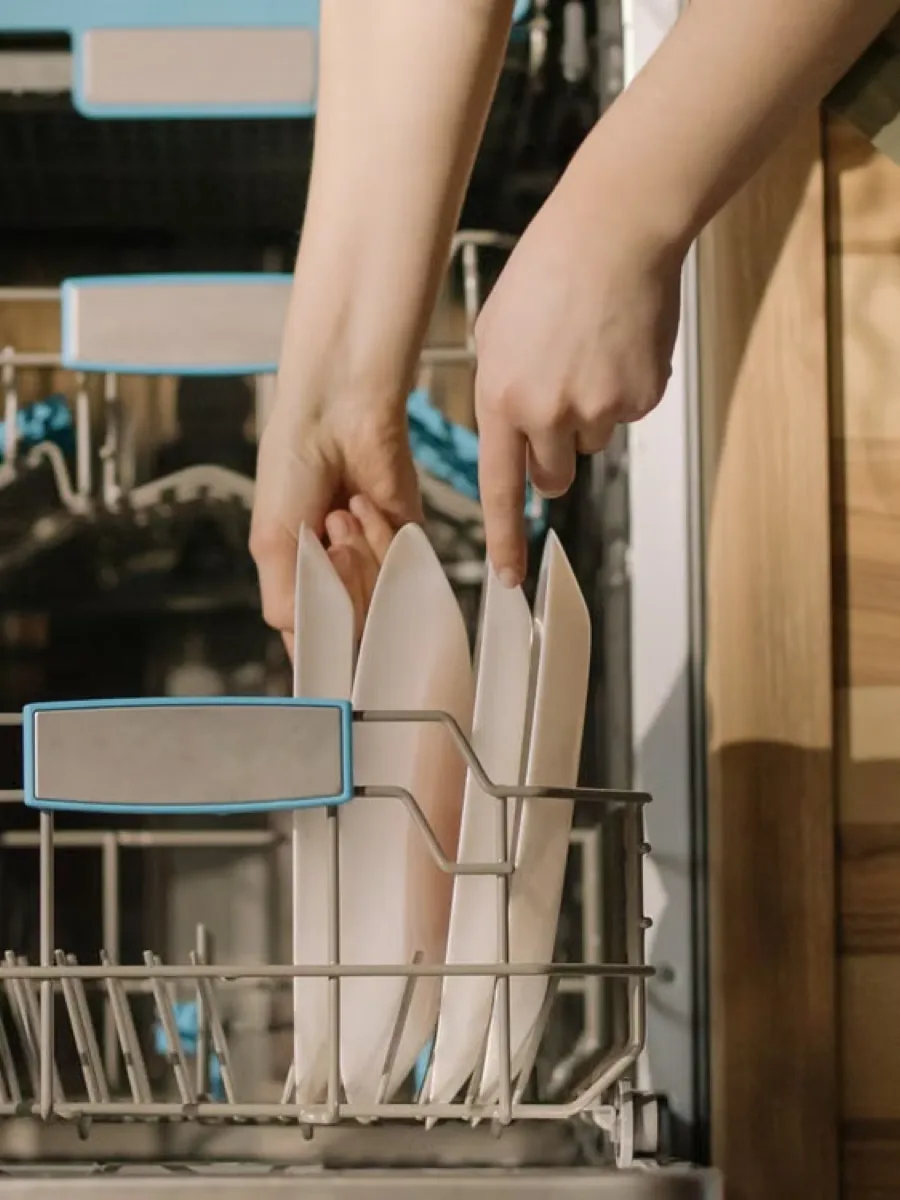
Pull out the bottom rack. Look at the floor of the dishwasher. That cylinder? That’s the filter. Most twist anticlockwise and lift out. Check your manual if it resists.
What you’ll find inside: old food, grease film, sometimes black mould. Rinse it under hot water. Then fill a bowl with hot water and a squirt of dish soap. Soak it for five minutes. Scrub the mesh parts with an old toothbrush. Rinse again. Set it somewhere to dry.
Step 2: Clear the Spray Arms
Those little holes in the spray arms collect gunk over time. Remove the arms—they usually click off or unscrew by hand. Hold each arm under the tap. Poke a toothpick through every blocked hole you see.
If the holes are crusted with white scale, soak the whole arm in white vinegar for 15 minutes first. Then poke, rinse, and click them back in.
Step 3: Wipe the Door Seal and Edges
Run your finger along that black rubber strip around the door. Feels gritty? That is moisture, old food, and sometimes mould hiding in the folds. Grab a damp microfibre cloth and wipe every inch of that seal. Got dark spots? Dip the cloth in undiluted white vinegar and scrub them out.
While you are at it, wipe the door edges and the control panel. Grease splatter lands there more often than you realise.
Step 4: Clean the Interior with Vinegar
Put the racks back in. Leave the dishwasher empty. Set a heatproof cup or bowl with 1–2 cups of white vinegar upright on the top rack. No detergent. Run the hottest cycle your machine has got.
Vinegar cuts grease and dissolves mineral buildup. But here is the catch. Only do this once a month. Vinegar wears down rubber seals over time. Need to freshen things up weekly? Buy a dishwasher cleaning tablet instead. Much gentler on the machine.
Step 5: Deodorise with Baking Soda
When the vinegar cycle finishes, skip the detergent. Sprinkle half a cup of bicarbonate of soda across the dishwasher floor. Run a short hot cycle. The bicarb kills any leftover smells and gives the inside a mild scrub.
One rule: never put vinegar and baking soda in the same cycle. They react and neutralise each other. Separate cycles only.
Step 6: Replace the Clean Filter
Once everything has air-dried for a few minutes, put the clean filter back in. Replace the bottom rack. Then leave the dishwasher door slightly open—just a crack. That last step stops mould from coming back.
Dishwasher Cleaning Schedule
| Task | Frequency |
|---|---|
| Inspect and rinse filter | Weekly |
| Full filter clean (soak and scrub) | Monthly |
| Vinegar wash cycle | Monthly |
| Bicarb deodorising cycle | Monthly |
| Wipe door seal and edges | Monthly |
| Check and clear spray arms | Every 3 months |
| Full exterior wipe-down | As needed |
Common Signs Your Dishwasher Needs Cleaning (Or a Repair)
Regular cleaning stops most problems before they start. But if you notice any of the following, your dishwasher needs attention now.
- Cloudy, greasy, or still-dirty dishes. That usually means a blocked filter or spray arm.
- A bad smell coming from inside. Food trapped in the filter. Or mould hiding in the door seal.
- Visible mould around the seal or inside the drum.
- White film or mineral deposits on the walls. That’s hard water scale—common in Adelaide, Melbourne, and Perth.
- Water pooling at the bottom after a cycle finishes. Could be a drain issue. Could be a blocked filter.
If cleaning doesn’t fix dirty dishes, standing water, or strange noises during a cycle, you’re probably looking at a mechanical fault. In that case, you’ll need to have it looked at professionally.
Tips to Keep Your Dishwasher Cleaner for Longer
- Scrape (but don’t necessarily rinse) dishes before loading — food particles are the primary source of filter blockages and bad smells
- Use the correct type and amount of dishwasher detergent for your water hardness — excess detergent leaves residue
- Run the dishwasher on hot cycles regularly, especially if you normally use an eco or low-temperature setting
- If you have hard water, use dishwasher salt (if your model has a salt reservoir) to prevent mineral scale build-up — this is particularly relevant in cities like Adelaide, which has notoriously hard water
- Leave the door ajar between uses where practical; this prevents moisture from sitting stagnant inside
FAQ
Why does my dishwasher smell even though I use it every day?
Using it every day actually makes the smell worse if you never clean the filter. Think about it. Every cycle dumps more food residue into that filter. That residue rots. Bacteria love it. Pull the filter out. It will probably look disgusting. Clean it. Then run a vinegar cycle. Smell will be gone.
Can I use bleach to clean my dishwasher?
Please don’t. Bleach is terrible for stainless steel—it corrodes the metal over time. It also chews up rubber seals. You want a leaking dishwasher? Because that’s how you get one. Stick with vinegar and baking soda. They are safer and they actually work.
How do I deal with hard water stains inside my dishwasher?
White vinegar does the job on light scale. Pour it in a cup, run a hot cycle. But if your dishwasher looks like a limestone cave, vinegar alone won’t cut it. Get a commercial descaler. Use it every three to six months. And for the love of clean dishes, use dishwasher salt regularly. That stops new scale from forming.
Is it worth cleaning a dishwasher that’s already several years old?
Absolutely. A clean old dishwasher runs better than a dirty new one. The seals last longer. The pump lasts longer. The spray arms actually spin instead of just dribbling water. Cleaning costs you maybe ten minutes. Replacing a pump costs you a few hundred dollars.
My dishwasher isn’t draining after I cleaned the filter. What’s wrong?
Stop cleaning. You have done what you can. If the filter is spotless and water is still sitting at the bottom, the problem is somewhere else. Could be a blockage in the drain hose. Could be the drain pump died. Either way, you cannot fix it with a toothbrush or a bottle of vinegar. Call someone who does this for a living.
Conclusion
The secret to a well-performing dishwasher is literally just spending 30 minutes cleaning it every month. Do the steps above consistently, and you’ll be able to catch most issues before they even start.
If your machine has developed a fault that cleaning hasn’t resolved — dishes coming out dirty, water not draining, or error codes appearing — National Appliance Repairs is ready to help. Our qualified technicians service all major brands across Australia. Call 1300 434 380 for a free phone consultation.