Ever cracked open commercial oven cleaner and gotten driven out of your kitchen by fumes? You're not alone. Most conventional cleaners pack sodium hydroxide (caustic soda) and other strong alkaline compounds -- brilliant at dissolving baked-on grease, terrible for your lungs and skin. They need serious ventilation.
You don't actually need them. Bicarbonate of soda and white vinegar work. Surprisingly well. Two kitchen staples that tackle oven grime effectively, even the stubborn baked-on grease from a roast that bubbled over months ago. It takes patience (mostly overnight waiting) but minimal active effort.
National Appliance Repairs' technicians notice a pattern: neglected ovens lose efficiency. Element failures spike. Heating becomes uneven. Cleaning matters -- not just for hygiene but for the machine itself. If your oven has a real problem beyond dirty glass or greasy walls, our oven repair service covers all major brands across Australia.
Why Avoid Harsh Oven Cleaners?
Conventional oven cleaners are effective, but they come with trade-offs:
Strong fumes -- sodium hydroxide-based sprays release fumes that irritate the eyes, nose, throat, and lungs.Safe Work Australia classifies many commercial cleaning chemicals as hazardous, particularly when used in poorly ventilated spaces.
Skin and eye hazard -- direct contact can cause chemical burns
Risk of cross-contamination -- residue left inside the oven can transfer to food during subsequent use if not completely rinsed away
Damage to certain surfaces -- commercial cleaners can discolour aluminium, damage self-cleaning oven liners, and degrade door seals over time
Bicarb and vinegar avoid all of these issues. They're food-safe, non-toxic, inexpensive, and widely available at any Australian supermarket.
What You'll Need
Bicarbonate of soda (about half a cup)
White vinegar (in a spray bottle)
Water
Rubber gloves
A damp microfibre cloth or sponge
An old toothbrush
A plastic scraper or old credit card (for heavily baked-on spots)
A small bowl for mixing paste
The Overnight Method (Heavy Grime)
Best for ovens that haven't been cleaned in ages.
Step 1: Remove everything
Take out the racks. Take out the trays. Remove any removable accessories. Set them aside -- you'll clean them separately.
Step 2: Make the paste
In a small bowl, combine half a cup of bicarbonate of soda with two to three tablespoons of water. Mix until spreadable. It should feel like thick yoghurt. You can adjust the water depending on oven size.
Step 3: Spread it everywhere
Gloves on. Spread paste across all interior surfaces -- walls, floor, ceiling, door interior. Leave the heating elements alone (top and bottom). Pay extra attention to heavily greased spots and baked-on areas. The paste will turn brownish-grey when it contacts grease. That's normal. If you have a glass door, paste it there too. Just avoid the rubber seals.
Step 4: Leave it
Close the door. Wait at least 12 hours. Overnight is ideal. During this time, bicarb breaks down the bonds between grease and oven surfaces. Everything becomes easier to wipe away.
Step 5: Wipe it clean
Next morning: damp microfibre cloth or sponge. Wipe away the paste and grime. Stubborn spots need a plastic scraper first. Loosen before wiping. Rinse your cloth constantly. Use an old toothbrush dipped in warm water for corners and door seals.
Step 6: Vinegar spray
Fill a spray bottle with white vinegar. Spray the interior surfaces. You'll see fizzing where vinegar reacts with remaining bicarb -- this lifts the last residue. Wipe down with a clean damp cloth.
Step 7: Final rinse
Warm water, plain. Wipe the interior once more. Remove all vinegar residue. Open the door. Let it air for 30 minutes.
Cleaning the Oven Racks
While the bicarb paste does its thing overnight, don't forget the racks.
Fill your bathtub or large sink with hot water. Make sure the racks are fully submerged. Add half a cup of bicarb soda and a few drops of dishwashing liquid to the water. Let them soak -- four hours minimum, but overnight is better. Let them soak alongside the oven while you sleep.
Next morning, grab a stiff brush or the non-scratch side of a sponge and scrub. The baked-on grease comes off easily. Rinse thoroughly. Dry them completely. Pop the racks back in the oven.
The Quick Method (For Regular Maintenance)
If you clean your oven regularly and are just dealing with light grease and fresh spills, the overnight soak isn't necessary.
While the oven is slightly warm (not hot), mix a small amount of bicarb paste and apply it directly to any soiled areas.
Wait 20--30 minutes.
Spray with white vinegar, let it fizz, then wipe away with a damp cloth.
Finish with a plain water wipe-down.
CHOICE Australia recommends a quick wipe-down after each use, while the oven is still warm, to stop grease from baking on in the first place -- which significantly reduces the effort required at deep-clean time.
Oven Cleaning Methods Compared
Method
Effort Required
Drying/Wait Time
Chemical Exposure
Best For
Bicarb paste + vinegar
Low--Medium
Overnight
None
Heavy build-up
Quick bicarb scrub
Low
20--30 minutes
None
Light soiling
Commercial oven cleaner
Low
30 minutes
High (fumes)
Heavy build-up
Self-clean cycle
Very low
2--4 hours
Smoke/fumes
Moderate build-up
Steam cleaning (built-in)
Very low
30 minutes
None
Light soiling
What Not to Do
Don't use bicarb soda on the oven's glass door if it has a special coating -- on some models it can be mildly abrasive and cause fine scratches. Vinegar spray and a damp cloth is safer for the glass.
Don't spray vinegar on a still-hot oven -- the rapid temperature change could crack the glass.
Don't ignore the door seal -- the rubber gasket around the oven door needs to stay flexible and clean. Wipe it gently with a damp cloth rather than scrubbing hard.
Don't use metal scrapers -- these will scratch the oven's enamel lining.
When Should You Use the Self-Clean Function?
Many modern Australian ovens include a pyrolytic self-cleaning function that heats the oven to around 450--500°C to incinerate food residue. It's convenient, but it produces smoke and fumes during the cycle (from burning food particles), requires good kitchen ventilation, and puts considerable stress on oven components. Used occasionally, it's fine -- but it's not a substitute for regular physical cleaning, and the heat cycle can accelerate wear on door seals and hinges over time.
If your oven's self-clean cycle isn't working correctly, or the oven is heating unevenly, it may need a professional inspection.
FAQ
Does bicarb soda and vinegar actually work on baked-on oven grease?
Yes for most ovens cleaned annually. The overnight bicarb method works well. For neglected ovens with heavy carbonised build-up? Commercial product or professional clean required.
Is it safe to cook in the oven right after cleaning with bicarb and vinegar?
Yes. Final water wipe, air-dry briefly. Both bicarb and vinegar are food-safe. Run an empty 180°C for five minutes to evaporate residue and odour if needed.
How often should I deep-clean my oven?
Aim for every three to four months if you use it regularly. But if you're constantly roasting or dealing with major spills, clean more frequently -- letting grease bake on repeatedly makes the next job significantly harder.
Can I use this method on a gas oven?
Yes, but be careful: avoid getting any liquid near the gas burner ports. Wipe around them gently with a barely damp cloth rather than applying paste directly.
My oven door glass is cloudy on the inside -- will bicarb clean it?
White vinegar sprayed directly onto inner glass and wiped with a microfibre cloth usually works. If the cloudiness is between the two glass panels inside the door, though, that requires partial door disassembly -- best left to a qualified technician.
Conclusion
You can clean your oven without harsh chemicals using what's already in your pantry. The overnight bicarb paste method handles heavy grease build-up. Between deep cleans, quick wipe-downs after cooking keep things manageable.
Now, if your oven isn't heating evenly, has a faulty element, or won't reach temperature no matter how clean it gets -- that's not a cleaning problem. That's a repair problem. National Appliance Repairs services all major oven brands across Australia. Call 1300 434 380, book online, or request same-day service in selected metro areas.
You set the temperature, wait, and the oven stays cold. Or it warms up a little but never gets where it needs to be -- the preheat light eventually goes out but the cavity isn't anywhere near hot. Fisher & Paykel ovens are generally solid, but when heating fails, it almost always comes down to one of a small number of components.
This guide works through each one in plain terms. For authorised repairs across Sydney, Melbourne, Brisbane, Perth, and Adelaide, National Appliance Repairs carries Fisher & Paykel parts and offers same-day availability.
Check These Before Anything Else
A handful of things can look like a heating fault but aren't. Worth spending 60 seconds ruling them out.
Is the clock set? Many Fisher & Paykel models won't operate in cook mode until the clock has been set after a power interruption. If there's been a recent outage, set the clock first and try again.
Has the auto-timer been activated? The auto-timer function, if accidentally switched on, makes the oven appear completely unresponsive. Check the display for a timer or clock symbol indicating the oven is waiting for a scheduled start time.
Has a circuit breaker tripped? Oven elements draw significant current. A tripped breaker at the switchboard cuts power entirely. Check the board before assuming the oven is faulty.
If all three are fine, the fault is inside the oven.
Bake Element
The bake element is the most common single failure point in Fisher & Paykel electric ovens. It's the horizontal element at the base of the cavity on conventional models, or the circular rear element on fan-forced models. When it burns out, the oven either produces no heat at all, or only partial heat from whichever elements are still functional.
Signs it's the element:
The display and controls work normally, but there's no heat
One function works (grill, for example) while another doesn't
You can see a visible break, blister, or dark burn mark on the element
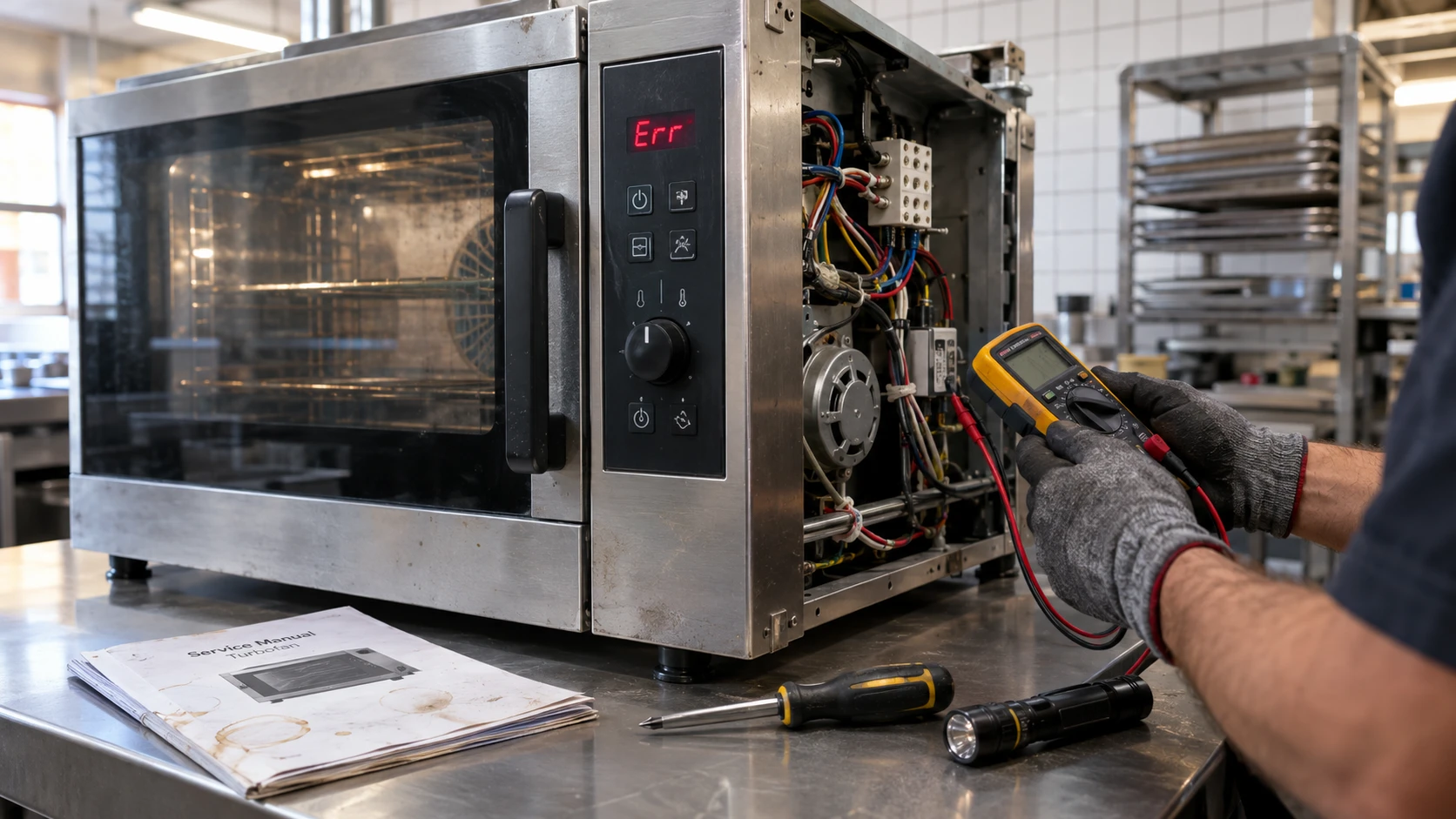
Disconnect power at the wall and at the switchboard before getting close to it. On most Fisher & Paykel models, the bake element is accessed by removing the back internal panel of the oven cavity -- usually three or four screws. The element connects at two terminals at the rear wall. A multimeter test for continuity gives a definitive answer. No continuity means it needs replacing.
Heating element replacement typically runs $200--$400 in parts and labour. For an oven under ten years old, it's almost always worth fixing.
Thermostat
The thermostat monitors internal temperature and controls when the elements activate to maintain the set level. When it fails, you lose temperature control. The oven might:
Run continuously at maximum heat without cycling down
Fail to heat at all because the thermostat circuit is permanently open
Cut out too early, leaving the oven well below the target temperature
The call-for-heat indicator light on most Fisher & Paykel models cycles on and off during normal operation as the thermostat requests and releases heat. If that light stays permanently on or permanently off when it shouldn't, the thermostat is a strong suspect.
Accessing the thermostat requires removing the oven and reaching the rear -- behind the control panel fascia on most models. The BI602 is a well-documented example where the thermostat commonly fails; technicians familiar with Fisher & Paykel models treat it as a routine repair.
Temperature Sensor (Probe)
On many modern Fisher & Paykel ovens, a separate temperature probe feeds real-time cavity temperature data to the control board. If the probe gives a false or out-of-range reading, the board may restrict power to the elements based on incorrect information.
This tends to cause gradual rather than sudden symptoms:
The oven reaches temperature eventually, but preheating takes far longer than it used to
Temperatures are inconsistent across the cavity
Some digital display models show an error code
A multimeter can measure the sensor's resistance at room temperature. Fisher & Paykel sensors have a specified resistance value -- a reading significantly outside that range points to a faulty probe.
Grill Element
If everything works except the grill function, the grill element has failed independently. It's a separate component and can fail on its own without affecting the bake function at all. A visible break or burn mark is usually apparent; a continuity test confirms it.
Thermal Fuse
Fisher & Paykel ovens -- particularly models with a self-clean function -- have a thermal fuse or high-limit thermostat at the rear of the cavity. It's a one-time safety device that cuts power permanently if the cavity reaches a dangerous temperature. Once tripped, it doesn't reset.
If the oven stopped working after or during a self-clean cycle, a tripped thermal fuse is a strong candidate. It sits near the back of the cavity and a continuity test confirms whether it's blown. Replacing it is straightforward, but it's worth also checking the cooling fan -- a failed cooling fan is usually what causes the overheating that blows the fuse in the first place.
Control Board
The control board manages everything: heating, timing, display, safety. Board faults can produce symptoms ranging from a single function not working to the oven being completely dead. Power surges are the most common cause of board damage in Australian homes.
Try disconnecting the oven for five minutes before assuming the board has failed -- a cold reset occasionally clears electronic faults. If specific components (element, thermostat, sensor) all test fine and the oven still won't heat, the board is the next step.
Control board replacement is expensive. It's the last thing to confirm, not the first thing to replace.
Fault Guide
What You're Seeing
Most Likely Cause
Oven completely dead, display also off
Power supply -- check breaker and clock setting
Display and fan work, no heat
Bake element failed
Heats in grill mode but not bake
Bake element failed; grill element intact
Won't hold temperature, cycles irregularly
Thermostat or temperature sensor fault
Stopped after self-clean cycle
Thermal fuse blown
Slow to preheat, inconsistent temperatures
Temperature sensor (probe) fault
Runs at full heat with no regulation
Thermostat fault
FAQ
Why did my Fisher & Paykel oven stop working after a self-clean cycle?
The self-clean cycle runs at very high temperatures. If the cooling fan wasn't working properly, the thermal fuse may have tripped. Have the fuse tested and replaced, and get the cooling fan inspected at the same time.
My oven heats but takes much longer than it used to -- what's going on?
A temperature sensor giving a slightly inaccurate reading causes the control board to underpower the elements. It tends to degrade gradually, so you notice it over weeks rather than suddenly.
Can I replace a heating element myself?
With power fully isolated at the switchboard, the element itself is accessible and can be replaced by a careful DIY repair. Anything involving the thermostat connections, wiring harness, or control board should be done by a licensed technician to comply with Australian electrical standards.
Is it worth repairing rather than replacing?
For ovens under ten years old, almost always yes. A heating element repair at $200--$400 compares very favourably against the $1,500--$4,000 cost of a comparable new oven.
Does Australian consumer law apply to oven repairs?
Under the Australian Consumer Law, appliances must be of acceptable quality and last a reasonable time. If a heating element or thermostat fails unusually early, the manufacturer may be obligated to repair or replace it regardless of when the warranty period ended.
Conclusion
Fisher & Paykel oven heating failures nearly always trace back to the bake element, the thermostat, or the temperature sensor. Start by checking power is reaching the oven and the clock is set. After that, a technician can test the components and usually complete the repair on the same visit. National Appliance Repairs services Fisher & Paykel ovens across Australia with authorised technicians, same-day availability, and a 12-month warranty on all replacement parts. Call 1300 434 380 to book.
You need a new oven and you're deciding between gas and electric.
Which one breaks less? The answer isn't straightforward. They fail differently. They fail at different rates. And what breaks first tells you a lot about which might be worth the investment for Brisbane.
National Appliance Repairs has serviced plenty of both types, and the patterns are pretty clear.
Gas Ovens: What Breaks
Igniters Fail Early (3-5 Years)
Gas igniters weaken or fail between year 3 and year 5. Not occasionally. Predictably.
An igniter works by creating a spark that lights the gas. Every time you use your oven, the igniter is stressed. Heat, cooling cycles, vibration -- all wear it out.
In Brisbane, where you're using your oven frequently year-round, igniters wear out faster. We see igniter failures regularly on ovens that are 4-5 years old.
When an igniter fails, your oven won't light. You get a click but no flame. Or it takes multiple attempts. The oven itself still has years of life left. The igniter is just done.
Replacement runs $150-300 including labour. Not expensive. But it's a predictable cost around year 4-5.
Burner Assemblies Get Clogged
Gas burners have ports where gas flows. In Brisbane's dust-heavy environment, these get clogged. Dust blocks gas flow. Flames become uneven. Heating becomes inconsistent.
A clogged burner isn't a true failure. It's maintenance. But it requires professional disassembly and cleaning.
Gas Valves and Lines
Valve failures are uncommon. Gas leaks are serious when they happen. If you smell gas persistently from your oven, don't ignore it. Call someone immediately.
Electric Ovens: What Breaks
Heating Elements Fail Later (7-10 Years)
Electric heating elements typically last 7-10 years before degradation becomes obvious.
Elements don't suddenly stop. They degrade. A bake element that's failing produces uneven heat. One part of your oven is hot. Another part is cooler. Your baking suffers before the element completely dies.
Replacement costs $150-250 for the element plus labour. Total around $250-400.
Control Boards and Thermostats
Electric ovens have electronic components managing temperature. In Brisbane's heat and humidity, these fail more often than in cooler climates.
A faulty thermostat means your oven can't regulate temperature. A broken control board means the oven won't turn on or cycle properly.
These repairs run $300-600+ depending on the board and brand.
Glass Doors Crack
Smooth-top electric ovens have glass doors. Toughened glass can crack from impacts or rapid temperature changes. Replacement glass runs $200-400.
Older gas ovens with traditional doors don't have this problem.
The Comparison
Component
Gas
Electric
Brisbane Reality
Igniter/Element
Fails 3-5 years
Fails 7-10 years
Igniter fails earlier but costs less to replace
Thermostat
Mechanical, durable
Electronic, more prone to failure
Both fail, but electric failures are pricier
Door Seal
Moderate degradation
Both degrade at similar rates
Control Systems
Minimal
Primary failure point
Electric has more components that can break
Overall Lifespan
13-20 years
10-18 years
Brisbane shortens both to around 10-15 years
Brisbane-Specific Factors
Gas ovens: the igniter works in a hot kitchen. Summer cooking heats your kitchen further. The igniter is already stressed at year 3-4. Brisbane heat brings forward the failure point.
Electric ovens: control boards are working in humid conditions. Dust settles on components. Electronic failures are slightly more common in Brisbane than in drier states.
Both types: door seals degrade faster in Brisbane's humidity. Expect 8-10 years instead of 10-12.
FAQ
Can I repair a 12-year-old oven if the igniter or element fails?
Usually, yes. If it's the only problem, repair makes sense. But at 12 years, you're approaching end-of-life. Get a diagnosis first. If other components show wear, factor that into the decision.
Is it cheaper to replace a broken element or buy a new electric oven?
Element replacement costs $250-400. A new electric oven costs $800-2,500+. If your oven is under 10 years old and the element is the only problem, repair it.
Do gas ovens really last longer than electric?
Gas can have a slight edge -- 13-20 years vs 10-18 years for electric. But Brisbane's heat affects both. Maintenance matters more than fuel type.
My gas oven clicks but won't ignite. Is it the igniter?
Usually, yes. But sometimes it's a gas supply issue or valve problem. Get a professional diagnosis before assuming igniter replacement.
Is a control board failure the end for an electric oven?
Not necessarily. If the board is replaceable and your oven is 8-10 years old or younger, replacement might make sense. At 12+ years, replacement is probably the call regardless.
Bottom Line for Brisbane
Gas fails earlier on the igniter but it's cheap to fix. Electric lasts longer on the heating element but control board failures hurt more when they happen.
In Brisbane's heat, both face challenges. Both fail predictably. Both need maintenance.
Need a diagnosis on your current oven? National Appliance Repairs services both gas and electric across Brisbane.