Ask any Adelaide plumber or appliance technician what their most reliable repeat business is, and dishwasher descaling and hard water damage will come up fast. Adelaide's water has a reputation, and while the city has improved its treatment significantly over the decades, the mineral content remains higher than most other Australian capitals -- and dishwashers take the brunt of it.
Water hardness is a measure of dissolved calcium and magnesium content, expressed in milligrams per litre (mg/L) of calcium carbonate equivalent. Sydney draws from soft, granite-filtered catchments with hardness typically below 50 mg/L. Melbourne sits similarly low. Adelaide is a different story.
AtNational Appliance Repairs, our Adelaide technicians servicedishwashers across the metro area every week. Hard water damage is visible in a predictable pattern -- it's entirely manageable once you understand what's happening and why.
Adelaide's Water Hardness: The Numbers
According to WaterScore, Adelaide has the hardest metropolitan water of any major capital in Australia. Depending on where you live, hardness can run anywhere from 87 to 136 mg/L. Some of the northern and western suburbs--Salisbury, Port Adelaide, West Lakes--regularly see levels above 110 to 120 mg/L. Eastern suburbs like Burnside, Norwood, and Unley are generally lower, but they are still well above what Sydney or Melbourne deal with.
Now, SA Water has its own definitions. They class water above 200 mg/L as "hard" and anything between 60 and 200 mg/L as "good quality." That sounds reassuring, until you look at what dishwasher manufacturers actually recommend. Bosch, Miele, most of the major brands say that once water hardness goes above 70 mg/L, you should be using dishwasher salt to soften it inside the machine.
At Adelaide's typical levels? Most of the metropolitan area is above that threshold, and not by a little.
What Hard Water Does to a Dishwasher
When hard water heats up inside a dishwasher -- and the wash cycle typically reaches 55-75°C -- the dissolved calcium and magnesium precipitate out of solution and deposit as limescale on every surface the water touches. This includes:
Spray arms: The small holes in the spray arms are the first casualty. Limescale accumulates inside the holes and on the outer rim, reducing water flow and altering the spray pattern. The dishes in certain rack positions stop getting properly cleaned -- usually the far corners that depend on a specific spray arm hole being unblocked.
Heating element: The element at the base of the dishwasher reaches the highest temperature in the machine. Scale builds fastest here, forming an insulating layer that forces the element to work harder to heat the water to the target temperature. Over time, this shortens element life and increases energy consumption. Heavy scale on a heating element is one of the most common causes of dishwasher faults in Adelaide homes.
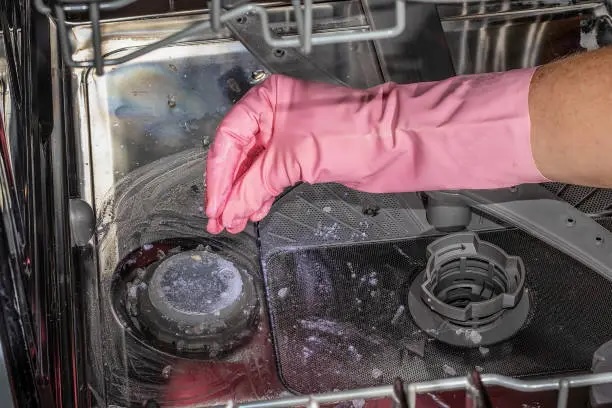
Interior walls and door: White or grey streaking on the stainless steel interior is mineral scale. It doesn't affect function directly, but it's a useful indicator of how aggressively the water is depositing minerals throughout the machine.
Glassware and dishes: The cloudiness that develops on glasses after repeated dishwasher cycles in Adelaide is mineral film -- calcium and magnesium deposits left behind when water evaporates from the glass surface. It's cosmetically unpleasant and resists normal detergent washing once it builds up.
Water inlet valve and internal pipes: Scale accumulation in narrow passages restricts water flow over time, contributing to pressure issues, fill problems, and eventually complete blockages in older machines.
The Dishwasher Salt Question
Most European dishwashers -- and the majority of mid-to-high-end dishwashers sold in Australia are European-designed -- have a built-in water softener in the base of the machine. It works by passing the incoming water through an ion exchange resin that swaps calcium and magnesium ions for sodium ions, producing softer water for the wash cycle.
The resin is regenerated automatically using dishwasher salt (specifically formulated coarse salt, not table salt). When the salt reservoir is empty, the softener stops working and hard water flows through the machine unchecked.
In Adelaide, keeping the salt reservoir filled is not optional maintenance -- it's the primary defence against scale damage. How often you refill it depends on your water hardness level and how frequently you run the machine, but in most metro Adelaide households using the dishwasher daily, checking and refilling monthly is a reasonable habit.
Set the water hardness level correctly Most dishwashers with a built-in softener have a hardness setting that determines how aggressively the softener operates. It is usually set using a dial or through the machine's digital menu. Check your manual and set it to match your local water hardness -- for most Adelaide metro addresses, a setting equivalent to around 100 mg/L (or the equivalent in your machine's units) is appropriate. An incorrectly low setting means the softener undershoots and scale still forms. An unnecessarily high setting wastes salt.
Rinse Aid: The Second Line of Defence
Rinse aid reduces the surface tension of water, causing it to sheet off dishes and glassware rather than forming droplets that dry into mineral spots. In hard water conditions, rinse aid is particularly effective at reducing the cloudiness and spotting that Adelaide water leaves on glasses.
Make sure the rinse aid reservoir is regularly topped up, and check that the dosing setting is appropriate for your water hardness -- most dispensers have an adjustable dial from 1 to 6. For Adelaide water, a mid-to-high setting typically gives the best result.
Descaling: When to Do It and How
Even with salt and rinse aid in use, scale builds up over time, particularly on the heating element and spray arms. Descaling the machine every three to six months is advisable in Adelaide.
How to descale:
Run an empty hot cycle with a commercial dishwasher descaling tablet or with 250ml of white vinegar placed in a dishwasher-safe cup on the top rack (do not mix the two -- run one or the other)
Remove and soak the spray arms in white vinegar for 20 minutes, then clear any blocked holes with a toothpick, before the descaling cycle if possible
After descaling, run one plain rinse cycle before using the machine for dishes
If the machine has been running without salt for an extended period, a single descaling cycle may not be enough to remove heavy built-up scale. Successive cycles over a few weeks will progressively break it down.
Suburb-by-Suburb: Adelaide's Hardness Variation
Area
Typical Hardness Range
Relative Risk
Salisbury, Port Adelaide, West Lakes
Often 120+ mg/L
High
Adelaide CBD, North Adelaide
~100-115 mg/L
Moderate-High
Norwood, Burnside, Kensington
~90-100 mg/L
Moderate
Eastern Suburbs generally
~85-100 mg/L
Moderate
Hills (Stirling, Crafers)
Variable, sometimes softer
Lower-Moderate
Note: These ranges are indicative based on SA Water data. Local hardness can vary with seasonal changes to the water source. SA Water publishes annual water quality reports that include hardness data by zone.
FAQ
Do I need dishwasher salt if I use all-in-one dishwasher tablets?
All-in-one tablets include a small amount of salt and rinse aid components, but not in quantities sufficient for Adelaide's water hardness levels in machines with a dedicated softener. If your machine has a salt reservoir, fill it with dishwasher salt regardless of which tablets you use -- the integrated softener needs it to function properly.
My dishwasher is producing cloudy glasses even with rinse aid -- is this the water or the machine?
Cloudiness from mineral deposits is Adelaide's most common dishwasher complaint. Check whether salt is present and the hardness setting is correctly configured. Run a descaling cycle. If cloudiness persists after these steps, the spray arm holes may be partially blocked, reducing rinsing effectiveness -- clean them with a toothpick and a vinegar soak.
How long does a dishwasher last in Adelaide vs. soft water cities?
If you skip the salt and descaling, your dishwasher will likely die early as heating elements go and spray arms becoming clogged in just 6 to 8 years – perhaps even sooner. With good maintenance, a dishwasher can typically hit 10 to 15 years.
Can a whole-house water softener help?
Yes, especially if it’s installed by a professional plumber. A water softener can strip out minerals from the water before it hits the dishwasher.
My old dishwasher is not doing well, should I repair or replace it in Adelaide?
Before you replace it, get a tech to clean the spray arms, descale it, and check the heating element. A lot of "dying" dishwashers in Adelaide are just neglected and not broken.
Conclusion
Adelaide's water is not going to get dramatically softer. Dishwashers in this city will always be working harder than they would in Melbourne or Sydney. The response is straightforward maintenance. Keep the salt reservoir filled. Set the hardness level correctly. Use rinse aid. Descale every few months. Those four habits make a significant difference to how long a dishwasher lasts and how well it performs.
When a fault goes beyond maintenance -- a heating element that has failed, a control board issue, a spray arm that is cracked rather than just blocked -- we at National Appliance Repairs service dishwashers across Adelaide. Call 1300 434 380 for a fast diagnosis and honest repair assessment.
It's one of those settings most people set once and never revisit. The dial gets turned to the middle, the fridge gets cold enough that the milk stays fresh, and that's considered job done. But if you've ever had food go off faster than it should, or noticed ice forming on your salad at the back of the shelf, the fridge temperature is usually the first thing worth checking.
The right fridge temperature isn't just about keeping food cold. It's about keeping food safe, reducing waste, and running the appliance efficiently. AtNational Appliance Repairs, our technicians see the effects of incorrect fridge temperatures regularly -- both in food safety complaints and in faults that develop when a compressor is pushed harder than necessary. Here's what you actually need to know.
The Recommended Temperature Range
For a domestic fridge in Australia, the correct temperature range for the fresh food compartment is 0°C to 4°C. The ideal target is 3°C. That is what the Australian Standard recommends.
CHOICE Australia agrees. They say 3°C is the practical target to aim for. It is cold enough to sit comfortably below the 4°C upper safe limit. But it also leaves enough buffer so that normal fluctuations--opening the door, adding warm food--do not push the fridge into freezing territory.
Now, Food Standards Australia New Zealand sets 5°C as the maximum safe temperature for perishable food. At or below 5°C, bacterial growth slows down to a rate that keeps food safe for its expected shelf life. Above 5°C, bacteria multiply quickly. That raises the risk of food-borne illness.
The 3°C target straddles the line between food safety and freezing point, with headroom on both ends -- making it the most practical temperature to set your fridge to.
The Temperature Danger Zone
In Australia, the temperature danger zone for food safety is 5°C to 60°C. Bacteria like Salmonella, Listeria, and E. coli thrive in that range. Some of them can double in number every 20 minutes under the right conditions.
Now, the rule from FSANZ is simple.
Food that has been in the danger zone for more than four hours? Bin it.
Food that has been in there between two and four hours? Use it immediately. Do not put it back in the fridge.
Under two hours? You can refrigerate it or use it.
This is called the 2-hour/4-hour rule.
For your home fridge, the practical implication is clear. If your fridge is running above 5°C, every single item inside is at elevated risk. Every hour it sits there. So keeping that temperature right is not just about energy bills or appliance longevity. It is about not getting sick.
What About the Different Zones in Your Fridge?
Temperature is not uniform throughout a fridge. Most fridge interiors have warmer and colder zones, and understanding them helps you store food correctly.
Coldest areas:
The bottom shelf and the area directly in front of the back panel (where cold air enters)
The chiller drawer, if your fridge has one -- this sits close to 0°C and is designed for meat, fish, and poultry
Warmer areas:
The door shelves, which are exposed to room temperature every time the fridge opens
The top shelf, which tends to be warmer than lower shelves in most fridge designs
Storage guide based on zones:
Bottom shelf / chiller drawer: Raw meat, poultry, seafood (coldest zone; keeps these items safest and prevents drip contamination onto other foods)
Top shelf: Drinks, foods less sensitive to temperature variation
Crisper drawers: Fruit and vegetables (slightly higher humidity helps extend freshness)
Door shelves: Condiments, juices, butter -- items with longer shelf lives and lower food safety risk
How to Check Your Fridge Temperature
Your fridge dial actually controls cooling intensity, not temperature – so the number “1” or “2” doesn’t necessarily mean 1 or 2°C. A thermometer is the only tool that'll actually tell you what's inside.
Place one in a glass of water on the middle shelf and leave it overnight. The next day, check the reading. You're looking for 4°C or below.
Higher than that? Your fridge needs to run colder. Too cold? You'll spot ice crystals on foods that should stay unfrozen.
The reason this matters: fridges run warmer than most people realize. A NSW Food Authority study found that nearly one in four Australian home fridges averaged above 5°C -- which is a food safety issue.
Fridge Temperature Quick Reference
Zone
Target Temperature
What to Store
Fresh food compartment
0°C to 4°C (target 3°C)
General refrigerated food
Chiller drawer
Close to 0°C
Raw meat, poultry, seafood, fish
Door shelves
5--8°C (warmest zone)
Condiments, juice, butter
Crisper drawers
0--4°C with higher humidity
Fruit and vegetables
Common Reasons a Fridge Isn't Reaching the Right Temperature
If your fridge is consistently running warmer than it should, a few common causes are worth checking before calling a technician:
The thermostat dial is set too warm. Check the setting and adjust as described above.
The door seal is damaged or not sealing properly. A faulty seal allows warm room air to enter continuously. Close a piece of paper in the door -- if it slides out with no resistance, the seal needs replacing.
The fridge is overpacked. Cold air needs to circulate to maintain an even temperature. A fridge so full that air can't move will have warm spots.
The fridge is placed in a hot environment. A fridge in a hot garage or in direct sun works harder to maintain temperature and may struggle in Australian summer conditions.
The condenser coils are dirty. Dusty coils at the back or base of the fridge can't dissipate heat effectively, causing the compressor to overwork and the interior to run warm.
The fridge is too empty. A nearly empty fridge loses temperature quickly when the door opens and takes longer to recover. Keeping a few containers of water in the fridge adds thermal mass.
If the fridge is still running warm after checking these, the problem may be a failing thermostat, a compressor issue, or low refrigerant -- all of which need a qualified technician.
Does Fridge Temperature Change by Season?
It can. Especially in Australia. Think about summer. Your fridge is in a hot kitchen or a hot garage. The ambient temperature around it rises. The compressor has to work harder just to keep up. And the internal temperature can drift upward without you even noticing.
So try this simple habit: At the start of every summer, check your fridge temperature with a thermometer. Adjust the thermostat if you need to. That one habit reduces food spoilage and saves energy.
FAQ
What is the maximum safe fridge temperature in Australia?
Why is my fridge set to 3 but still not cold enough?
It's likely because the number on the dial doesn't mean Celsius. A 3 on one fridge is not the same as a 3 on another. In this case, you'll want to trust a refrigerator thermometer, instead to check the actual temperature. We do not recommend you trust the dial.
Is it bad to keep the fridge too cold?
Yes. Below 0°C and you freeze things that should not freeze like veggies, dairy, and anything liquid. It'll also cause ice build-up that blocks airflow. Stick to 0–4°C.
Where should eggs go? Door or shelf?
Middle shelf while it's still in the carton. The door is the warmest part and fluctuates most. Carton on a shelf keeps eggs stable and stops them absorbing other food smells.
Dial goes 1 to 7. What setting do I use?
Higher number = colder usually. But the only real answer is to measure it. Start at the midpoint. Check the actual temperature after 8 hours and adjust from there. Aim for 3°C.
Conclusion
The right fridge temperature -- 0°C to 4°C, with 3°C as the practical target -- is not set-and-forget. It's worth checking with an appliance thermometer at least once a year, and again after any major environmental change (a move, a hot summer, a fridge in a new location). Most of the food safety and spoilage problems that seem like a fridge fault are actually a temperature calibration issue.
If your fridge is struggling to reach or maintain safe temperatures despite correct settings and a good door seal, there may be a mechanical fault involved. We atNational Appliance Repairs carry outfridge and freezer repairs across Australia -- call 1300 434 380 for a same-day assessment in most metro areas.
Perth is, by most measures, the most geographically isolated major city in the world. The nearest large city is Adelaide -- more than 2,100 kilometres away by road. Sydney is around 3,900 kilometres away by road. That's not a gap you bridge overnight, and for anything shipped along the ground, it means freight times that the rest of Australia simply doesn't experience.
For appliance parts, this has real consequences. When a washing machine control board or a dishwasher pump needs to come from an east coast distribution centre -- which is where most appliance parts warehouses in Australia are located -- Perth customers are at the end of a long logistics chain. Understanding why the wait happens, and what can be done to shorten it, is practical knowledge for anyone managing appliance repairs in Western Australia.
AtNational Appliance Repairs, we service appliances across Perth and manage parts sourcing for repairs every day. The geographic reality shapes how we operate, and we think it's worth being transparent about it.
The Geography Problem
Most major appliance brands -- Bosch, Fisher & Paykel, Electrolux, Samsung, LG, Miele -- run their Australian parts distribution out of warehouses in Sydney, Melbourne, or both. When a technician in Brisbane or Melbourne needs a spare part, it's often a same-day or next-day order. When the same order goes to Perth, air freight is the fast option; road freight is the default.
Road freight from Sydney or Melbourne to Perth typically takes four to seven business days for standard consignments. Add in any warehouse processing time, and a part that would arrive within 24 hours in Sydney can take a week or more to reach a Perth address.
Air freight is faster -- one to two business days in most cases -- but it's significantly more expensive and is generally reserved for urgent orders or high-priority commercial accounts. For standard residential repairs, parts typically travel by road.
The result is a repair timeline that looks quite different from what customers in other capital cities experience. A fault that could be resolved in one or two days on the east coast may require a week to ten days in Perth purely due to transit time -- even when the diagnosis is clear and the part is in stock.
When Parts Aren't Stocked Locally
The secondary issue is local inventory. Parts distributors balance the cost of holding stock against demand. For a high-volume part -- a common washing machine pump, a standard oven element -- local Perth distributors are likely to carry stock. For less common parts, or for newer model-specific components, the order goes east.
Older or discontinued appliance models can be particularly difficult. If a manufacturer's part is no longer actively distributed in Australia, it may need to come from an international warehouse or be sourced through a specialist. That adds further time.
Appliance brands with strong local distribution networks in Perth -- and Fisher & Paykel, which manufactures in New Zealand and has well-established Australian distribution, is a notable example -- generally have better parts availability in WA than brands that distribute entirely from east coast hubs.
What Affects the Wait (and What Doesn't)
Factor
Effect on Wait Time
Standard vs air freight
Air freight cuts transit from 5--7 days to 1--2 days
Part in Perth local stock
Near same-day turnaround
Part shipped from east coast
Add 4--7 days standard freight
Discontinued or rare parts
Can extend to weeks; international sourcing may apply
Parts ordered Friday afternoon
Warehouse processing often resumes Monday; add 2 days
Multiple parts needed
Wait is determined by the last part to arrive
The factors that genuinely shorten the wait are local stock and air freight. Everything else -- the fault type, the brand, the model age -- affects which category the part falls into.
How to Avoid the Longest Waits
Use a technician who carries common parts
The most effective way to avoid a wait is to work with a technician whose service van carries stock of the most commonly needed parts. For high-volume repairs -- pump replacements, door seal replacements, standard heating elements -- a well-stocked technician can complete the repair on the first visit. Ask when booking whether common parts for your appliance brand and type are typically carried on the van.
Describe the fault accurately when booking
The more precisely the fault is described, the better the chance a technician can identify the likely part needed and bring it to the first visit. "Won't drain" is more useful than "not working." "Makes a grinding noise on spin" is more useful than "has a problem." Accurate fault descriptions let an experienced technician make a reasonable parts prediction before they arrive.
Avoid peak storm and holiday periods for non-urgent repairs
Parts warehouses, like all logistics operations, experience slower turnaround around public holidays and during periods of high volume. In Perth, delays compound further because each additional day of processing time in an east coast warehouse becomes proportionally more significant when combined with a multi-day freight leg.
Confirm parts availability before committing to a repair
For older appliances where the age and model might make parts harder to source, it's worth asking your technician to confirm parts availability before proceeding. Discovering that a part has a three-week wait after the repair has been started is a poor outcome for everyone. A good technician will check availability upfront and discuss options if the timeline is problematic.
Consider the repair vs replace calculation realistically
For appliances that are eight to ten or more years old, a parts delay is also a useful moment to assess whether repair is the right call. If the part costs $250, freight adds $50, and the appliance is twelve years old with an expected remaining life of two to four years, the economics of a like-for-like replacement may be worth running. We'll always be honest with you about that assessment rather than push a repair that doesn't make sense.
What We Do to Minimise the Wait in Perth
When we take a booking for an appliance repair in Perth, our approach is:
Diagnose thoroughly on the first visit -- understanding the exact fault means ordering the right part the first time, avoiding secondary delays from incorrect orders
Carry high-turnover Perth parts stock on our vans -- for the most common repair types we see in Perth, parts travel with the technician
Use air freight for urgent repairs -- for appliances where the delay causes genuine hardship (a primary fridge, a washing machine in a household with young children), we can escalate the freight priority
Source locally where possible -- Perth has local parts distributors for many common brands, and we use them
FAQ
Why is my appliance repair taking longer in Perth than a friend in Sydney experienced?
Almost certainly a parts transit issue. Most appliance parts warehouses are on the east coast. What takes one to two days to reach Sydney from a Melbourne warehouse takes five to seven days by road freight to Perth. It's not the fault of the technician or the repair company -- it's the geography.
Can I speed up the repair by paying for express freight?
Yes, in most cases. Air freight from Sydney or Melbourne to Perth takes one to two business days rather than five to seven. There will be a freight cost associated with this, which we'll confirm before proceeding. For urgent situations, it's usually a worthwhile expense.
What if the part for my appliance is no longer made?
Discontinued parts can sometimes be sourced through specialist suppliers in Australia or internationally, or reconditioned parts may be available. In some cases, a comparable alternative part can be used. Your technician should advise on availability and any implications of using a non-original part.
Does the brand of appliance affect how quickly parts arrive in Perth?
Yes. Brands with strong Australian distribution networks -- including those with Perth-based distributors -- have better local availability. Brands that distribute exclusively from east coast hubs will always face the freight delay. Fisher & Paykel, for example, has well-established Australian distribution that often serves Perth faster than some imported European brands.
Is it worth buying a local brand to make future repairs easier in Perth?
Parts availability and servicing support are worth factoring into any appliance purchase in WA, especially for premium or specialist brands. If local servicing support and parts turnaround matter to you, ask the retailer about the brand's local distribution before buying.
Conclusion
Parts delays in Perth are a function of geography, not inefficiency. The distance is real, and freight timelines reflect it. The most effective mitigation is working with a technician who carries common parts, describes the fault precisely, and plans the repair with the freight reality in mind.
We atNational Appliance Repairs service all major appliance brands across Perth. Our technicians carry stocked vans and know the parts landscape in WA. Call 1300 434 380 to book, and we'll be upfront about likely wait times before work begins.
Most Australians with a dishwasher have spotted that round screw-top cap near the drain -- filled it once out of curiosity, or left it alone because the manual was long gone before they moved in.
Dishwasher salt doesn't get much attention, and most people aren't sure what it actually does. It's not the same as table salt, it's not optional for every machine, and whether you need it at all comes down to your dishwasher, your water, and your postcode.
At National Appliance Repairs, we’ve been asked (and recommended) dishwasher salt plenty of times to our clients.
So -- what is it, how does it work, and do you actually need it?
What Dishwasher Salt Actually Is
Dishwasher salt is not the same as table salt or cooking salt. It is a coarse-grained, high-purity form of sodium chloride (NaCl) with no additives -- no iodine, no anti-caking agents, no magnesium compounds. The coarse grain size is important: fine salt would dissolve too quickly and risk clogging the softener unit inside the machine.
Its sole purpose is to regenerate the ion exchange resin inside the dishwasher's built-in water softener. It does not go into the wash water directly and does not clean the dishes.
The Problem It Solves: Hard Water
Water hardness is determined by the concentration of dissolved calcium and magnesium ions in the water supply. Water that has passed through limestone or chalk geological formations picks up these minerals. When hard water is heated -- as it is during a dishwasher's wash cycle -- these minerals precipitate out of solution and deposit as limescale on whatever surface they land on: the spray arms, the heating element, the interior walls, and the dishes themselves.
Hard water is a widespread issue across Australia. Per WaterScore, Adelaide's water hardness runs around 87-120+ mg/L depending on the suburb. Perth and large parts of regional Queensland and Western Australia also have moderately hard water. Even Melbourne and Sydney, which draw from relatively soft catchments, can have localised hardness depending on the local distribution infrastructure.
Limescale on a dishwasher's heating element acts as an insulating layer, forcing the element to work harder to heat the water to the target temperature. This shortens the element's life, increases energy consumption, and degrades cleaning performance over time. The spray arm holes become partially blocked, reducing water pressure and coverage. Glasses develop a cloudy, permanently etched appearance.
How the Built-In Water Softener Works
Most mid-to-high-end European dishwashers -- and the majority of quality dishwashers sold in Australia, including Bosch, Miele, Smeg, AEG, and Fisher & Paykel -- include a built-in water softener. It sits at the base of the machine and contains a bed of synthetic ion exchange resin.
As the incoming water passes through the resin:
Calcium and magnesium ions in the water are attracted to the resin and bond to it
Sodium ions from the resin are released into the water in exchange
The water leaving the softener contains sodium instead of calcium and magnesium -- it is now "soft"
Over time, the resin becomes saturated with calcium and magnesium and loses its ability to soften the water. To restore it, the machine runs a regeneration cycle: concentrated salt water (brine) from the salt reservoir is flushed through the resin. The high sodium concentration forces the calcium and magnesium off the resin beads, which are flushed away, and the sodium is restored. The resin is ready to work again.
This regeneration process happens automatically during a wash cycle when the machine determines it's needed, based on the water hardness setting programmed into the machine. The dishwasher salt provides the sodium for that process.
Does Your Dishwasher Have a Salt Reservoir?
Not all dishwashers do. Some budget models, particularly smaller or older machines, do not have a built-in softener and have no salt reservoir. These machines cannot soften the wash water at all, which is why they tend to leave more scale in hard water areas over time.
To check whether your machine has a salt reservoir:
Look at the base of the dishwasher interior (remove the lower rack)
You should see a round cap, usually marked with an "S" or a salt indicator, near the drain
If there's no such cap, your machine does not have a softener system
The machine's manual will confirm this definitively.
Do You Need Salt in Your Australian Dishwasher?
If your machine has a salt reservoir, yes -- filling it is necessary for the softener to work. An empty salt reservoir means the regeneration cycle can't run, the resin becomes saturated, and the machine starts delivering hard water to the wash cycle. Scale build-up follows.
How much salt you'll use depends on your local water hardness:
In areas with soft water, the machine regenerates less often and the salt lasts longer
In hard water areas like Adelaide, Perth, or regional Queensland, the machine regenerates more frequently and you'll need to refill the reservoir more often
Most reservoirs hold around 1 to 1.5 kg of salt at a time
Your water authority's website publishes annual water quality reports that include hardness data. SA Water, Sydney Water, Melbourne Water, and Seqwater (Queensland) all provide this information publicly.
Does Dishwasher Salt Change the Taste of Food or Dishes?
No. The salt reservoir is sealed from the wash compartment during normal operation. Brine used in the regeneration cycle is flushed through the softener unit and drained away -- it does not enter the wash water that touches your dishes. You will not taste salt on your dishes or cutlery as a result of using dishwasher salt.
Can You Use Table Salt, Pool Salt, or Rock Salt Instead?
No. None of these work as substitutes.
Table salt is too fine -- it dissolves too fast and can clog the softener components. It also contains iodine and anti-caking agents that damage the resin over time.
Pool salt and rock salt are coarser and often purer than table salt, but they're not manufactured to the same standard as dishwasher salt and can contain trace elements that degrade the resin.
Sea salt brings extra minerals and compounds beyond sodium chloride -- same problem.
Dishwasher salt is cheap and on the shelf at any Australian supermarket. There's no real reason to substitute.
What About All-in-One Dishwasher Tablets?
Many all-in-one tablets include a small salt component as part of their formulation. For households in soft water areas where the machine barely needs to soften at all, the salt in an all-in-one tablet may be sufficient.
For most of Australia -- and particularly for Adelaide, Perth, and other moderately hard water areas -- the salt in all-in-one tablets does not provide adequate regeneration for a machine with a dedicated softener unit. The machine needs the reservoir to be filled with proper dishwasher salt.
Miele, Bosch, and most other major brands explicitly state in their manuals that dishwasher salt should be used regardless of whether all-in-one tablets are used, if the machine has a salt reservoir and the local water hardness requires it.
Salt and Dishwasher Lifespan
Consistently using dishwasher salt in areas with moderately hard water is one of the most effective things you can do to extend your dishwasher's working life. It protects the heating element, keeps spray arm holes clear, reduces internal scale build-up, and maintains the cleaning performance you paid for when you bought the machine.
If you've been running your dishwasher without salt for years in an area with moderate-to-hard water, a significant scale build-up may already have occurred. Descaling the machine with a commercial dishwasher cleaner or white vinegar cycle, and then resuming regular salt use going forward, will gradually improve performance -- but severe scale on the heating element may already have caused permanent damage.
If your dishwasher is not cleaning well, is taking longer to heat water, or is leaving cloudy residue on glassware despite salt and rinse aid use, a technician can assess whether a mechanical fault has developed. We atNational Appliance Repairs carry outdishwasher repairs across Sydney, Melbourne, Brisbane, Adelaide, and Perth.
FAQ
My dishwasher has a salt indicator light -- how often will it need refilling?
This depends on your water hardness, how often you run the machine, and the hardness setting programmed into it. In Adelaide or Perth with daily dishwasher use, monthly top-ups are common. In softer water areas with the same usage frequency, it may be every two to three months.
Can dishwasher salt go off or expire?
No. Sodium chloride does not degrade or expire. A bag of dishwasher salt stored in a dry location will remain effective indefinitely. The only concern is moisture: if the bag is stored somewhere damp, the salt can clump together, but this doesn't affect its performance -- break up any clumps before using.
The salt reservoir cap is hard to remove -- is this normal?
The cap can become stiff if it hasn't been removed for a long time, or if limescale has formed around the threads. Wearing rubber gloves to improve grip usually helps. If it's genuinely stuck, a cloth for grip and gentle turning force should free it. Do not use tools that might damage the cap or the reservoir opening.
I filled the salt and now there's a salty taste on my dishes -- what went wrong?
This usually means salt spilled into the machine during filling without being rinsed away. After filling the salt reservoir, always run a short cycle immediately to flush away any spilled salt before loading dishes. Keeping a cloth nearby to wipe up spills around the cap before screwing it back on also helps.
My dishwasher has no salt compartment but leaves scale on my glasses -- what can I do?
Without a built-in softener, the options are: use a commercial dishwasher descaler regularly to remove existing scale; install an inline water filter that reduces hardness before it reaches the machine (a plumber's job); or switch to a dishwasher with a built-in softener when it's time to replace the machine.
Conclusion
Dishwasher salt is not optional maintenance for Australian households with a dishwasher that has a salt reservoir and moderate-to-hard water -- it's the mechanism by which the machine protects itself from the mineral content of the water supply. Understanding what it does makes it easy to use correctly.
For the practical how-to on filling the reservoir and setting the hardness level, see our article onhow to use dishwasher salt and rinse aid. And if your dishwasher has developed a fault from years of scale build-up, we at National Appliance Repairs are here to help across Australia. Call 1300 434 380.
You would think getting a technician into a Sydney high-rise to fix an appliance would be simple. Call someone. They show up. They fix it.
Not so much.
In reality, you are dealing with a building booking system. A freight lift that only runs at certain hours. A concierge who needs 24 hours' notice--minimum. And a strata by-law that nobody has read until suddenly the repair cannot happen because of some obscure rule.
Sydney's apartment population has been growing for years. More high-rises. More people. And with that, more complexity around getting tradies into buildings. Whether you are a tenant in a Pyrmont tower, an owner in Chatswood, or a property manager looking after buildings all over the CBD, figuring out building access ahead of time saves everyone a lot of frustration.
At National Appliance Repairs, our Sydney techs deal with high-rise access every single day. So here is what we have learned. What helps things go smoothly. And what almost always causes delays. Take notes. It will make your life easier.
Why High-Rise Access Is Different
In a freestanding house, a technician knocks on the door, brings in the tools, and gets to work. In a high-rise apartment building, there's a layer of building management between the street and the apartment. That layer exists for good reasons -- security, lift protection, noise control, and the safety of all residents -- but it requires planning.
The three main access considerations are:
Building entry and security systems
Lift access, particularly freight or service lifts
Building by-laws and strata rules that govern contractor access times and conduct
Building Entry and Security
Most Sydney high-rises have some kind of controlled entry. Could be a security intercom. A key fob system. A concierge desk. Or a mix of all three. The bottom line is that a technician cannot just walk in. Someone needs to let them in, or they need to be registered as a visitor.
Here is what you can do to make the process painless:
First, give building management or the concierge a heads-up. Tell them a tradesperson is coming. Give them the date and an arrival window. No surprises.
Second, if your building uses a visitor management system, see if you can pre-register the technician's name. Saves time on the day.
Third, be available to buzz them in. If you cannot be there, ask a trusted neighbour to help out.
Fourth, check if your building requires contractors to sign in and show ID at the concierge desk before they are allowed to head to the lift.
One more thing. Some of the larger buildings in the CBD and North Sydney have a stricter rule. The resident has to accompany the tradesperson for the entire visit. If that is your building, make sure you have factored that into your schedule. You cannot just let them in and disappear.
Freight and Service Lifts: What You Need to Know
The most common access delay in Sydney high-rises is the freight lift. Most residential towers with more than a handful of storeys have a dedicated service or freight lift, separate from the passenger lifts, and buildings typically require tradespeople with tools and equipment to use it rather than the passenger lift.
Key things to be aware of:
Freight lifts often have restricted hours. Many Sydney buildings only allow freight lift use during business hours on weekdays, with restricted or no access on weekends. If your appliance repair is urgent and the building's freight lift is unavailable outside business hours, that limits when the work can be done.
Bookings are frequently required. In larger towers -- particularly buildings in Barangaroo, Pyrmont, Green Square, and the CBD -- freight lift time may need to be booked through the building manager or concierge in advance. Same-day bookings are not always possible.
Lift protection may be required. Some buildings require felt or padding to be installed in the lift before any large items are transported. This is to protect the lift's internal surfaces. Check with building management whether this applies and who supplies the protection.
Passenger lifts are generally not to be used for equipment. Using the passenger lift with large toolboxes or appliance parts can result in the technician being turned away, which means rescheduling.
If you're arranging an appliance repair in a Sydney high-rise, one of the most useful calls you can make before booking the technician is to your building manager to confirm freight lift availability and any booking requirements.
Strata By-Laws and Contractor Rules
Here is something a lot of people do not realise. Under the Strata Schemes Management Act, owners corporations can adopt by-laws that regulate how work is carried out in the building. That includes setting rules for tradespeople who need to get in to fix things.
Some common by-law provisions that can affect an appliance repair are:
Permitted working hours. A lot of buildings restrict tradesperson access to weekday business hours. Usually 8am to 5pm, something like that. Weekend work often needs special approval from the owners corporation or strata committee.
Noise restrictions. Even within the allowed hours, noisy work might be limited to certain windows of time. So if the repair involves hammering or power tools, check first.
Contractor registration. Some buildings keep a list of approved contractors. Or they require tradespeople to submit their details--name, licence number, company--to the strata manager before they are allowed to attend.
Insurance requirements. Larger buildings sometimes require contractors to carry a minimum level of public liability insurance. Most reputable appliance repair companies have this as standard. But it is worth confirming before you book.
Waste removal. By-laws often say that the contractor has to take any packaging, removed parts, or waste off the premises. Do not assume the building's bins are an option.
By-laws are not always communicated clearly. Even to owners, let alone tenants. So do not guess. The best source of information for your building is the strata manager or the owners corporation secretary. You can also request a copy of the registered by-laws. Every owners corporation in NSW is required to maintain them. Get a copy. Read the relevant bits. Save yourself a headache.
How to Make a High-Rise Repair Run Smoothly
Preparation Step
Why It Matters
Contact building management to confirm access requirements
Avoids technician being turned away at the door
Check freight lift availability and book if required
Prevents delays on the day of the repair
Confirm permitted working hours under the building's by-laws
Avoids booking outside allowed hours
Provide the technician's name and company details to the concierge
Speeds up entry, especially in larger buildings
Be on-site or have a contact available to grant access
Technicians cannot enter without resident presence in most buildings
Confirm whether lift protection is required
Some buildings will not allow lift use without felt padding in place
When Access Problems Cause Delays
If a repair is genuinely urgent -- a broken oven with no alternative cooking, a washing machine that won't drain and is connected to the building's water supply -- the access constraints don't simply disappear. In practice, here's what to do:
Contact building management and explain the urgency; most reasonable buildings will make accommodation for genuine emergencies
Under Section 62 of the Residential Tenancies Act 2010 (NSW), a failure of essential laundering or cooking services is classified as an urgent repair, and the landlord is obligated to respond quickly regardless of access inconvenience
If the landlord is responsible for the repair and building access is preventing a timely response, document all communication in writing
Tips for Property Managers and Landlords
If you manage multiple apartments across different Sydney buildings, keeping a record of each building's access requirements -- freight lift booking contacts, permitted hours, contractor requirements -- saves significant time when urgent repairs arise. A simple spreadsheet per building prevents the scramble that happens when an oven element fails on a Friday afternoon.
We work with Sydney property managers regularly and are used to navigating building access protocols. When you call us for a repair, let us know the building name, floor level, and any known access requirements, and we'll plan around them as efficiently as possible.
FAQ
Do techs need to use the freight lift?
In most Sydney high-rises, yes. Passenger lifts are not for tradies with tools. Building management will point you to the service lift. Check your building's rules. Smaller buildings may not have a freight lift and will handle it differently.
Can a repair happen after hours?
Depends on the by-laws. Most buildings say weekday business hours only. Some allow weekends with strata approval. Need an urgent repair outside those hours? Call your building manager directly and ask.
What if the freight lift is broken when the tech arrives?
Usually means rescheduling. For a small job where parts fit in a bag, the building manager might allow the passenger lift temporarily. For big appliances or lots of gear? Reschedule.
Does strata have to let a tech into my apartment?
No. Strata does not control access to your lot. That is between you and the tech. Strata controls common property--lifts, hallways, and so on. That is why their rules apply to how the tech moves through the building.
Who do I call to find out the building's rules?
The strata manager. They have the by-laws. They can tell you about contractor access, freight lift bookings, and what hours are allowed.
Conclusion
Appliance repairs in Sydney high-rises are entirely manageable with the right preparation. The key is checking your building's access requirements before the technician arrives -- not after. Freight lift availability, permitted hours, and concierge registration can all affect timing, and a ten-minute call to building management in advance prevents the scenarios that lead to rescheduling.
When you're ready to book,National Appliance Repairs services apartments and high-rise buildings across Sydney. Our technicians are experienced in building access protocols and are happy to work within your building's requirements. Call 1300 434 380 to arrange a time.