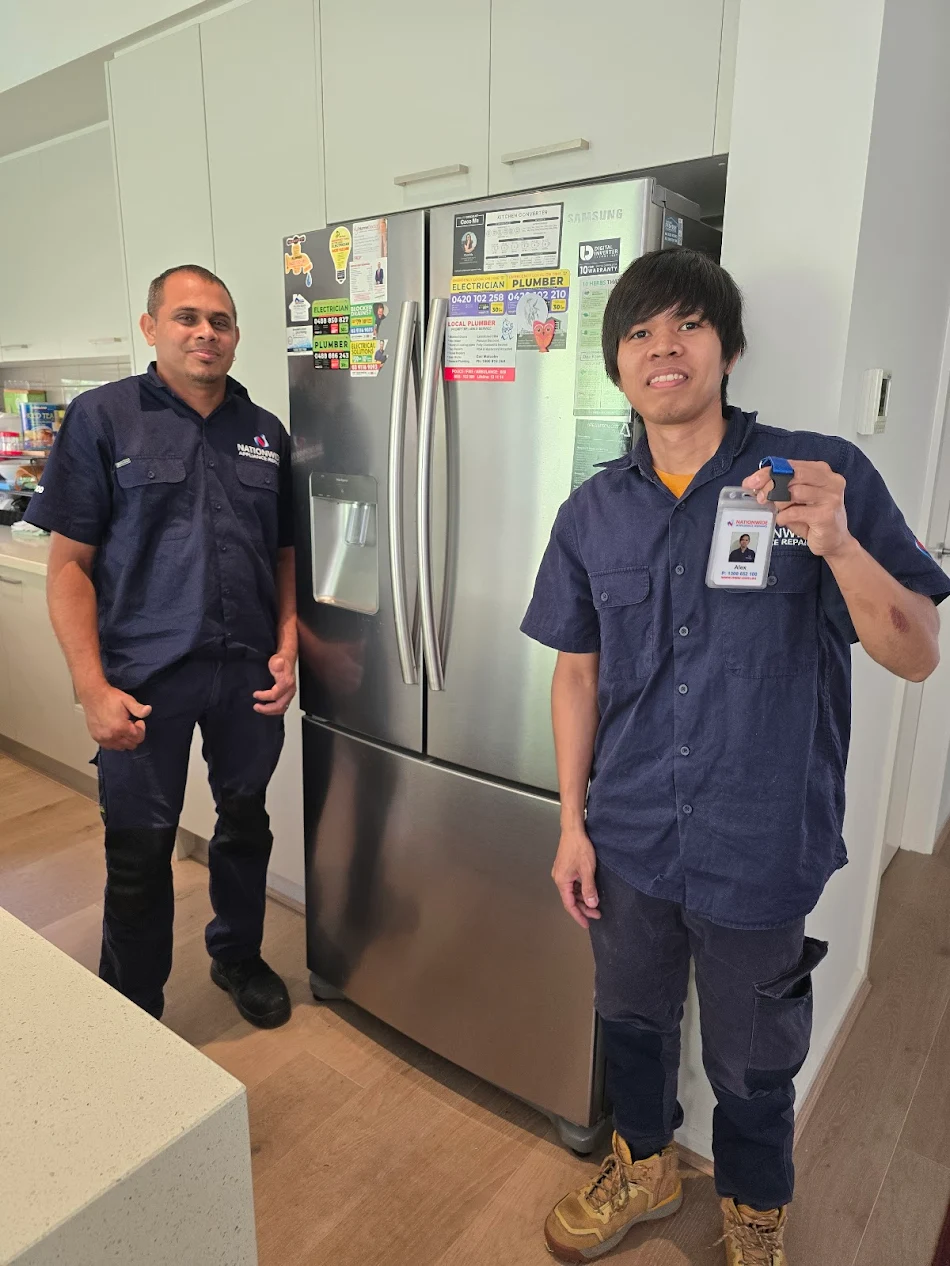
After 15+ years repairing appliances across Brisbane, we can tell you straight up: fridge seals fail faster in Brisbane than anywhere else. Not by a little bit, either. We’re talking years of extra wear in the span of months. At National Appliance Repairs, we see this pattern constantly in our service calls.
If your fridge is three or four years old and the seal is already showing cracks, or if water is pooling on your kitchen floor, Brisbane’s humidity is almost certainly the reason.
Why Brisbane’s Humidity Is Actually the Problem
Here’s the thing about Brisbane: the air is always moist.
From June to August, humidity hovers around 50-60%. That’s actually not too bad. But come November, it climbs (Bureau of Meteorology). By February, we’re sitting at 65-73% humidity, and it stays there for months. Your fridge seal never really gets a break.
How Humidity Actually Breaks Down Rubber (It’s Simpler Than You Think)
The rubber that makes up your fridge seal isn’t like the rubber on a bike tire. It’s designed to be soft and flexible so it squeezes against the door frame and creates an airtight seal. The problem is, that same flexibility that makes it work is what gets destroyed by moisture.
Think of it like this: moisture gets into the rubber and causes it to swell slightly. That swelling changes how the material behaves at a molecular level. The flexible rubber becomes less flexible. It starts to harden in some spots and stay compressed in others. Eventually, it just gives up.
In Brisbane’s heat and humidity combined, this happens faster. Every time you open your fridge on a 35°C day and then the compressor kicks in to cool everything down again, you’re putting the seal through a thermal cycle. That cycle, repeated hundreds of times over a few years in constant humidity, breaks down the material permanently.
Once that chemical breakdown happens, you can’t reverse it. It’s done. You’re not going to clean the seal and fix it. You’re going to replace it.
What You’re Actually Looking at When a Seal Starts Dying
When a seal begins to fail, you’ll notice signs. Water sitting around the door after you’ve closed it, for instance. That’s the seal losing its squeeze and isn’t compressing properly anymore. Then you’ll start seeing visible damage if you look closely. The rubber will have hairline cracks, especially at the corners where it has to bend when the door closes.
By the time the seal is really failing, you can actually see mold growing on it. That’s a dead giveaway. Once mold moves in, the seal is definitely done.
Worse than the visual damage, though, is that a failed seal forces your fridge’s compressor to work almost nonstop. Your compressor is already working hard in Brisbane’s heat. A loose seal means it’s fighting a losing battle during summer, trying to maintain 4°C inside while 35°C humid air is constantly leaking in.
We’ve seen this exact pattern lead to compressor failure by year 9 or 10. The fridge might have had another 5 years left, but a neglected seal made it die early.
What Actually Works (And What Doesn’t)
Replace your seal every 8-10 years and don’t wait for it to fail
We know it sounds like we’re trying to sell you something, but this is the single most cost-effective thing you can do.
A new genuine seal costs $80-150, takes 30 minutes to install, and you’re done. Compare that to a failed seal that ruins your compressor three years down the line.
| Maintenance Task | When to Do It | Time Required | Impact |
|---|---|---|---|
| Clean seal with warm soapy water | Monthly | 5 min | Prevents moisture trapping and early degradation |
| Check door closes evenly | Quarterly | 5 min | Ensures seal compresses uniformly |
| Inspect for visible cracks/warping | Every 6 months | 2 min | Catches failure before pooling water |
| Replace seal completely | Every 8-10 years | 30 min | Prevents compressor overwork and failure |
| Ensure 4″ clearance around fridge | When moving/installing | 10 min | Allows proper heat dissipation |
| Set consistent temperature (3-4°C) | Once, then leave it | 1 min | Reduces thermal cycling stress |
Clean your seal monthly in Brisbane
Use warm soapy water and a soft cloth. Wipe out any grime, soap residue, or food particles that have accumulated. In Brisbane’s humidity, junk accumulates on seals and traps moisture. Five minutes a month prevents a lot of problems.
Check that your door is closing properly
Hinges shift over time. Sometimes a fridge door doesn’t close evenly anymore. Maybe the top closes fine but the bottom sits open slightly. That’s stressing your seal because it’s not compressing evenly. Most of the time it’s just a case of adjusting the feet or loosening/tightening the hinge bolts. If the door closes with light, even pressure, you’re good.
Give your fridge some breathing room
Don’t wedge it into a corner. Your fridge needs space around it, especially on the back where the condenser coils are. Leave at least 4 inches on all sides to let the fridge breathe.
Don’t obsess over temperature settings
Set your fridge to 3-4°C and leave it. Constantly adjusting the thermostat because “the food’s not cold enough” just stresses everything. Usually if food isn’t cold enough, your coils need cleaning or the filter needs replacing, not a temperature adjustment.
Brisbane vs Other Australian Cities
In our service across Queensland, we see a clear pattern. Brisbane fridge seals fail at predictable intervals. Brisbane suburbs from Indooroopilly to Fortitude Valley to Bowen Hills all show similar degradation timelines.
Areas slightly inland — Ipswich, which is further from the coast — see slightly slower seal degradation because daytime heat is higher but nighttime humidity drops more. Coastal suburbs like Redland Bay and Morningside see seal failure faster because the air is consistently humid day and night.
What We Tell Brisbane Homeowners
After 15+ years servicing appliances across Brisbane, our recommendation is simple: treat your fridge seal replacement like you treat your car’s air filter. It’s not dramatic or exciting. But it’s the difference between a fridge that works for 12 years and one that fails at eight because humidity did its job.
Brisbane’s subtropical climate is beautiful for living. For appliances, it’s unforgiving. The humidity that makes our winters mild and our summers warm is the same humidity that slowly breaks down rubber. Accept that, plan for it, and your fridge will reward you with years of reliable service.
FAQs
How do I know if my fridge seal is failing?
Look for visible cracks, warping, or areas where the rubber is compressed and doesn’t spring back. Open the door and feel the gasket — it should be firm and springy. If it feels soft, brittle, or sticky, it’s degrading. If water pools inside after a night with the door closed, the seal is no longer functioning.
Can I clean a degraded seal to extend its life?
Cleaning removes mold and debris, which helps, but it doesn’t reverse the chemical degradation of the rubber. A seal that’s already cracked or warped won’t be restored by cleaning. Cleaning slows further damage but doesn’t fix the underlying problem.
Is it cheaper to replace just the seal or the whole fridge?
If your fridge is under 10 years old and the seal is the only problem, replacing the seal ($150-250 installed) is vastly cheaper than a new fridge ($800-2,000). If the fridge is 12+ years old and the seal has failed, check the compressor before deciding. If the compressor still works, replace the seal. If the compressor is also failing, replacement is likely your better option.
Do all fridge brands have this problem in Brisbane?
Yes, though some manufacturers use slightly more durable seal materials. Bosch and Miele seals tend to last slightly longer than some budget brands, but in Brisbane’s humidity, all seals degrade. The difference is maybe 1-2 years, not a complete solution.
Should I use a humidifier to protect my appliances?
No. Indoor humidity in Brisbane is already high enough. Running a humidifier increases the indoor humidity and speeds up seal degradation on all appliances. The solution is ventilation and seal replacement, not adding moisture.
Can I repair a cracked seal myself?
Small cracks can be temporarily sealed with silicone sealant, but this is a temporary fix. The underlying rubber is still degraded. Within weeks to months, the seal will fail again. Professional replacement is the only lasting solution.
Needs a Seal Inspection? We Can Help!
Your fridge seal is working harder in Brisbane’s climate than it would anywhere else in Australia. The science is more than clear on this, and we’ve documented this pattern across thousands of Brisbane homes.
Give National Appliance Repairs a call to schedule a seal inspection or replacement. In Brisbane’s climate, prevention is always cheaper than repair.
Call Us:
or leave a message using the form below