
Westinghouse, Electrolux, Simpson and AEG washing machines look different and wear different badges, but in Australian laundries they share one code system. An E20 means the same thing on all four.
That makes the codes easier to read than most. Electrolux groups them by the system involved, and once you know the group you know where to start. National Appliance Repairs services Westinghouse, Electrolux and AEG washing machines across Melbourne, Sydney, Brisbane, Adelaide and Perth.
How the codes are grouped
Electrolux’s own support guidance describes each family as “E10 or similar”, “E20 or similar”, and so on. The first two characters tell you the system. The final digit narrows down the specific fault within it, which is mainly useful to a technician.
| Code family | What Electrolux says it relates to | First check |
|---|---|---|
| E10 and similar | Water supply | Taps open, hoses straight, inlet filters clean |
| E20 and similar | Draining | Pump filter, drain hose, sink or standpipe |
| E30 | Water pressure sensor | Technician |
| E40 and similar | Door lock | Door properly closed, nothing caught in the seal |
| E50 | Motor | Technician |
| E60 | Heating | Technician |
| EF0 and the EF family | Water leakage, over-foaming, or an unbalanced load | Detergent, load balance, any water underneath |
E10: the machine is not filling
- Open the taps fully. Many front loaders fill from cold only and heat the water themselves, so the cold tap matters most.
- Check the inlet hoses for kinks behind the machine.
- Clean the inlet filters. Turn off the taps, unscrew the hoses at the machine end, and clean the small mesh screens in the inlet. Sediment and scale collect there.
- Check the house has normal pressure.
If E10 appears only on warm or hot cycles on a dual-fill top loader, the hot supply is the one to look at.
E20: the machine is not draining
- Unplug the machine and let it cool if it stopped mid-wash.
- Clean the pump filter. On front loaders it sits behind the small round cap low on the front. Drain the water slowly into a tray first, because there will be a lot of it.
- Check the drain hose for kinks, and check it is not pushed too far into the standpipe.
- Check the laundry tub or standpipe is draining freely. A slow tub backs water up into the machine, which reports it as its own fault.
Our general guide to washing machines that won’t drain covers the same checks for any brand.
E40: the door will not lock
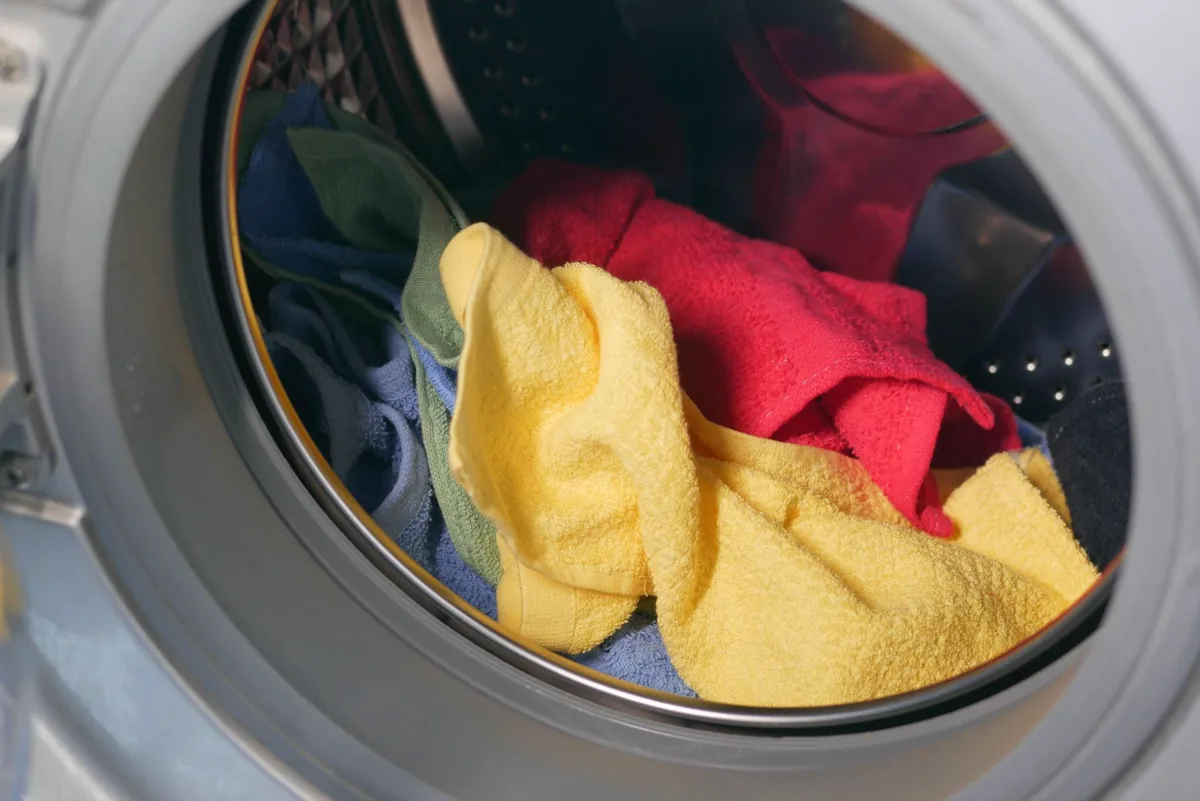
Close the door firmly. Look for a sock, a sleeve or a drawstring caught in the seal or the latch, which stops the door seating properly. Restart the program.
If the door is properly closed and E40 persists, the door lock or its wiring needs testing. Do not force the door handle to get clothes out, because a broken handle turns a lock repair into a bigger job. A machine that is holding water will also keep its door locked by design. That is the lock doing its job, not a second fault.
The EF codes
The EF family covers three things that look unrelated: a leak, too much foam, and a load the machine cannot balance.
- Foam. Use a front loader detergent in a front loader, and use less of it. Excess suds stop a machine draining and spinning properly.
- Unbalanced load. A single heavy item such as a bath mat or doona, or a load all wound to one side. Redistribute it and try again.
- Leak. If there is water underneath the machine, stop. A code reporting water in the base of the machine means water is escaping somewhere inside. Our guide to washing machines leaking from the bottom covers the usual causes.
When to book
Book on any E30, E50 or E60 code, on an E10 or E20 that survives the checks above, on an E40 with the door properly closed, and on any EF code with water on the floor.
Our washing machine repair service covers Westinghouse, Electrolux, Simpson and AEG across all five capitals, with same-day appointments subject to availability, upfront quoting, and a 12-month parts warranty with a 3-month labour warranty.
Call:
- Melbourne 03 9123 0548
- Sydney 02 9621 5988
- Brisbane 07 3166 9770
- Adelaide 08 7123 4027 or
- Perth 08 9470 4450
Tell us the full code including the last digit, and the model number from the label inside the door.
Frequently asked questions
Do Westinghouse and Electrolux washing machines use the same error codes?
Yes. Westinghouse, Electrolux, Simpson and AEG washing machines sold in Australia share the same code system, so E20 means the same thing on each.
What does E20 mean on a Westinghouse washing machine?
A draining problem. Clean the pump filter at the bottom front, check the drain hose, and make sure the tub or standpipe drains freely.
What does E10 mean on an Electrolux washing machine?
A water supply problem. Check the taps are fully open, the hoses are not kinked, and the inlet filters are clean.
What does EF0 mean on a Westinghouse or Electrolux washer?
Electrolux groups leakage, over-foaming and unbalanced loads under the EF family. Check the detergent and the load, and stop if there is water underneath.
Why does my washing machine door stay locked?
Usually because there is still water in the drum. Once it drains, the door releases. If it stays locked with an empty drum, the lock needs testing.
The short version
Westinghouse, Electrolux, Simpson and AEG washers share one set of codes. E10 is water in, E20 is water out, E40 is the door, and the EF family is leaks, foam and balance. Most E10, E20 and E40 codes have causes you can check yourself.
E30, E50 and E60 are pressure sensor, motor and heating faults for a technician. National Appliance Repairs services all four brands across five capitals with upfront quoting. Book online or call your nearest office.
Sources to link at publish: Electrolux support, “Electrolux washing machine displays an error code: causes and solutions” (use the Electrolux or Westinghouse Australia equivalent, confirm URL at publish)