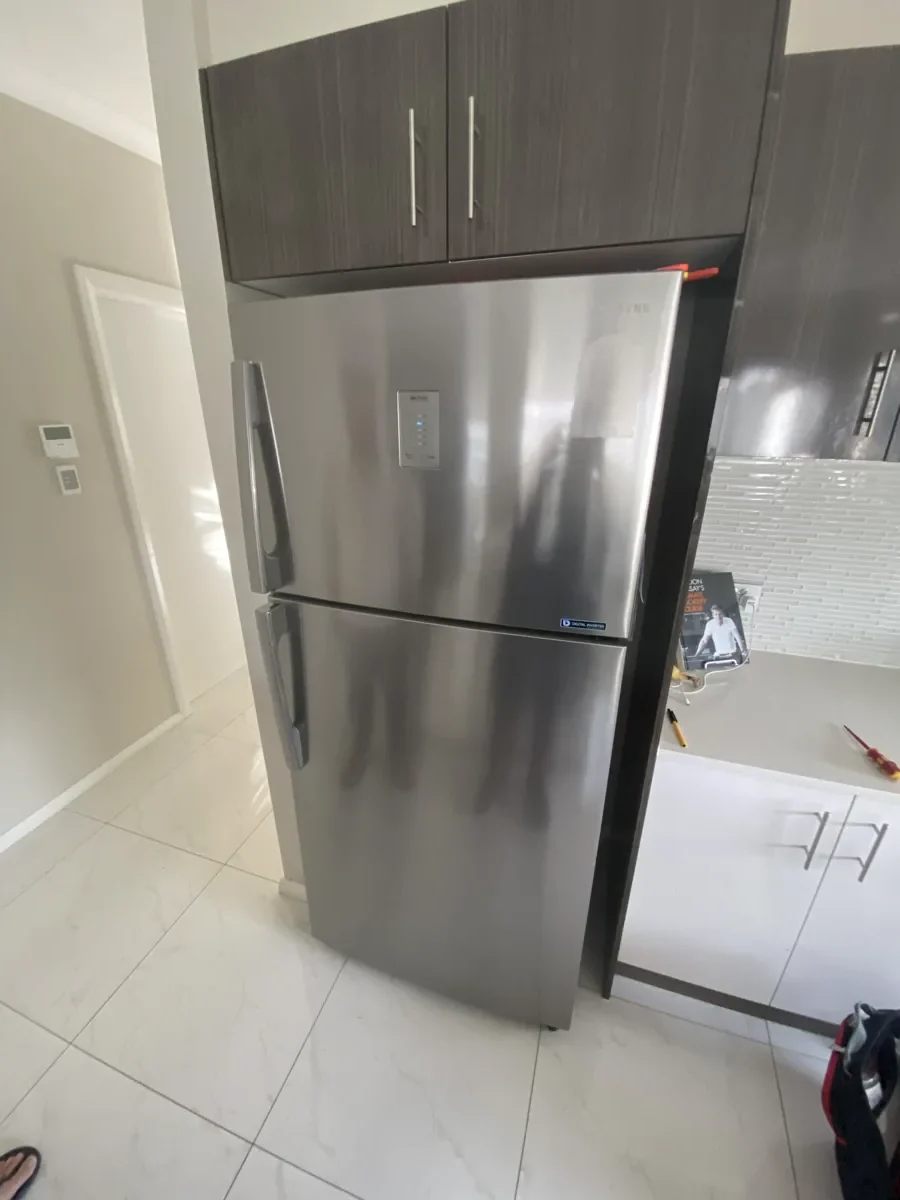
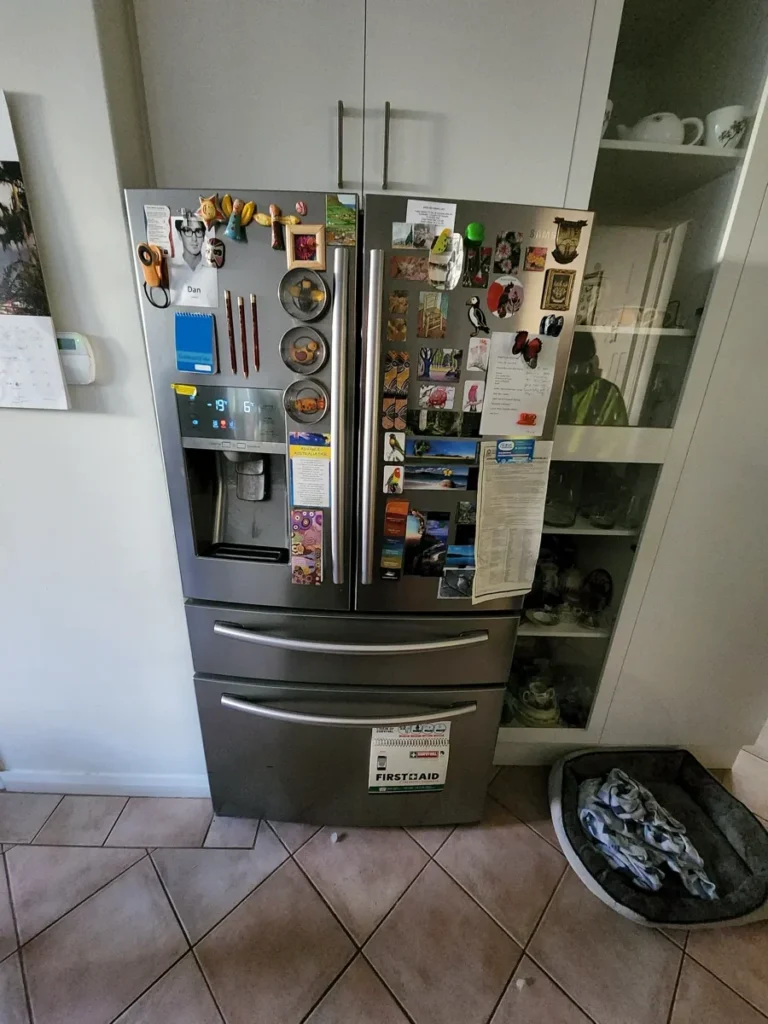
The freezer has stopped freezing. Ice cream has gone soft, the ice tray is slushy, and 21E is showing on the display.
Unlike its near neighbour 22E, this one affects the whole appliance. National Appliance Repairs services Samsung fridges and freezers across five capitals, and 21E is the fridge code we treat with the most urgency.
What 21E means on a Samsung fridge
21E is a freezer fan error. The evaporator fan behind the rear panel of the freezer has stopped turning, or the control board is no longer receiving the rotation signal it expects from that fan motor. On newer Samsung panels the same fault displays as 21C.
The fan itself sits behind a panel at the back of the freezer compartment, directly in front of the evaporator coil. Its job is to pull air across that coil and push it where it needs to go.
Need This Fixed Today?
Our licensed technicians repair this exact fault every week – fast, reliable, and backed by a workmanship guarantee.
- Licensed & insured
- Workmanship guarantee
- No fix, no fee
Why this one is more urgent than 22E
Here is the part most guides miss. On most Samsung fridges, the freezer evaporator produces all the cold air for the appliance, and the freezer fan distributes it to both compartments.
A 22E means the fresh food side has lost its own circulation fan while the freezer keeps working. A 21E means the source of cold air for the entire cabinet has stopped moving. Both sections warm up, and they warm up together.
| 21E (or 21C) | 22E (or 22C) | |
|---|---|---|
| Component | Freezer evaporator fan | Fridge compartment fan |
| Freezer | Warming | Usually still cold |
| Fridge | Warming | Warming |
| Urgency | High, whole cabinet affected | Moderate, one side affected |
If you are seeing 22E instead, our guide to the Samsung 22E error covers that fault.
The three things that cause it
Ice around the fan blade. The most common cause by a wide margin. Frost builds on the evaporator, spreads outward, and locks the blade in place. You will often hear a warning before the code appears: chirping, humming, or grinding from the back of the freezer as the motor strains against the ice.
A failed fan motor. The motor itself has stopped. The freezer will be silent, not noisy.
A feedback fault. Samsung freezer fans report their speed back to the control board. If that feedback circuit fails, or the wiring plug has vibrated loose, the board reports 21E even though the blade is turning normally.
The listening test
Before you take anything apart, spend fifteen seconds working out which of those three you have.
Open the freezer door and find the door switch, the small button or lever the door presses when it closes. Hold it in. On most models that tells the fridge the door is shut, so the fan should run.
- You hear the fan running. The blade is turning, so you are likely looking at a feedback or wiring fault.
- You hear grinding, clicking or scraping. Ice is catching the blade.
- You hear nothing at all. Either the motor has failed or ice has locked it solid.
That one test tells a technician more than any description of the symptoms will, so note the answer before you call.
What to try first
- Check the door is sealing. Run a finger around the gasket looking for tears, folds, flattened sections or food residue. A door that does not seal draws humid air into the freezer continuously, and humid air is what becomes ice.
- Check nothing is holding the door open. An overstuffed drawer or a package jammed at the back will hold a bottom-freezer drawer open by a few millimetres unnoticed.
- Clear the rear vents. Food packed hard against the back wall restricts airflow and speeds up frost formation.
- Run a full defrost. Empty the freezer, switch off at the wall, put towels down and leave both doors open for several hours at minimum. A room fan blowing in from a safe distance speeds it up. Do not use a heat gun, hair dryer on hot, or anything sharp near the evaporator: the coil is thin-walled and holds refrigerant under pressure.
- Note the date and watch. If the code stays gone for a month, ice was the cause. If it returns within a week or two, something is producing ice faster than the defrost cycle can clear it.
Protect the food before you start
A Samsung fridge with a failed freezer fan loses both compartments, so this is not a case of moving a few items across. Food Standards Australia New Zealand identifies 5°C to 60°C as the range where food-poisoning bacteria multiply, with a total safe window of generally less than four hours.
Frozen items that still have ice crystals through them can usually be refrozen. Anything fully thawed should not be. Move what you can into an esky before starting a defrost, and do not judge by smell or appearance.
When it needs a technician
Book if the code returns after a defrost, if the freezer is silent, or if you have seen 21E more than once in a month.
That last signal is the one that matters. A fan frozen solid is a symptom, and the cause is usually a defrost heater or sensor that has stopped clearing the evaporator on schedule. Replacing the fan on a fridge with a failed defrost circuit buys a few weeks and nothing more, which is why our technicians test that circuit before quoting a fan motor.
Our fridge repair service and freezer repairs cover Samsung across Melbourne, Sydney, Brisbane, Adelaide and Perth, with same-day appointments subject to availability, upfront quoting, and a 12-month parts warranty with a 3-month labour warranty.
Call:
- Melbourne 03 9123 0548
- Sydney 02 9621 5988
- Brisbane 07 3166 9770
- Adelaide 08 7123 4027 or,
- Perth 08 9470 4450.
Tell us the code, and tell us what you heard during the listening test.
Frequently asked questions
What does 21E mean on a Samsung fridge?
It is a freezer fan error. The evaporator fan in the freezer has stopped turning, or the control board is not receiving rotation feedback from it. Newer models show the same fault as 21C.
Is 21E worse than 22E?
Yes. The freezer fan supplies cold air to both compartments, so a 21E warms the entire fridge. A 22E affects the fresh food side while the freezer keeps working.
Can I keep using the fridge with a 21E error?
Not for food storage. Both compartments will drift out of safe temperature. Move perishables to an esky and treat the repair as urgent.
Why does 21E keep coming back after I defrost it?
Because the defrost system is probably the underlying fault. If the defrost heater or sensor is not clearing frost on schedule, ice rebuilds around the fan and the code returns.
Does 21E always mean the fan motor has failed?
No. Ice locking the blade is more common, and a loose wiring plug or failed speed-feedback circuit can trigger the code with a perfectly healthy motor.
The short version
21E names the freezer fan, and because that fan feeds the whole appliance, it is the Samsung fridge code to act on quickly. Ice around the blade causes it more often than motor failure, so a full defrost is worth doing before anything else. What happens next tells you which one you have: a code that stays gone was ice, and a code that comes back is the defrost circuit.
National Appliance Repairs services Samsung fridges across five capitals with upfront quoting. Book online or call your nearest office with the code.
Call Us:
or leave a message using the form below