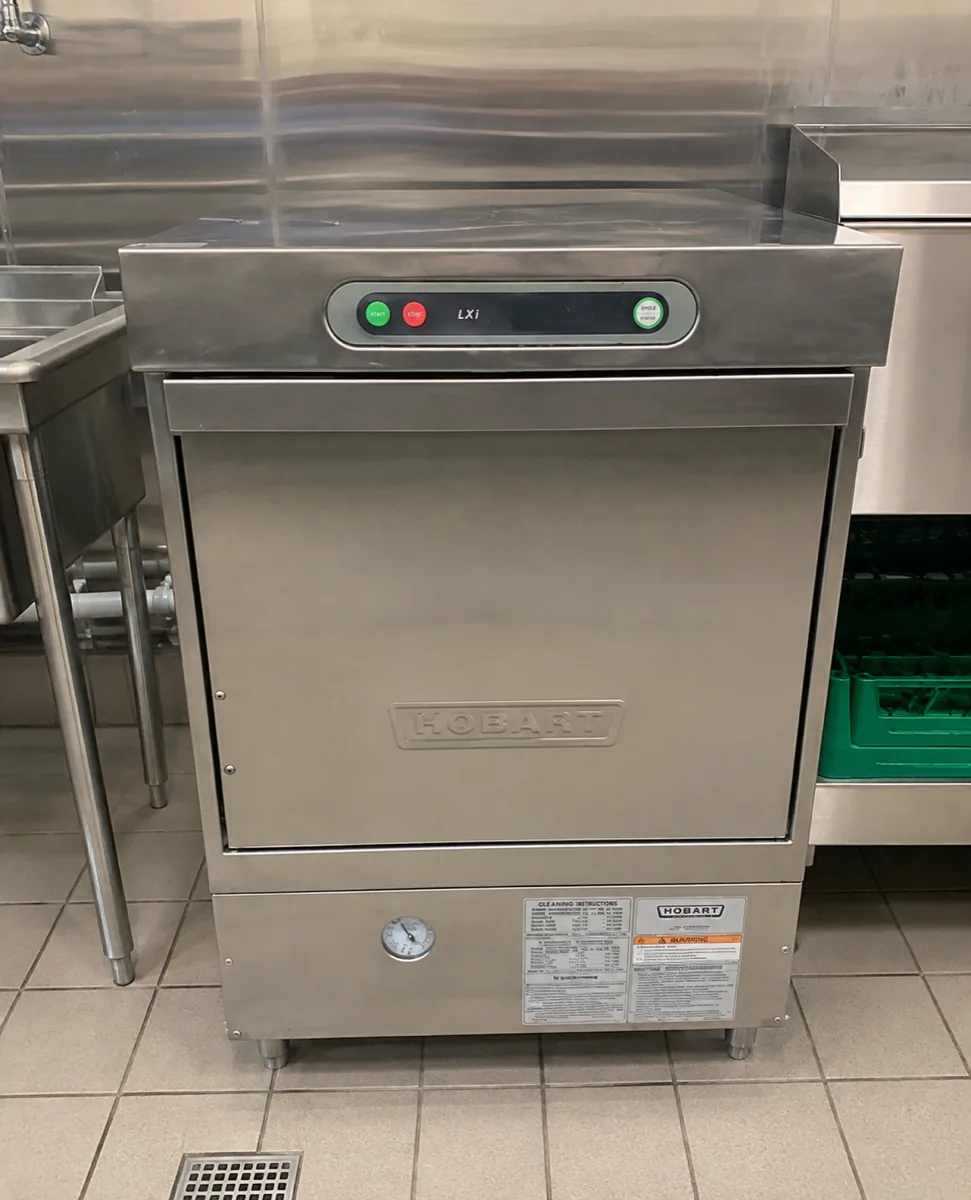
Mid-service, racks stacked up, and the Hobart has stopped with a code on the display. One question matters right now: can your team clear this in two minutes, or is it hand washing for the rest of the night?
Fill and drain faults you can usually answer yourself. Anything else is a call. National Appliance Repairs maintains Hobart warewashing equipment across five capitals, and this is the decision tree our technicians walk venue managers through on the phone.
What the E codes actually cover
On Hobart LXi and AM Select undercounter machines, the E series is reserved for fill and drain problems. When one appears, the machine stops the cycle, shuts off all heat sources, and holds the message on the display until the OFF button is pressed.
That heat detail matters before you improvise a workaround. A Hobart running a thermal cycle relies on the final rinse to sanitise. With the heat sources off, it is not sanitising, even if you can coax water through it.
| Code | What it means | Can the venue clear it? |
|---|---|---|
| E0, E2, E3, E4 | The machine is not filling, or not filling high enough. The unit will not run | Often yes |
| E5 | The machine is not draining properly | Often yes |
| E6 | Contact an authorised service agent | No |
| CL or Pr | Filling too high, or leaking from the door | Sometimes |
| P1, P2, P3 flashing with a spanner icon | Contact an authorised service agent | No |
E0, E2, E3 and E4 all describe the same broad condition. Hobart splits them by which stage of the fill sequence failed, not by which part broke. Four codes, one investigation.
Fill faults: what to check before you call
Work through these in order. Most fill errors are upstream of the machine.
- Check the isolation valve is open. Somebody closes it during a clean-down and forgets. This is the single most common cause and it costs nothing to rule out.
- Check building water pressure. Undercounter machines need adequate pressure to fill within the expected window. If other outlets in the venue are weak too, the problem is not the dishwasher.
- Clean the inlet strainer. Hobart machines have a strainer at the inlet solenoid or hose connection. Blocked, it starves the machine of water. Isolate, unscrew, rinse, refit.
- Check the float and water level probes. A float that cannot move freely, or probes coated in scale, will misreport the level. Wipe the probes clean.
- Confirm the machine is level. An unlevel unit reads its water level wrong, which is also what sits behind a CL or Pr message.
If the code returns after all five, the inlet solenoid valve or the level sensing circuit needs testing. That is a technician job.
Drain faults and the E5 code
E5 says the machine could not empty within the allotted time. In a commercial kitchen the cause is almost always physical.
- Scrap trays and strainer baskets full. Pre-scrapping discipline slips during a rush and the trays fill faster than anyone expects.
- Drain hose kinked or restricted. Check the run behind and under the machine, especially after it has been pulled out for cleaning.
- Grease and mineral buildup in the drain line. Builds over months and announces itself as a code that appears more and more often.
- Drain stop or overflow tube not seated correctly. Easy to misfit after a wash-down.
Clear the obvious and restart. An E5 that returns the same shift usually means the drain pump or the line beyond the machine needs attention.
Why the code you are looking at may not match your model
This is where most online guides fall down, because they treat Hobart as one machine.
- LXi and AM Select display the numeric E series described above.
- LXe machines use plain text messages such as a fill error or a door open message instead of E codes.
- LX40 uses a different convention again, with fill and drain problems shown as worded prompts.
- CL and CLe conveyor machines are a separate platform with their own diagnostics, and they should not be diagnosed against an undercounter code list.
If the code you have found online does not match what is on your display, check the model number on the rating label before acting on it. Parts ordered against the wrong code list are a common and expensive mistake.
The compliance angle nobody mentions
Under Standard 3.2.2 of the Australia New Zealand Food Standards Code, a food business must ensure eating and drinking utensils and food contact surfaces are both clean and sanitised. The NSW Food Authority notes that commercial dishwashers relying on heat alone should generally reach above 80°C in the sanitising rinse.
A machine sitting on an E code with its heat sources off is not meeting that. Neither is one somebody has restarted repeatedly to force through a cycle. If the fault will not clear, move to a compliant manual wash and sanitise process and get the machine looked at.
Document the downtime. Your Environmental Health Officer will ask.
When to book, and what to have ready
Book immediately on E6, on any flashing P code with a spanner icon, on a fill or drain fault that returns after the checks above, or on any code accompanied by visible water on the floor.
Our commercial dishwasher repairs and commercial warewasher and glasswasher service cover Hobart in all five capitals. We offer priority scheduling for urgent commercial repairs, discounted rates for ongoing B2B work, and service reports with job photography for your compliance records.
Call:
- Melbourne 03 9123 0548
- Sydney 02 9621 5988
- Brisbane 07 3166 9770
- Adelaide 08 7123 4027 or
- Perth 08 9470 4450
Our office team answers B2B calls until 6:30 PM weekdays.
Have three things ready: the model number from the rating label, the exact code, and whether it shows on fill or on drain. That combination usually tells our technician which part to load.
Frequently asked questions
What does E0 mean on a Hobart dishwasher?
It is a fill fault. The machine has not filled, or has not filled to the required level, and will not run. E2, E3 and E4 describe the same condition at different points in the fill sequence.
What is the difference between E0 and E5 on a Hobart?
E0 and the other low-numbered E codes are fill faults. E5 is a drain fault, meaning the machine could not empty within the expected time.
Can we keep using a Hobart dishwasher showing an error code?
No. The machine shuts off its heat sources when it displays these codes, so it is not sanitising. Move to a compliant manual process until the fault is cleared.
What does E6 mean on a Hobart dishwasher?
Hobart directs this one straight to an authorised service agent. There is no venue-side fix.
Why do the error codes online not match my Hobart?
Because Hobart uses different conventions across model families. LXi and AM Select machines use numeric E codes, LXe uses text messages, and conveyor machines are different again. Check your model number first.
The short version
E0 through E4 are fill faults, E5 is a drain fault, and both are usually caused by something outside the machine: a closed valve, a blocked strainer, a full scrap tray, a kinked hose. Those are worth five minutes before you call anyone.
E6 and flashing P codes are not. Neither is any code that comes back the same shift. And a machine holding an error is a machine that is not sanitising, which makes it a compliance problem as well as a service problem. National Appliance Repairs services Hobart warewashers nationally, with priority commercial scheduling. Get in touch or call your nearest office.
Call Us:
or leave a message using the form below