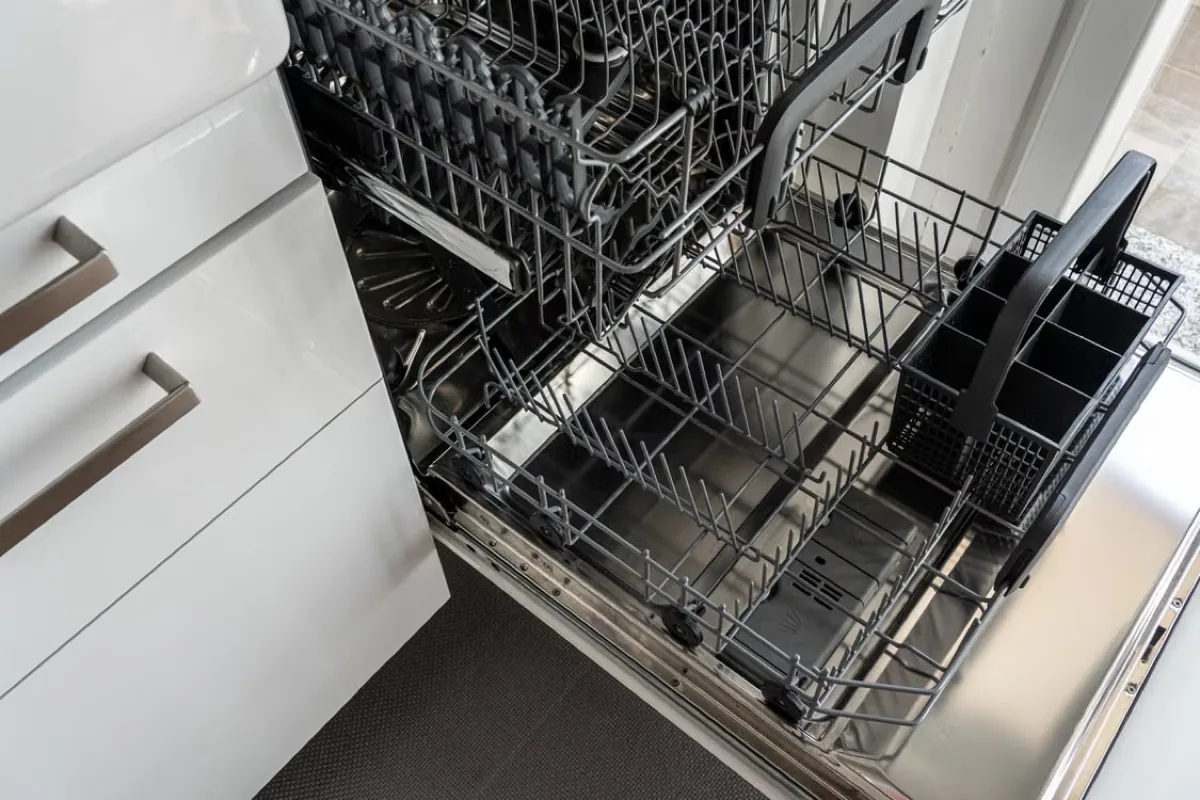
Dishes still wet, water pooling in the tub, a faint smell building if it’s sat there a day or two.
We’ve had several of such calls at National Appliance Repairs from owners of Westinghouse and Asko-branded dishwashers. In our experience, they fail in fairly similar ways when it comes to drainage, even sitting at opposite ends of the market the way they do. Here’s what actually causes it in each, and what’s worth checking before booking anyone.
Start With the Filter, Regardless of Brand
No matter what badge is out in the front, every dishwasher comes with a filter.
There’ll be a sump filter, which will catch food debris before it reaches the pump. However, it’s the coarse or fine mesh that’s the single biggest cause of drainage problems on both brands, and it’s the easiest thing to check yourself.
Take the bottom rack out and remove the filter assembly. Use hot water and take a soft brush to anything stuck to it – check again. This fixes the problem most of the time.
Westinghouse: Where It Usually Goes Wrong
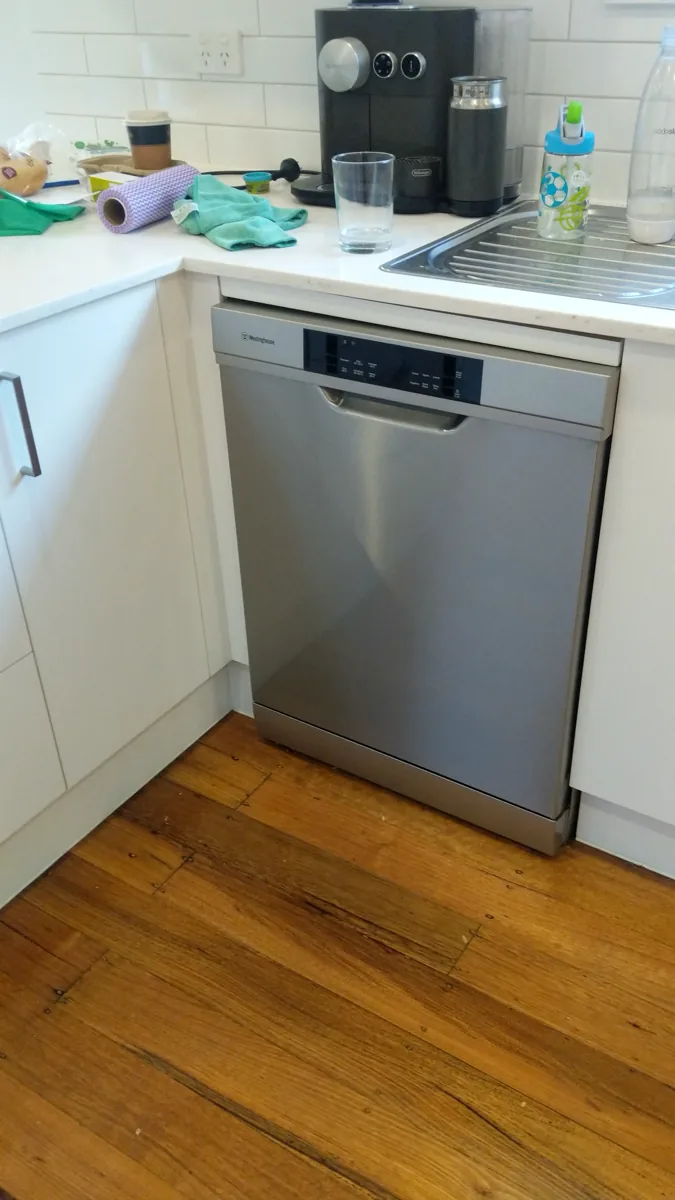
Westinghouse shares a lot of its dishwasher engineering with Electrolux, so the faults we see tend to follow a familiar pattern. If the filter’s already clean, the next most likely cause is the drain pump itself, either a failed motor or a jammed impeller. Broken glass and food scraps are the usual obstruction, and if the pump hums without actually spinning, that’s a fairly good sign the impeller’s caught on something rather than the motor being dead.
Some Westinghouse models also use a drain solenoid to open the drain valve at the right point in the cycle. If the solenoid fails, the valve simply won’t open, and no amount of filter cleaning is going to fix that. The valve itself can clog with debris over years of use too, and unlike a filter, it’s not something you clean and reuse once it’s actually failed. It gets replaced.
Less obviously, a fault on the control board can stop it sending power to the drain pump at all, even though the pump itself is fine. This one’s harder to work out yourself, since everything downstream looks normal until you actually test for power at the pump.
Asko: A Similar Pattern, With a Couple of Extras
Asko dishwashers follow much the same order of likely causes: filter first, pump second, control board third. Where Asko differs a little is the float switch, a small component that monitors water level and is meant to stop the machine overfilling. If it sticks or fails, it can throw off draining too, since the machine ends up reading the water level incorrectly and never triggers the drain cycle properly.
Asko dishwashers do display fault codes on the panel, though the exact code and what it means can vary noticeably between model generations. A code that means one thing on an older Asko can mean something else entirely on a newer one, so rather than guess based on a number, it’s worth checking your specific model’s manual, or having a technician read it against the right reference.
Quick Reference: Symptom to Likely Cause
| Symptom | Westinghouse | Asko |
|---|---|---|
| Standing water, filter already clean | Pump impeller obstruction | Pump impeller obstruction |
| Pump hums, doesn’t spin | Impeller jammed on debris | Impeller jammed on debris |
| No pump activity at all | Failed solenoid or control board | Control board or float switch fault |
| Mid-cycle drain doesn’t reduce water level | Drain valve clogged or stuck | Check valve or float switch issue |
| Fault code on display | Model-specific, check manual | Varies significantly by model generation |
What You Can Check Yourself
- Clean the filter assembly thoroughly, including the fine mesh section if your model has one
- Check the drain hose for kinks and confirm it’s still properly connected at both ends
- If it’s connected to a garbage disposal, run the disposal before starting a cycle to clear any blockage in the shared line
- Listen for the pump during the drain stage. A hum with no spin points at an obstructed impeller rather than a dead motor
- Power the dishwasher off for a few minutes and run a short cycle to see if a temporary glitch clears on its own
Why Some of This Needs a Professional
Clearing debris from a pump impeller is a reasonable job for most people who are comfortable pulling a filter out. Diagnosing a failed solenoid, a faulty control board, or a stuck float switch is a different level of work, and getting a control board diagnosis wrong means paying for a part that was never actually the problem. It’s also worth remembering that standing water left in the tub damages pump seals and encourages mould the longer it sits, so it’s not a fault worth working around for long.
National Appliance Repairs technicians work on both Westinghouse and Asko dishwashers regularly, and carry genuine filters, pumps, solenoids, and control boards for dishwasher repairs across the range. Most drainage faults are diagnosed and fixed in a single visit, backed by a 12-month parts warranty and 3-month labour warranty.
Keeping the Fault From Coming Back
- Clean the filter on a regular schedule rather than waiting for symptoms to show up
- Scrape plates before loading, so there’s less debris for the filter to trap in the first place
- If your model shares a drain with a garbage disposal, run it briefly before every wash, not just after something’s already blocked
- Avoid using rinse aid or detergent well past its use-by date, since old detergent can leave residue that builds up over time
Frequently Asked Questions
Why does my Westinghouse dishwasher keep leaving water at the bottom?
In most cases it’s the filter. If that’s already clean, a jammed pump impeller is the next most likely cause, followed by a failed drain solenoid or control board issue if the pump isn’t responding at all.
What does a fault code on my Asko dishwasher actually mean?
It depends heavily on the specific model and generation, since Asko’s codes aren’t consistent across the whole range. It’s worth checking your model’s manual rather than assuming a code means what it did on an older machine.
Is a humming pump that isn’t spinning a serious fault?
Not usually. A hum with no spin generally points to something physically obstructing the impeller, like broken glass or a fruit pit, rather than a burnt-out motor. Clearing the obstruction often solves it.
Can I test or replace a drain solenoid myself?
It’s a fair bit more involved than a filter clean, and getting the diagnosis wrong means you might replace a part that was never faulty. It’s worth having a technician confirm it’s actually the solenoid before ordering the part.
What does it cost to fix a Westinghouse or Asko dishwasher that won’t drain?
It depends on the fault. A filter clean or impeller clear costs very little. A solenoid, control board, or pump replacement is a bigger job. Call 1300 434 380 for a ballpark before booking.
The Bottom Line
Filter, pump, then the electronics behind it. That order solves the overwhelming majority of drainage faults on both brands. If you’ve worked through the checks above and it’s still not draining, contact National Appliance Repairs or call 1300 434 380 for a same-day assessment, subject to availability, across Melbourne, Sydney, Brisbane, Adelaide, and Perth.
Call Us:
or leave a message using the form below