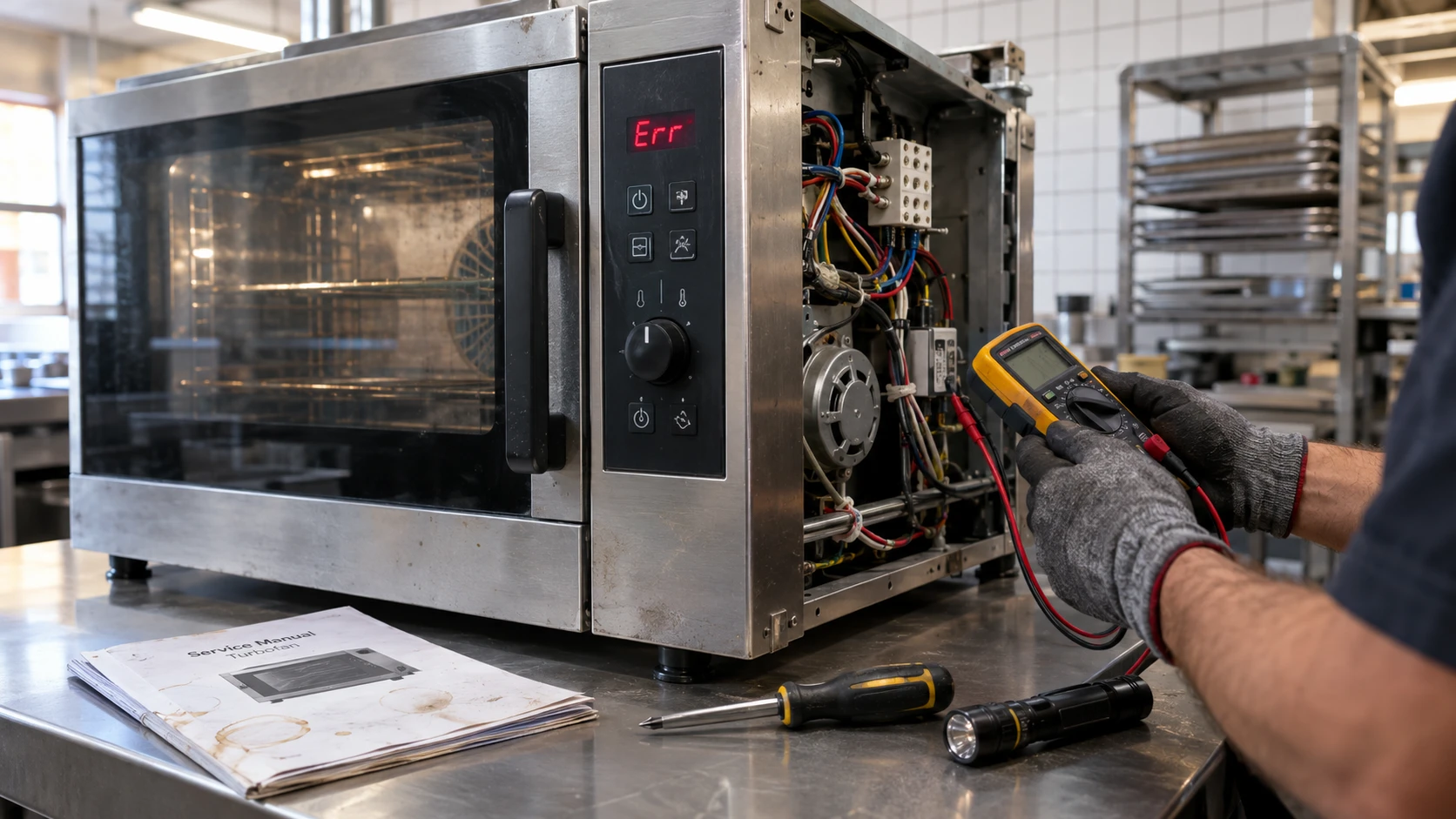

When Your Kitchen Workhorse Goes Cold
A micro oven heating problem is a frustrating appliance failure. Your microwave appears to work, the light is on, the turntable spins, the timer counts down, but your food stays cold. Here’s what you need to know.
Quick Answer: Common Causes of a Microwave Not Heating
- User Settings Issues (10% of cases), Control Lock, Demo Mode, or low power level settings
- Faulty Door Switch (20% of cases), Door not latching properly, preventing heating as a safety feature
- Failed Magnetron (40% of cases), The component that generates microwaves has burned out
- High-Voltage Component Failure (15% of cases), Diode, capacitor, or transformer malfunction
- Blown Fuse (15% of cases), Line fuse or thermal fuse has blown due to component failure
Important Safety Note: Microwaves store lethal voltages (up to 5,000V) even when unplugged. The high-voltage capacitor retains a charge that can cause fatal electric shock. Never open a microwave unless you’re a qualified technician.
Industry data shows microwaves have a failure rate of 10-15% per year, with heating issues being a top complaint. The good news is that many problems can be resolved by checking simple settings before you need professional repair.
At National Appliance Repairs, we’ve been providing quality services since 2009. With over four decades of experience in the appliance industry, we’ve witnessed countless micro oven heating problem scenarios. We connect homeowners with qualified technicians who can safely diagnose and fix these issues.
Safety First: Critical Precautions Before You Troubleshoot
Before we go any further, let’s be clear: microwaves are extremely dangerous to repair yourself. After four decades in the appliance industry, I still get nervous when someone says they plan to open their microwave to fix a micro oven heating problem.
Here’s why: a component inside called the high-voltage capacitor stores an electrical charge of approximately 3,000 volts. It holds this charge even after you unplug the unit. That’s more than ten times the voltage of a standard wall outlet, and it can be fatal.
This capacitor can hold its lethal charge for hours or even days after being disconnected from power. A microwave that has been unplugged for a week could still deliver a fatal shock.
During operation, internal components can reach up to 5,000 volts. Even qualified technicians approach these repairs with specialized equipment and extreme caution.
What should you do? Always unplug the unit before any inspection. Understand the line between safe troubleshooting (checking settings, the door latch, and power supply) and dangerous territory (opening the case).
If you suspect an internal component failure, don’t be a hero. Contact the professionals at National Appliance Repairs. Our certified technicians have the training and tools to safely discharge capacitors and repair high-voltage components. They know how to handle these dangers and get the job done safely.
No appliance is worth your life. When in doubt, make the call.
Simple Fixes: Checking User Settings and Basic Issues
Before worrying about expensive repairs, let’s cover the good news: sometimes a micro oven heating problem has a simple solution. These user-level fixes are safe to check yourself and account for about 10% of all heating problems. No tools are required.
Is It Plugged In? Checking the Power Supply
It may seem obvious, but start with the basics. A loose plug or tripped breaker is a common culprit.
- Check the power cord: Ensure it’s firmly plugged into the wall outlet.
- Test the outlet: Plug a small lamp or phone charger into the same outlet to see if it works. If not, the issue is with your home’s electricity.
- Check the circuit breaker: Go to your electrical panel and look for a tripped breaker. Reset it by switching it fully off, then back on. If it trips again immediately, call an electrician.
Have You Checked the Microwave’s Settings?
Modern microwaves have features that can be activated by mistake, causing confusion.
- Control Lock (or Child Lock): This feature prevents accidental use. The microwave will seem to work (lights, fan, turntable) but won’t heat. Look for “LOC” or “L” on the display. Your owner’s manual will explain how to disable it.
- Demo Mode: Retailers use this to showcase microwaves without generating heat. The unit will light up and spin, but your food will stay cold. Check your manual to learn how to exit this mode.
- Power Levels: Someone may have left the microwave on a low power setting (e.g., 30% for defrosting). Try heating a cup of water on full power for two minutes to test this.
- Delay Start: This feature programs the microwave to start cooking later. Check the display for any delay indicators and cancel the setting if it’s active.
- Reset the Microwave: Unplug the unit, wait a full minute, and plug it back in. This can clear minor electronic glitches. Test it again with a cup of water.
Is the Door Securely Latched?
Your microwave door is a critical safety feature. It has safety interlock switches that prevent the unit from generating microwaves unless the door is securely closed. Faulty door switches account for roughly 20% of all micro oven heating problems.
Push the door firmly to ensure it’s latched. Over time, the latch mechanism can wear out or the door alignment can shift. The door might look closed, but if it’s not engaging the switches, the heating function won’t activate.
Signs of a bad door switch include the microwave running but not heating, the light staying on when the door is closed, or having to slam the door to get it to start. While replacing a door switch is a relatively inexpensive repair, it requires opening the case. Given the high-voltage dangers, we strongly recommend calling National Appliance Repairs for this task.
Advanced Troubleshooting for a Micro Oven Heating Problem
If the simple fixes didn’t work, you’re likely dealing with a failed internal component. A reminder of our safety warning: Microwaves contain high-voltage parts that can deliver a lethal shock. This information is to help you understand the problem, not to encourage DIY repair. For internal failures, please contact National Appliance Repairs for professional help.
The Heart of the Microwave: The Magnetron
The magnetron is the component that creates the microwaves to cook your food. It’s the primary suspect in a micro oven heating problem, accounting for roughly 40% of all heating issues. It converts high-voltage power into the electromagnetic waves that heat your food.
Signs of a failed magnetron include a loud, unusual humming noise, a burning smell, or a distinct “popping” sound. In other cases, the microwave may just stop heating altogether, even though the light and turntable work. Replacing a magnetron is a complex repair that involves dangerous high-voltage components and is best left to a professional.
Powering the Process: High-Voltage Components
Several high-voltage components work together to power the magnetron. Failures in this system account for about 15% of heating problems and are extremely dangerous to handle.
- High-Voltage Diode: This converts electricity to the proper format for the magnetron. If it fails, the magnetron won’t get enough power.
- High-Voltage Capacitor: This part stores an extremely dangerous electrical charge (around 3,000 volts) even when the microwave is unplugged. It works with the diode and transformer to power the magnetron.
- High-Voltage Transformer: This heavy component boosts your home’s voltage to the thousands of volts the magnetron needs. A burning smell is a common sign of failure.
- High-Voltage Fuse: This protects the high-voltage circuit. If it blows, it’s often a sign that another component (like the diode or capacitor) has failed.
Testing or replacing any of these parts requires specialized knowledge to safely discharge the capacitor. This is work for qualified technicians only.
Other Potential Internal Failures
- Line Fuse: If your microwave is completely dead (no lights, no display), the main line fuse may have blown due to a power surge.
- Thermal Fuse: This safety device blows if the microwave overheats. If your unit stops mid-cycle or won’t start after being hot, this could be the cause.
- Control Board Failure: The microwave’s “brain” can fail, preventing it from sending the signal to start the heating process.
- Intermittent Issues: If the microwave only heats sometimes, it could point to a failing door switch or a short in the transformer. One homeowner found a faulty micro switch in the door was the culprit for their 10-year-old unit’s intermittent problem.
For any of these internal failures, the safest path is professional repair from National Appliance Repairs.
Repair or Replace? Making the Right Financial Decision
When facing a micro oven heating problem, you must decide: is it worth fixing, or should you buy a new one? There’s no single right answer.
In the appliance repair industry, repairs costing up to 70% of a new appliance’s price are generally worth doing. If your repair quote falls within this range, it’s typically a smart investment.
The average repair cost for a non-heating microwave is typically $100 to $300. About 60% of these repairs make financial sense, while the other 40% may cost as much as a new unit.
Here’s a look at common repair costs:
| Component | Typical Repair Cost (Parts + Labor) | Repair Viability |
| Door Switch | Low ($50-$150) | High (often an easy and affordable fix) |
| High-Voltage Fuse | Very Low ($50-$100) | High (if underlying issue resolved, very cheap part) |
| High-Voltage Diode | Medium ($100-$200) | Medium-High (part often affordable) |
| Magnetron | High ($150-$300+) | Medium (depends heavily on new unit cost) |
| High-Voltage Transformer | High ($150-$300+) | Medium (often a more complex, costly part) |
Consider these factors:
- Age: Most microwaves last about seven years. If yours is older and needs a major repair, replacement might be smarter.
- Type: Replacing a basic countertop model can be cheaper than a major repair. For a built-in or over-the-range unit, the high cost of installation often makes repair the better financial choice.
- Repair Type: A faulty door switch is almost always worth fixing. If multiple major components like the magnetron and transformer have failed, the costs can add up quickly.
- Warranty: If your microwave is still under warranty, the repair should be covered.
Here’s an important advantage: older microwaves were often built with superior materials and stronger components compared to many modern models. Repairing your existing appliance means keeping equipment with more durable parts.
The best approach is to get a professional diagnosis from National Appliance Repairs. Our technicians can give you a precise repair estimate, helping you weigh your options and make the best decision for your budget.
For complete pricing details, visit our Pricing Page.
Frequently Asked Questions about Microwave Heating Issues
Why does my microwave run but not heat the food?
This classic micro oven heating problem usually points to one of a few causes. First, check for simple user settings like Control Lock or Demo Mode, which prevent heating while allowing other functions to run. A faulty door switch is the next most common culprit; for safety, the microwave won’t generate heat unless the door is securely latched. If those are not the issue, the problem is likely an internal component failure. The most common is a failed magnetron (about 40% of cases), but it could also be another high-voltage component (diode, capacitor) or a blown fuse.
Is it dangerous to repair a micro oven heating problem myself?
Yes, it is extremely dangerous. Microwaves contain a high-voltage capacitor that stores a lethal electrical charge of around 3,000 volts, even when the unit is unplugged. This charge can persist for hours or days and can cause severe injury or death if touched. Only trained professionals with specialized equipment to safely discharge the capacitor should ever open a microwave for repair. For your safety, please call a professional.
How much does it cost to fix a microwave that’s not heating?
The cost to fix a micro oven heating problem typically ranges from $100 to $300. Simpler repairs like a faulty door switch or a blown fuse are on the lower end of that range ($50-$150). A major repair like a magnetron replacement is more expensive ($150-$300+). For a basic countertop model, this cost may approach the price of a new unit. However, for more expensive built-in or over-the-range models, even a costly repair is often more economical than replacement. A professional diagnosis from National Appliance Repairs will give you a clear estimate to help you decide. For complete pricing details, visit our Pricing Page.
How often should I get my microwave professionally serviced?
We recommend having your microwave professionally serviced every 12 months. Think of it like your car: service it on time, and you’ll get a much longer lifespan. More frequent servicing means fewer breakdowns. Regular professional servicing significantly reduces the likelihood of unexpected breakdowns and costly repairs.
Conclusion: Getting Your Microwave Back in Action
A microwave that runs but won’t heat is a major kitchen disruption. We’ve all been there: hungry, in a hurry, and let down by a key appliance.
Throughout this guide, we’ve covered everything from simple fixes to complex internal failures that cause a micro oven heating problem. The most important takeaway is that safety always comes first. The high-voltage components inside a microwave can be lethal, even when unplugged, making DIY repair a dangerous gamble.
Before panicking, perform the simple checks: ensure the power cord is secure, the circuit breaker isn’t tripped, and settings like Control Lock or Demo Mode aren’t active. Make sure the door closes firmly. These steps resolve many heating issues at no cost.
If these basic steps don’t work, the problem is likely internal, a failed magnetron, a blown fuse, or another faulty component. At this point, it’s time to step back and call a professional. The risk is not worth it.
Deciding whether to repair or replace isn’t always clear. A professional diagnosis is key to making a smart financial decision. A $150 repair on a three-year-old built-in unit makes sense; the same repair on a ten-year-old countertop model may not.
At National Appliance Repairs, we’ve been providing quality services since 2009. We understand how vital your microwave is. Our qualified technicians can safely diagnose and fix your micro oven heating problem, providing an honest assessment to help you decide the best path forward. We offer comprehensive warranties, including a 12-month parts warranty and a 3-month labour warranty.
Don’t let a cold microwave frustrate you.
Call us today on 1300 434 380 or your local number: – Adelaide: 08 7123 4027 – Sydney: 02 9621 5988 – Brisbane: 07 3166 9770 – Perth: 08 9470 4450 – Melbourne: 03 9123 0548 Get expert help for your appliance and get back to enjoying hot meals without the hassle. Visit our Areas We Service page to confirm we cover your location.