Damp clothes, a cycle that stopped early, and E:00:03 on the display. The instinct is to assume the dryer has stopped heating.
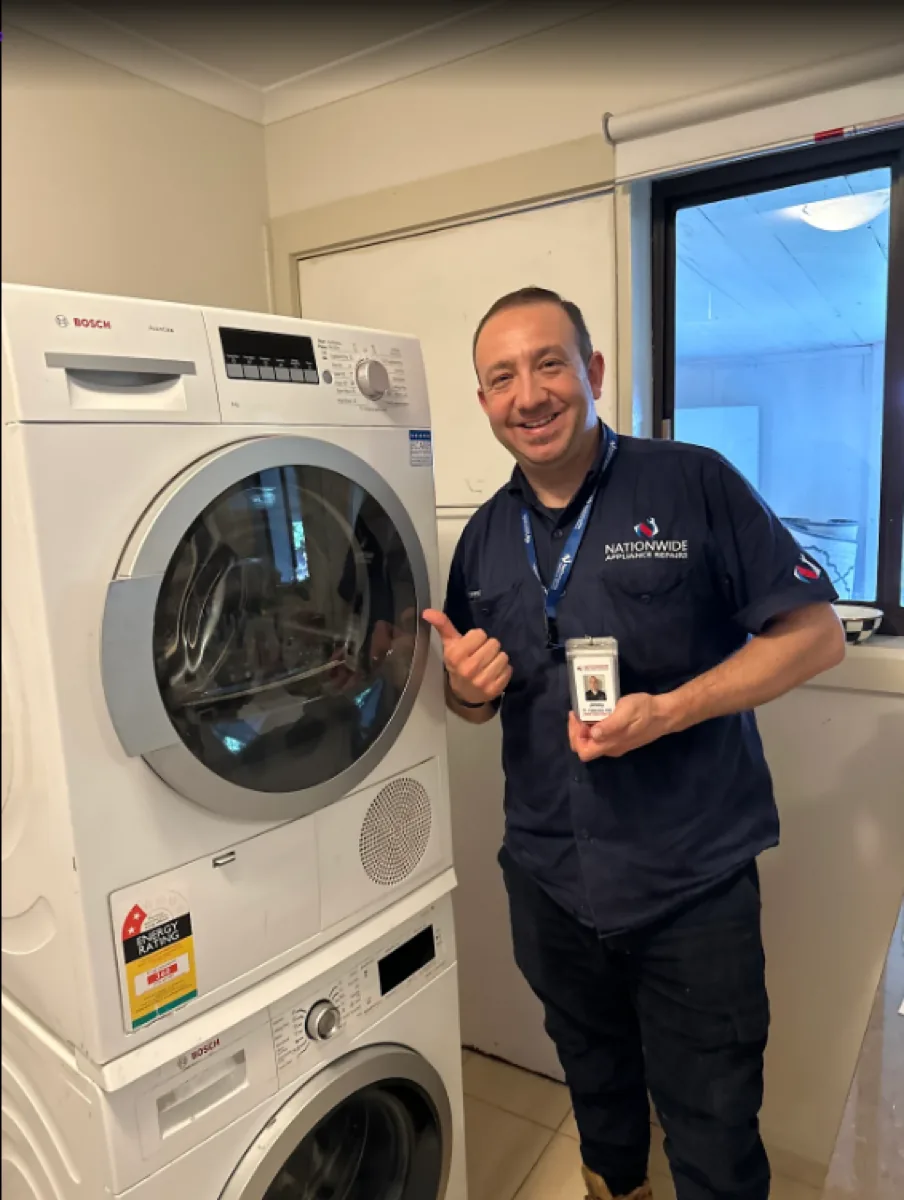
It hasn’t. E:00:03 sits in the condensate water circuit. Your dryer is pulling moisture out of the load perfectly well but cannot move that water where it belongs, so it stops before it floods its own cabinet. That distinction matters, because heating faults and drainage faults lead to completely different parts. National Appliance Repairs technicians service Bosch dryers across five capitals, and this is one of the codes where owners frequently do half the fix themselves.
Reading the code format
Bosch’s newer control panels display faults in a three-part format: E:00:03. Older Bosch and Siemens panels write the equivalent drainage fault simply as E03. If you have searched the short version and found results that do not match your machine, the display format is why.
Bosch’s guidance for the drainage fault directs owners to the condensation drain hose, checking for a blockage or a kink. Australian field reports on E:00:03 line up with that: lint accumulation in the water system and an intermittently operating condensate pump are common findings.
Bosch does not publish a full consumer-facing code table, so check the fault code section of your model’s manual to confirm before ordering any part.
How a heat pump dryer handles water
A heat pump dryer does not vent moist air outside. It runs the same air around a closed loop, cools it against an evaporator so the moisture condenses out, reheats it and sends it back through the drum.
That condensed water collects in a sump at the base of the machine. A small pump lifts it into the removable water container at the top, or out through the drain hose if you have plumbed the dryer in. Every drying cycle produces litres of water that has to go somewhere.
Block that path anywhere and the machine detects the water is not clearing. E:00:03 is the result.
What to check, in order
| Step | What you are looking for | Difficulty |
|---|---|---|
| Water container | Full, or not seated firmly enough for the machine to register it | Easy |
| Drain hose (if plumbed in) | Kinks, sharp bends, blockage, hose end sitting in standing water | Easy |
| Fluff filter at the door | Lint, and the film of fabric softener residue that builds up under it | Easy |
| Condenser filter | Compacted lint restricting the heat exchanger | Easy |
| Sump and pump filter | Lint slurry settled around the pump inlet | Moderate |
| Condensate pump | Intermittent operation, weak flow, seized impeller | Technician |
Work down that list. The first four cost nothing and resolve a meaningful share of cases.
Cleaning the condenser on a heat pump dryer
This is where heat pump dryers differ from older condenser dryers, and the difference trips people up.
On a traditional condenser dryer, the condenser block slides out and you rinse it under a tap. On most heat pump dryers the heat exchanger is fixed inside the machine and does not come out. What you can remove is the condenser filter in front of it. Clean that, then use a vacuum with a soft brush attachment to lift dust off the exposed fins behind it.
Be careful with the fins. They are thin metal, they bend easily, and bent fins reduce airflow permanently. The edges are sharp enough to cut.
Bosch typically recommends cleaning the condenser filter every few cycles. In practice, most machines we attend have not had it touched since installation.
Where the line sits between you and a technician
You can clean filters, empty containers, clear the drain hose and vacuum the accessible face of the heat exchanger. All of that is routine maintenance and it is in your manual.
Past that point the machine has to come apart. The condensate pump sits behind panels, alongside mains wiring, and the sealed refrigerant circuit that makes a heat pump dryer work is not user-serviceable under any circumstances. Refrigerant work is licensed work in Australia. If the code persists after you have cleaned everything reachable, the pump, the float switch or the wiring back to the control board needs testing with a meter.
Being straight about that division is the point. A heat pump dryer is an expensive appliance, and the economics usually favour repair over replacement, but only if the right part gets replaced.
Our heat pump dryer repair service covers Bosch models specifically, and sits alongside our general dryer repairs for vented and condenser units. Call NAR’s local branch, and tell us the code and whether you have already cleaned the filters. If you have, we bring a pump.
Preventing it from happening again
- Empty the water container after every cycle: Not when the light comes on. Every cycle.
- Clean the door fluff filter after every load: Lint that gets past the filter is what eventually ends up in the sump.
- Clean the condenser filter every few cycles: Rinse it, let it dry fully, and reseat it properly.
- Rinse the filter, do not just brush it dry: Fabric softener leaves a film that dry brushing does not remove, and that film traps the next round of lint.
- If the dryer is plumbed in, check the hose run twice a year: A hose that has been pushed against a wall during cleaning develops a kink that nobody notices for months.
Hard water accelerates deposits through the water circuit, which is worth knowing if you are in Adelaide or another hard-water area. Our guide to how Australian conditions wear out appliances covers where that matters most.
Frequently asked questions
What does E:00:03 mean on a Bosch dryer?
It is a condensate drainage fault. The dryer is condensing moisture from the load but cannot clear that water to the container or the drain, so it stops the cycle.
Is E:00:03 the same as E03?
They refer to the same drainage fault family. Newer Bosch panels use the three-part E:00:03 format; older panels display E03. Confirm against your model’s manual before ordering parts.
Can I fix a Bosch E:00:03 error myself?
Often, yes. Empty the water container, check the drain hose for kinks and blockages, and clean the fluff filter and condenser filter. If the code persists after all of that, the condensate pump needs testing.
Why does my Bosch dryer say the water container is full when it is empty?
Usually a blockage between the sump and the container, or lint around the pump inlet. The machine detects that water is not clearing and reports it the only way it can.
Should I repair or replace a heat pump dryer with this fault?
A drainage fault is one of the cheaper repairs on an expensive appliance, so repair usually makes sense. Our repair or replace framework sets out how to weigh age against repair cost.
The short version
E:00:03 is about water, not heat. Start with the container, the drain hose and the filters, because those four checks are free and they resolve a good proportion of these calls. If the code survives a thorough clean, the condensate pump or its float switch is the next candidate and that needs a meter and panels off.
National Appliance Repairs services Bosch heat pump dryers in Melbourne, Sydney, Brisbane, Adelaide and Perth, with upfront quotes and a 12-month parts warranty. Book online or call your nearest office.
Call Us:
or leave a message using the form below