LG washing machines run a self-diagnosis system in the background during every cycle, and when something doesn’t check out, a short code shows up on the display rather than the machine just quietly stopping. That’s genuinely useful once you know what each code is telling you.
Here’s what the common ones (according to our experience at National Appliance Repairs) mean, based on LG’s own support documentation, and what’s worth checking before deciding it needs a technician.
OE (also E03 or E21 on some models): Drain Error
This is the most common code by a fair margin. It means the washing machine can’t drain the water used during the cycle. LG’s own troubleshooting points to two usual suspects: a kinked drain hose, or a clogged drain pump filter.
Check behind the machine first. The drain hose needs to run without being pinched or bent sharply anywhere along its length. If that’s clear, the drain pump filter, generally accessed from a small panel at the front base of the machine, is the next place to look. Clean it out and run a spin cycle to confirm the code’s actually cleared rather than just reset. If OE comes back after both checks, it’s worth having a technician look at the pump itself.
IE (also E02 or E10): Water Inlet Error
The tub isn’t filling to an adequate level within the time the machine expects. A few common causes: the tap’s turned off, the supply hose isn’t properly connected, or the hose is kinked or bent somewhere along its run. In colder months, a frozen water pipe or supply hose is also worth ruling out, particularly if the machine’s in an unheated laundry or garage.
Check the tap is fully open and the hose is properly connected and unkinked. If all of that checks out and the fill is still slow or incomplete, the water inlet valve itself may be the fault, which needs a technician to confirm and replace.
UE, Ub: Unbalance Error
The load has bunched up on one side of the drum, which the machine detects and stops rather than risk excessive vibration during spin. Large single items, such as sheets, doonas, or blankets washed alone, are a common trigger, since there’s nothing else in the drum to balance the weight. Mixing very different item types, like jeans with lightweight t-shirts, has a similar effect.
Redistribute the load by hand, and where possible use a dedicated bedding or blanket cycle for large single items rather than the standard cotton cycle. After the tub fills, pressing the laundry down to make sure it’s properly submerged also helps avoid this on some loads.
dE, dE1, dE2: Door Errors
A dE code means the door was unable to lock properly, and it often clears with a simple reset: unplug or switch off at the breaker, hold the start/pause button for around five seconds with the power off, then restore power and try again.
dE1 specifically indicates the door isn’t closing properly, frequently because laundry has caught between the door and the rubber door seal rather than an actual fault with the lock mechanism. It’s worth checking the door and gasket for anything trapped before assuming it’s a hardware problem.
tE: Heating Error
This usually points to a faulty thermistor, the sensor responsible for monitoring water temperature during the wash. If the error shows mid-cycle, powering off, letting the water cool, then draining and restarting is the standard first step. If tE keeps returning after that, the thermistor itself likely needs replacing.
PF: Power Failure
This simply means the power supply to the washer was interrupted mid-cycle, generally from an outage rather than a fault in the machine itself. If it persists without any actual power interruption having occurred, that points to something wrong with the unit’s power handling rather than the mains supply, and it needs a technician to look at.
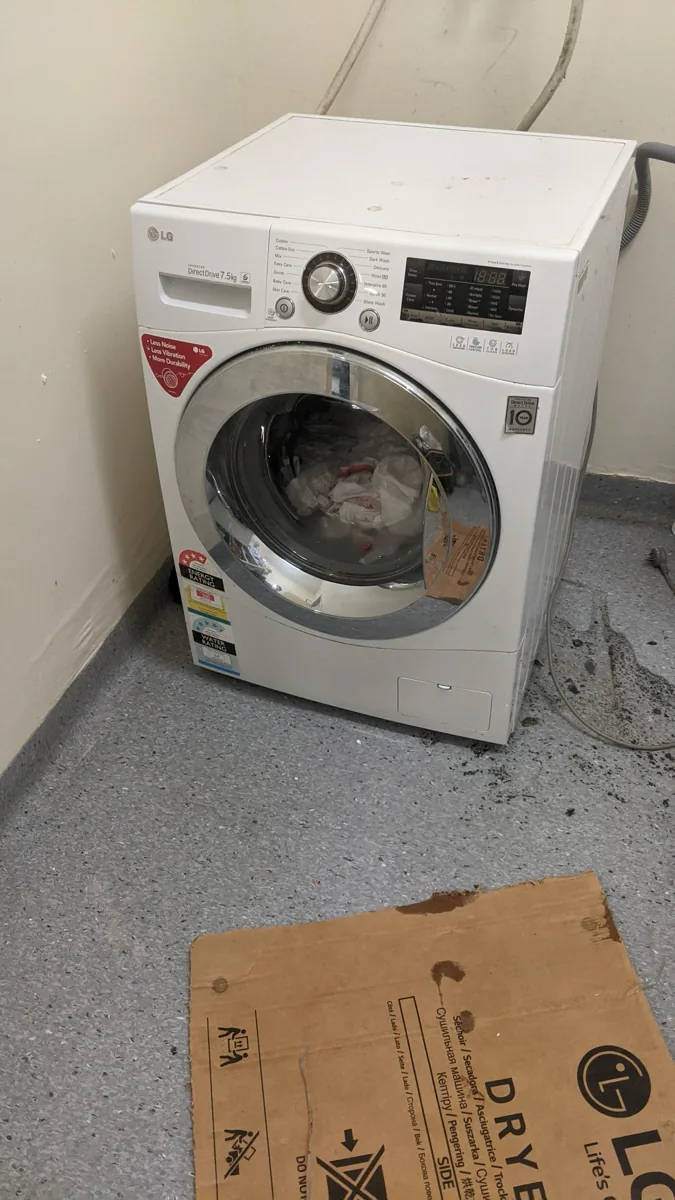
Quick Reference Table
| Code | Also Shown As | What It Usually Means |
|---|---|---|
| OE | E03, E21 | Can’t drain. Check hose kinks and pump filter |
| IE | E02, E10 | Not filling. Check tap, hose, possible frozen line |
| UE, Ub | — | Unbalanced load. Redistribute by hand |
| dE | — | Door failed to lock. Try power reset |
| dE1 | — | Door not closing properly. Check for trapped laundry |
| tE | — | Heating/thermistor fault. Check after cooling |
| PF | — | Power interruption during cycle |
What You Can Check Yourself
- For OE codes, check the drain hose for kinks and clean the drain pump filter
- For IE codes, confirm the tap is fully open and the hose isn’t frozen or kinked
- For UE codes, redistribute the load and avoid washing single large items alone
- For dE codes, check nothing’s caught in the door or gasket, then try a power reset
- For most codes, a full power cycle, off at the breaker for a couple of minutes then back on, clears a temporary glitch before you need to assume a hardware fault
When It’s Worth Calling a Technician
A code that clears with a basic check and doesn’t come back generally means that was the actual cause. A code that returns after you’ve confirmed the obvious things, the hose, the tap, the load balance, the door, points toward an actual component fault: a pump, an inlet valve, a door lock assembly, or a thermistor. These are all straightforward repairs for someone who works on LG machines regularly, but guessing at which part to replace without confirming the fault first tends to be an expensive way to find out you guessed wrong.
National Appliance Repairs technicians work on LG washing machines regularly, and carry genuine drain pumps, inlet valves, door locks, and thermistors for washing machine repairs across the range. If your machine isn’t showing a code at all and simply won’t respond, our guide on washing machines that won’t turn on covers that separately. Every repair comes with a 12-month parts warranty and 3-month labour warranty.
Frequently Asked Questions
What does the OE code mean on an LG washing machine?
It means the machine can’t drain the water from the current cycle. Most often it’s a kinked drain hose or a clogged drain pump filter, both worth checking before assuming the pump itself has failed.
Why does my LG washer show IE during winter specifically?
Cold weather can freeze the water supply hose or the pipe feeding it, which stops water reaching the machine within the expected time and triggers the code. Once the line thaws, it typically fills normally again.
What’s the difference between dE and dE1 on an LG front-loader?
dE means the door failed to lock. dE1 more specifically indicates the door isn’t closing fully in the first place, often because something’s caught between the door and the rubber seal rather than a lock mechanism fault.
Can I fix a UE unbalance error myself?
Yes, in almost every case. Pause the cycle, redistribute the load by hand so weight isn’t bunched on one side, and restart. Washing large single items like doonas on their own is a common trigger worth avoiding where possible.
What does it cost to fix an LG washing machine showing an error code?
It depends entirely on the code and the actual cause. A hose or filter clean costs nothing. An inlet valve, drain pump, or thermistor replacement is a bigger job. Call 1300 434 380 for a ballpark before booking.
The Bottom Line
LG’s codes are genuinely useful once you know what each one’s pointing at: OE for drainage, IE for fill, UE for balance, dE for the door, tE for temperature. Work through the relevant check for your code first. Still showing after that? Get in touch with National Appliance Repairs or call 1300 434 380 for a same-day assessment, subject to availability, across Melbourne, Sydney, Brisbane, Adelaide, and Perth.
Call Us:
or leave a message using the form below