Most Australians with a dishwasher have spotted that round screw-top cap near the drain — filled it once out of curiosity, or left it alone because the manual was long gone before they moved in.
Dishwasher salt doesn’t get much attention, and most people aren’t sure what it actually does. It’s not the same as table salt, it’s not optional for every machine, and whether you need it at all comes down to your dishwasher, your water, and your postcode.
At National Appliance Repairs, we’ve been asked (and recommended) dishwasher salt plenty of times to our clients.
So — what is it, how does it work, and do you actually need it?
What Dishwasher Salt Actually Is
Dishwasher salt is not the same as table salt or cooking salt. It is a coarse-grained, high-purity form of sodium chloride (NaCl) with no additives — no iodine, no anti-caking agents, no magnesium compounds. The coarse grain size is important: fine salt would dissolve too quickly and risk clogging the softener unit inside the machine.
Its sole purpose is to regenerate the ion exchange resin inside the dishwasher’s built-in water softener. It does not go into the wash water directly and does not clean the dishes.
The Problem It Solves: Hard Water
Water hardness is determined by the concentration of dissolved calcium and magnesium ions in the water supply. Water that has passed through limestone or chalk geological formations picks up these minerals. When hard water is heated — as it is during a dishwasher’s wash cycle — these minerals precipitate out of solution and deposit as limescale on whatever surface they land on: the spray arms, the heating element, the interior walls, and the dishes themselves.
Hard water is a widespread issue across Australia. Per WaterScore, Adelaide’s water hardness runs around 87-120+ mg/L depending on the suburb. Perth and large parts of regional Queensland and Western Australia also have moderately hard water. Even Melbourne and Sydney, which draw from relatively soft catchments, can have localised hardness depending on the local distribution infrastructure.
Limescale on a dishwasher’s heating element acts as an insulating layer, forcing the element to work harder to heat the water to the target temperature. This shortens the element’s life, increases energy consumption, and degrades cleaning performance over time. The spray arm holes become partially blocked, reducing water pressure and coverage. Glasses develop a cloudy, permanently etched appearance.
How the Built-In Water Softener Works
Most mid-to-high-end European dishwashers — and the majority of quality dishwashers sold in Australia, including Bosch, Miele, Smeg, AEG, and Fisher & Paykel — include a built-in water softener. It sits at the base of the machine and contains a bed of synthetic ion exchange resin.
As the incoming water passes through the resin:
- Calcium and magnesium ions in the water are attracted to the resin and bond to it
- Sodium ions from the resin are released into the water in exchange
- The water leaving the softener contains sodium instead of calcium and magnesium — it is now “soft”
Over time, the resin becomes saturated with calcium and magnesium and loses its ability to soften the water. To restore it, the machine runs a regeneration cycle: concentrated salt water (brine) from the salt reservoir is flushed through the resin. The high sodium concentration forces the calcium and magnesium off the resin beads, which are flushed away, and the sodium is restored. The resin is ready to work again.
This regeneration process happens automatically during a wash cycle when the machine determines it’s needed, based on the water hardness setting programmed into the machine. The dishwasher salt provides the sodium for that process.
Does Your Dishwasher Have a Salt Reservoir?
Not all dishwashers do. Some budget models, particularly smaller or older machines, do not have a built-in softener and have no salt reservoir. These machines cannot soften the wash water at all, which is why they tend to leave more scale in hard water areas over time.
To check whether your machine has a salt reservoir:
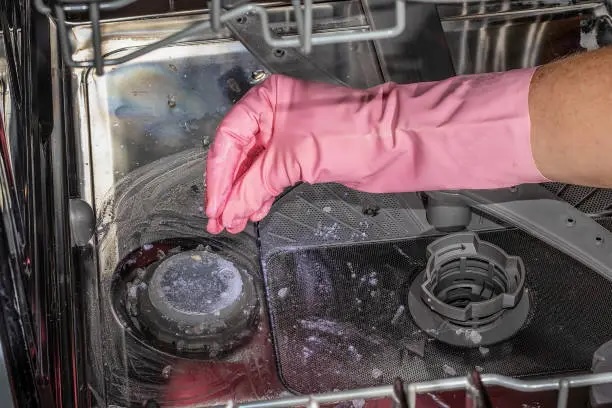
- Look at the base of the dishwasher interior (remove the lower rack)
- You should see a round cap, usually marked with an “S” or a salt indicator, near the drain
- If there’s no such cap, your machine does not have a softener system
The machine’s manual will confirm this definitively.
Do You Need Salt in Your Australian Dishwasher?
If your machine has a salt reservoir, yes — filling it is necessary for the softener to work. An empty salt reservoir means the regeneration cycle can’t run, the resin becomes saturated, and the machine starts delivering hard water to the wash cycle. Scale build-up follows.
How much salt you’ll use depends on your local water hardness:
- In areas with soft water, the machine regenerates less often and the salt lasts longer
- In hard water areas like Adelaide, Perth, or regional Queensland, the machine regenerates more frequently and you’ll need to refill the reservoir more often
- Most reservoirs hold around 1 to 1.5 kg of salt at a time
Your water authority’s website publishes annual water quality reports that include hardness data. SA Water, Sydney Water, Melbourne Water, and Seqwater (Queensland) all provide this information publicly.
Does Dishwasher Salt Change the Taste of Food or Dishes?
No. The salt reservoir is sealed from the wash compartment during normal operation. Brine used in the regeneration cycle is flushed through the softener unit and drained away — it does not enter the wash water that touches your dishes. You will not taste salt on your dishes or cutlery as a result of using dishwasher salt.
Can You Use Table Salt, Pool Salt, or Rock Salt Instead?
No. None of these work as substitutes.
Table salt is too fine — it dissolves too fast and can clog the softener components. It also contains iodine and anti-caking agents that damage the resin over time.
Pool salt and rock salt are coarser and often purer than table salt, but they’re not manufactured to the same standard as dishwasher salt and can contain trace elements that degrade the resin.
Sea salt brings extra minerals and compounds beyond sodium chloride — same problem.
Dishwasher salt is cheap and on the shelf at any Australian supermarket. There’s no real reason to substitute.
What About All-in-One Dishwasher Tablets?
Many all-in-one tablets include a small salt component as part of their formulation. For households in soft water areas where the machine barely needs to soften at all, the salt in an all-in-one tablet may be sufficient.
For most of Australia — and particularly for Adelaide, Perth, and other moderately hard water areas — the salt in all-in-one tablets does not provide adequate regeneration for a machine with a dedicated softener unit. The machine needs the reservoir to be filled with proper dishwasher salt.
Miele, Bosch, and most other major brands explicitly state in their manuals that dishwasher salt should be used regardless of whether all-in-one tablets are used, if the machine has a salt reservoir and the local water hardness requires it.
Salt and Dishwasher Lifespan
Consistently using dishwasher salt in areas with moderately hard water is one of the most effective things you can do to extend your dishwasher’s working life. It protects the heating element, keeps spray arm holes clear, reduces internal scale build-up, and maintains the cleaning performance you paid for when you bought the machine.
If you’ve been running your dishwasher without salt for years in an area with moderate-to-hard water, a significant scale build-up may already have occurred. Descaling the machine with a commercial dishwasher cleaner or white vinegar cycle, and then resuming regular salt use going forward, will gradually improve performance — but severe scale on the heating element may already have caused permanent damage.
If your dishwasher is not cleaning well, is taking longer to heat water, or is leaving cloudy residue on glassware despite salt and rinse aid use, a technician can assess whether a mechanical fault has developed. We at National Appliance Repairs carry out dishwasher repairs across Sydney, Melbourne, Brisbane, Adelaide, and Perth.
FAQ
My dishwasher has a salt indicator light — how often will it need refilling?
This depends on your water hardness, how often you run the machine, and the hardness setting programmed into it. In Adelaide or Perth with daily dishwasher use, monthly top-ups are common. In softer water areas with the same usage frequency, it may be every two to three months.
Can dishwasher salt go off or expire?
No. Sodium chloride does not degrade or expire. A bag of dishwasher salt stored in a dry location will remain effective indefinitely. The only concern is moisture: if the bag is stored somewhere damp, the salt can clump together, but this doesn’t affect its performance — break up any clumps before using.
The salt reservoir cap is hard to remove — is this normal?
The cap can become stiff if it hasn’t been removed for a long time, or if limescale has formed around the threads. Wearing rubber gloves to improve grip usually helps. If it’s genuinely stuck, a cloth for grip and gentle turning force should free it. Do not use tools that might damage the cap or the reservoir opening.
I filled the salt and now there’s a salty taste on my dishes — what went wrong?
This usually means salt spilled into the machine during filling without being rinsed away. After filling the salt reservoir, always run a short cycle immediately to flush away any spilled salt before loading dishes. Keeping a cloth nearby to wipe up spills around the cap before screwing it back on also helps.
My dishwasher has no salt compartment but leaves scale on my glasses — what can I do?
Without a built-in softener, the options are: use a commercial dishwasher descaler regularly to remove existing scale; install an inline water filter that reduces hardness before it reaches the machine (a plumber’s job); or switch to a dishwasher with a built-in softener when it’s time to replace the machine.
Conclusion
Dishwasher salt is not optional maintenance for Australian households with a dishwasher that has a salt reservoir and moderate-to-hard water — it’s the mechanism by which the machine protects itself from the mineral content of the water supply. Understanding what it does makes it easy to use correctly.
For the practical how-to on filling the reservoir and setting the hardness level, see our article on how to use dishwasher salt and rinse aid. And if your dishwasher has developed a fault from years of scale build-up, we at National Appliance Repairs are here to help across Australia. Call 1300 434 380.
Call Us:
or leave a message using the form below