It’s one of those settings most people set once and never revisit. The dial gets turned to the middle, the fridge gets cold enough that the milk stays fresh, and that’s considered job done. But if you’ve ever had food go off faster than it should, or noticed ice forming on your salad at the back of the shelf, the fridge temperature is usually the first thing worth checking.
The right fridge temperature isn’t just about keeping food cold. It’s about keeping food safe, reducing waste, and running the appliance efficiently. At National Appliance Repairs, our technicians see the effects of incorrect fridge temperatures regularly — both in food safety complaints and in faults that develop when a compressor is pushed harder than necessary. Here’s what you actually need to know.
The Recommended Temperature Range
For a domestic fridge in Australia, the correct temperature range for the fresh food compartment is 0°C to 4°C. The ideal target is 3°C. That is what the Australian Standard recommends.
CHOICE Australia agrees. They say 3°C is the practical target to aim for. It is cold enough to sit comfortably below the 4°C upper safe limit. But it also leaves enough buffer so that normal fluctuations–opening the door, adding warm food–do not push the fridge into freezing territory.
Now, Food Standards Australia New Zealand sets 5°C as the maximum safe temperature for perishable food. At or below 5°C, bacterial growth slows down to a rate that keeps food safe for its expected shelf life. Above 5°C, bacteria multiply quickly. That raises the risk of food-borne illness.
The 3°C target straddles the line between food safety and freezing point, with headroom on both ends — making it the most practical temperature to set your fridge to.
The Temperature Danger Zone
In Australia, the temperature danger zone for food safety is 5°C to 60°C. Bacteria like Salmonella, Listeria, and E. coli thrive in that range. Some of them can double in number every 20 minutes under the right conditions.
Now, the rule from FSANZ is simple.
- Food that has been in the danger zone for more than four hours? Bin it.
- Food that has been in there between two and four hours? Use it immediately. Do not put it back in the fridge.
- Under two hours? You can refrigerate it or use it.
This is called the 2-hour/4-hour rule.
For your home fridge, the practical implication is clear. If your fridge is running above 5°C, every single item inside is at elevated risk. Every hour it sits there. So keeping that temperature right is not just about energy bills or appliance longevity. It is about not getting sick.
What About the Different Zones in Your Fridge?
Temperature is not uniform throughout a fridge. Most fridge interiors have warmer and colder zones, and understanding them helps you store food correctly.
Coldest areas:
- The bottom shelf and the area directly in front of the back panel (where cold air enters)
- The chiller drawer, if your fridge has one — this sits close to 0°C and is designed for meat, fish, and poultry
Warmer areas:
- The door shelves, which are exposed to room temperature every time the fridge opens
- The top shelf, which tends to be warmer than lower shelves in most fridge designs
Storage guide based on zones:
- Bottom shelf / chiller drawer: Raw meat, poultry, seafood (coldest zone; keeps these items safest and prevents drip contamination onto other foods)
- Middle shelves: Dairy, eggs, leftovers, cooked food
- Top shelf: Drinks, foods less sensitive to temperature variation
- Crisper drawers: Fruit and vegetables (slightly higher humidity helps extend freshness)
- Door shelves: Condiments, juices, butter — items with longer shelf lives and lower food safety risk
How to Check Your Fridge Temperature
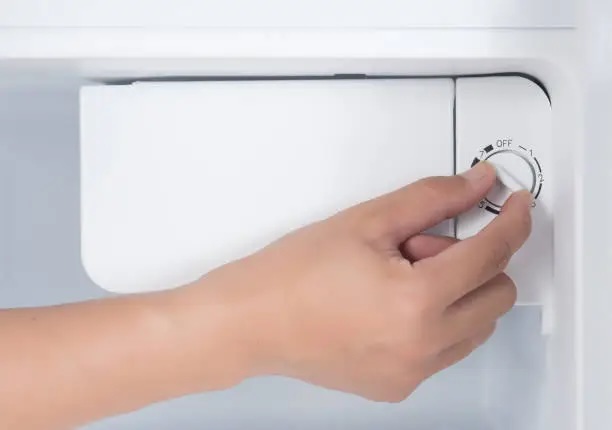
Your fridge dial actually controls cooling intensity, not temperature – so the number “1” or “2” doesn’t necessarily mean 1 or 2°C. A thermometer is the only tool that’ll actually tell you what’s inside.
Place one in a glass of water on the middle shelf and leave it overnight. The next day, check the reading. You’re looking for 4°C or below.
Higher than that? Your fridge needs to run colder. Too cold? You’ll spot ice crystals on foods that should stay unfrozen.
The reason this matters: fridges run warmer than most people realize. A NSW Food Authority study found that nearly one in four Australian home fridges averaged above 5°C — which is a food safety issue.
Fridge Temperature Quick Reference
| Zone | Target Temperature | What to Store |
|---|---|---|
| Fresh food compartment | 0°C to 4°C (target 3°C) | General refrigerated food |
| Chiller drawer | Close to 0°C | Raw meat, poultry, seafood, fish |
| Door shelves | 5–8°C (warmest zone) | Condiments, juice, butter |
| Crisper drawers | 0–4°C with higher humidity | Fruit and vegetables |
Common Reasons a Fridge Isn’t Reaching the Right Temperature
If your fridge is consistently running warmer than it should, a few common causes are worth checking before calling a technician:
- The thermostat dial is set too warm. Check the setting and adjust as described above.
- The door seal is damaged or not sealing properly. A faulty seal allows warm room air to enter continuously. Close a piece of paper in the door — if it slides out with no resistance, the seal needs replacing.
- The fridge is overpacked. Cold air needs to circulate to maintain an even temperature. A fridge so full that air can’t move will have warm spots.
- The fridge is placed in a hot environment. A fridge in a hot garage or in direct sun works harder to maintain temperature and may struggle in Australian summer conditions.
- The condenser coils are dirty. Dusty coils at the back or base of the fridge can’t dissipate heat effectively, causing the compressor to overwork and the interior to run warm.
- The fridge is too empty. A nearly empty fridge loses temperature quickly when the door opens and takes longer to recover. Keeping a few containers of water in the fridge adds thermal mass.
If the fridge is still running warm after checking these, the problem may be a failing thermostat, a compressor issue, or low refrigerant — all of which need a qualified technician.
Does Fridge Temperature Change by Season?
It can. Especially in Australia. Think about summer. Your fridge is in a hot kitchen or a hot garage. The ambient temperature around it rises. The compressor has to work harder just to keep up. And the internal temperature can drift upward without you even noticing.
So try this simple habit: At the start of every summer, check your fridge temperature with a thermometer. Adjust the thermostat if you need to. That one habit reduces food spoilage and saves energy.
FAQ
What is the maximum safe fridge temperature in Australia?
5°C, according to Food Standards Australia New Zealand (FSANZ). Above that, bacteria multiply fast. But in practice, you’ll want to aim for 3°C for a safe buffer.
Why is my fridge set to 3 but still not cold enough?
It’s likely because the number on the dial doesn’t mean Celsius. A 3 on one fridge is not the same as a 3 on another. In this case, you’ll want to trust a refrigerator thermometer, instead to check the actual temperature. We do not recommend you trust the dial.
Is it bad to keep the fridge too cold?
Yes. Below 0°C and you freeze things that should not freeze like veggies, dairy, and anything liquid. It’ll also cause ice build-up that blocks airflow. Stick to 0–4°C.
Where should eggs go? Door or shelf?
Middle shelf while it’s still in the carton. The door is the warmest part and fluctuates most. Carton on a shelf keeps eggs stable and stops them absorbing other food smells.
Dial goes 1 to 7. What setting do I use?
Higher number = colder usually. But the only real answer is to measure it. Start at the midpoint. Check the actual temperature after 8 hours and adjust from there. Aim for 3°C.
Conclusion
The right fridge temperature — 0°C to 4°C, with 3°C as the practical target — is not set-and-forget. It’s worth checking with an appliance thermometer at least once a year, and again after any major environmental change (a move, a hot summer, a fridge in a new location). Most of the food safety and spoilage problems that seem like a fridge fault are actually a temperature calibration issue.
If your fridge is struggling to reach or maintain safe temperatures despite correct settings and a good door seal, there may be a mechanical fault involved. We at National Appliance Repairs carry out fridge and freezer repairs across Australia — call 1300 434 380 for a same-day assessment in most metro areas.
Call Us:
or leave a message using the form below