Ask any Adelaide plumber or appliance technician what their most reliable repeat business is, and dishwasher descaling and hard water damage will come up fast. Adelaide’s water has a reputation, and while the city has improved its treatment significantly over the decades, the mineral content remains higher than most other Australian capitals — and dishwashers take the brunt of it.
Water hardness is a measure of dissolved calcium and magnesium content, expressed in milligrams per litre (mg/L) of calcium carbonate equivalent. Sydney draws from soft, granite-filtered catchments with hardness typically below 50 mg/L. Melbourne sits similarly low. Adelaide is a different story.
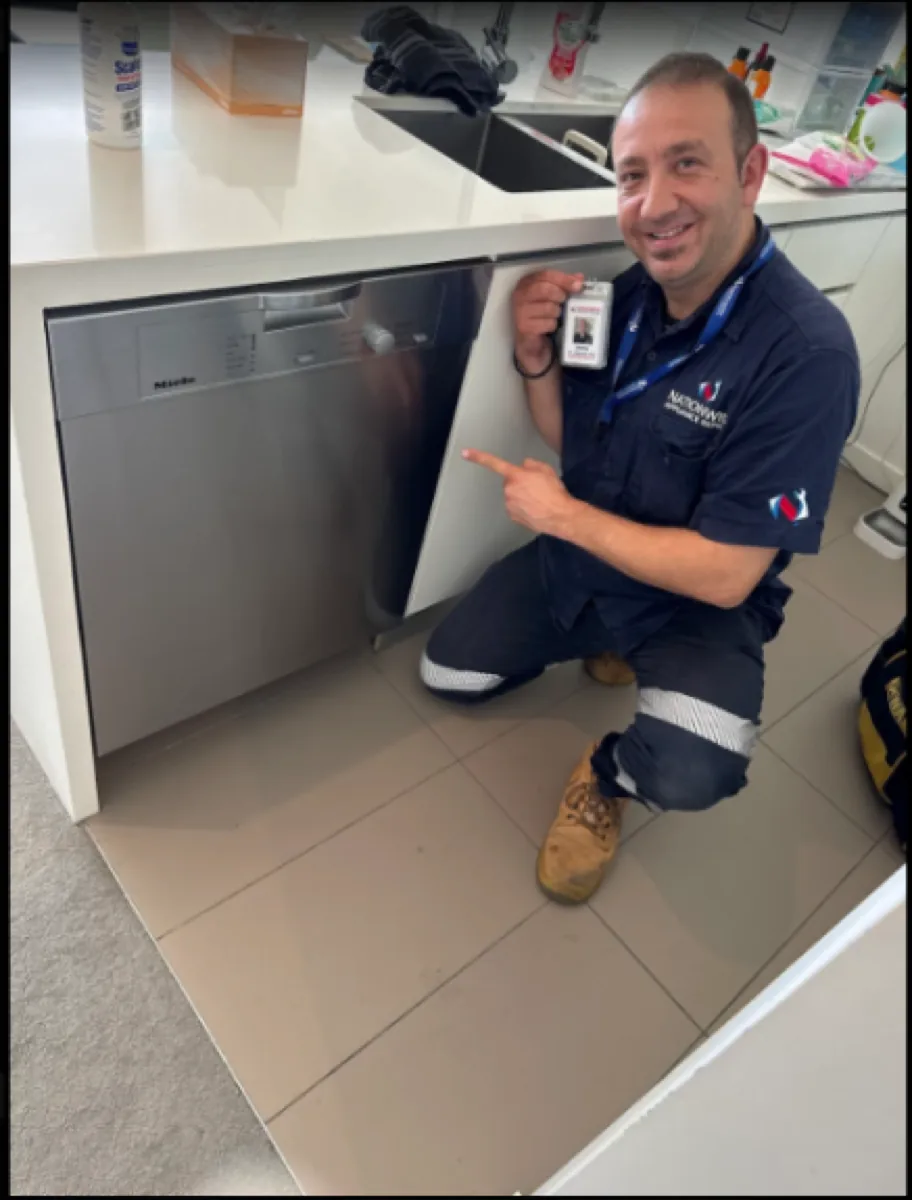
At National Appliance Repairs, our Adelaide technicians service dishwashers across the metro area every week. Hard water damage is visible in a predictable pattern — it’s entirely manageable once you understand what’s happening and why.
Adelaide’s Water Hardness: The Numbers
According to WaterScore, Adelaide has the hardest metropolitan water of any major capital in Australia. Depending on where you live, hardness can run anywhere from 87 to 136 mg/L. Some of the northern and western suburbs–Salisbury, Port Adelaide, West Lakes–regularly see levels above 110 to 120 mg/L. Eastern suburbs like Burnside, Norwood, and Unley are generally lower, but they are still well above what Sydney or Melbourne deal with.
Now, SA Water has its own definitions. They class water above 200 mg/L as “hard” and anything between 60 and 200 mg/L as “good quality.” That sounds reassuring, until you look at what dishwasher manufacturers actually recommend. Bosch, Miele, most of the major brands say that once water hardness goes above 70 mg/L, you should be using dishwasher salt to soften it inside the machine.
At Adelaide’s typical levels? Most of the metropolitan area is above that threshold, and not by a little.
What Hard Water Does to a Dishwasher
When hard water heats up inside a dishwasher — and the wash cycle typically reaches 55-75°C — the dissolved calcium and magnesium precipitate out of solution and deposit as limescale on every surface the water touches. This includes:
- Spray arms: The small holes in the spray arms are the first casualty. Limescale accumulates inside the holes and on the outer rim, reducing water flow and altering the spray pattern. The dishes in certain rack positions stop getting properly cleaned — usually the far corners that depend on a specific spray arm hole being unblocked.
- Heating element: The element at the base of the dishwasher reaches the highest temperature in the machine. Scale builds fastest here, forming an insulating layer that forces the element to work harder to heat the water to the target temperature. Over time, this shortens element life and increases energy consumption. Heavy scale on a heating element is one of the most common causes of dishwasher faults in Adelaide homes.
- Interior walls and door: White or grey streaking on the stainless steel interior is mineral scale. It doesn’t affect function directly, but it’s a useful indicator of how aggressively the water is depositing minerals throughout the machine.
- Glassware and dishes: The cloudiness that develops on glasses after repeated dishwasher cycles in Adelaide is mineral film — calcium and magnesium deposits left behind when water evaporates from the glass surface. It’s cosmetically unpleasant and resists normal detergent washing once it builds up.
- Water inlet valve and internal pipes: Scale accumulation in narrow passages restricts water flow over time, contributing to pressure issues, fill problems, and eventually complete blockages in older machines.
The Dishwasher Salt Question
Most European dishwashers — and the majority of mid-to-high-end dishwashers sold in Australia are European-designed — have a built-in water softener in the base of the machine. It works by passing the incoming water through an ion exchange resin that swaps calcium and magnesium ions for sodium ions, producing softer water for the wash cycle.
The resin is regenerated automatically using dishwasher salt (specifically formulated coarse salt, not table salt). When the salt reservoir is empty, the softener stops working and hard water flows through the machine unchecked.
In Adelaide, keeping the salt reservoir filled is not optional maintenance — it’s the primary defence against scale damage. How often you refill it depends on your water hardness level and how frequently you run the machine, but in most metro Adelaide households using the dishwasher daily, checking and refilling monthly is a reasonable habit.
Set the water hardness level correctly Most dishwashers with a built-in softener have a hardness setting that determines how aggressively the softener operates. It is usually set using a dial or through the machine’s digital menu. Check your manual and set it to match your local water hardness — for most Adelaide metro addresses, a setting equivalent to around 100 mg/L (or the equivalent in your machine’s units) is appropriate. An incorrectly low setting means the softener undershoots and scale still forms. An unnecessarily high setting wastes salt.
Rinse Aid: The Second Line of Defence
Rinse aid reduces the surface tension of water, causing it to sheet off dishes and glassware rather than forming droplets that dry into mineral spots. In hard water conditions, rinse aid is particularly effective at reducing the cloudiness and spotting that Adelaide water leaves on glasses.
Make sure the rinse aid reservoir is regularly topped up, and check that the dosing setting is appropriate for your water hardness — most dispensers have an adjustable dial from 1 to 6. For Adelaide water, a mid-to-high setting typically gives the best result.
Descaling: When to Do It and How
Even with salt and rinse aid in use, scale builds up over time, particularly on the heating element and spray arms. Descaling the machine every three to six months is advisable in Adelaide.
How to descale:
- Run an empty hot cycle with a commercial dishwasher descaling tablet or with 250ml of white vinegar placed in a dishwasher-safe cup on the top rack (do not mix the two — run one or the other)
- Remove and soak the spray arms in white vinegar for 20 minutes, then clear any blocked holes with a toothpick, before the descaling cycle if possible
- After descaling, run one plain rinse cycle before using the machine for dishes
If the machine has been running without salt for an extended period, a single descaling cycle may not be enough to remove heavy built-up scale. Successive cycles over a few weeks will progressively break it down.
Suburb-by-Suburb: Adelaide’s Hardness Variation
| Area | Typical Hardness Range | Relative Risk |
|---|---|---|
| Salisbury, Port Adelaide, West Lakes | Often 120+ mg/L | High |
| Adelaide CBD, North Adelaide | ~100-115 mg/L | Moderate-High |
| Norwood, Burnside, Kensington | ~90-100 mg/L | Moderate |
| Eastern Suburbs generally | ~85-100 mg/L | Moderate |
| Hills (Stirling, Crafers) | Variable, sometimes softer | Lower-Moderate |
Note: These ranges are indicative based on SA Water data. Local hardness can vary with seasonal changes to the water source. SA Water publishes annual water quality reports that include hardness data by zone.
FAQ
Do I need dishwasher salt if I use all-in-one dishwasher tablets?
All-in-one tablets include a small amount of salt and rinse aid components, but not in quantities sufficient for Adelaide’s water hardness levels in machines with a dedicated softener. If your machine has a salt reservoir, fill it with dishwasher salt regardless of which tablets you use — the integrated softener needs it to function properly.
My dishwasher is producing cloudy glasses even with rinse aid — is this the water or the machine?
Cloudiness from mineral deposits is Adelaide’s most common dishwasher complaint. Check whether salt is present and the hardness setting is correctly configured. Run a descaling cycle. If cloudiness persists after these steps, the spray arm holes may be partially blocked, reducing rinsing effectiveness — clean them with a toothpick and a vinegar soak.
How long does a dishwasher last in Adelaide vs. soft water cities?
If you skip the salt and descaling, your dishwasher will likely die early as heating elements go and spray arms becoming clogged in just 6 to 8 years – perhaps even sooner. With good maintenance, a dishwasher can typically hit 10 to 15 years.
Can a whole-house water softener help?
Yes, especially if it’s installed by a professional plumber. A water softener can strip out minerals from the water before it hits the dishwasher.
My old dishwasher is not doing well, should I repair or replace it in Adelaide?
Before you replace it, get a tech to clean the spray arms, descale it, and check the heating element. A lot of “dying” dishwashers in Adelaide are just neglected and not broken.
Conclusion
Adelaide’s water is not going to get dramatically softer. Dishwashers in this city will always be working harder than they would in Melbourne or Sydney. The response is straightforward maintenance. Keep the salt reservoir filled. Set the hardness level correctly. Use rinse aid. Descale every few months. Those four habits make a significant difference to how long a dishwasher lasts and how well it performs.
When a fault goes beyond maintenance — a heating element that has failed, a control board issue, a spray arm that is cracked rather than just blocked — we at National Appliance Repairs service dishwashers across Adelaide. Call 1300 434 380 for a fast diagnosis and honest repair assessment.
Call Us:
or leave a message using the form below