If you own a terrace house in Melbourne, you know this moment. You have done the work. Found the right washing machine. Checked the dimensions three times. Ordered it. Then you grab the tape measure and check the laundry one more time. And your stomach drops.
The doorway is 600mm wide. The machine is 595mm.
Technically, it fits. But barely.
Then you notice the water connection is on the wrong side. And the dryer you planned to stack on top? It is not clearing that overhead cupboard.
Look, Melbourne’s inner-city terraces are some of the most beautiful homes in Victoria. But the laundries are terrible. Victorian and Edwardian homes were not designed for modern appliances. Washing was done outside by hand. The laundry was a lean-to or a bathroom corner. Fitting a washer, dryer, and any storage into that space takes real planning.
When something goes wrong with an appliance in a period home–whether the machine breaks while you are trying to shoehorn it in, or it develops a fault after a few months–National Appliance Repairs has seen it all. Our technicians are out in Melbourne every day. And cramped terrace laundries are a regular part of the job. So here is what you need to know before you buy. And how to make the space actually work.
Why Terrace Laundries Are a Different Proposition
Most laundry design advice assumes a purpose-built space of at least 2 square metres with plumbing on one wall, a floor waste, and a power point within reach. Melbourne terrace laundries often have none of this in a convenient configuration.
Typical constraints include:
- Narrow doorways — Victorian and Edwardian terrace doors were typically 760mm to 810mm wide internally, but original rear additions can have openings as narrow as 600–650mm
- Low ceilings in rear additions — the lean-to or skillion-roofed back sections common in these homes often have lower ceilings than the main body of the house, which affects stacking options
- Plumbing in fixed positions — moving water supply and drainage connections in a period home can involve cutting through solid brick or timber flooring, making it a significant job
- Limited floor space — Australian laundry design guides suggest a minimum usable area of around 3.25 square metres; many terrace laundries fall well below this
- No mechanical ventilation — older lean-to laundries rely on natural airflow, which may not be sufficient for a condenser or heat pump dryer
Know Your Measurements Before You Buy
The standard front-load washing machine in Australia is 595–600mm wide, approximately 600mm deep, and around 850mm tall. That sounds like it should fit into a 600mm cabinet opening — but it won’t, because you need clearance on either side (5–10mm minimum) and 60–100mm behind for hoses, power leads, and drainage connections.
Before purchasing any appliance for a terrace laundry, measure:
- The doorway opening (width and height) — can the machine physically enter the space?
- The floor area available, including clearance in front of the machine for door opening and loading
- The depth from the back wall to the front of any cabinetry, bench, or obstacle
- The height clearance to any overhead shelving, cabinetry, or ceiling
- The location of the water inlet tap, drainage point, and power outlet relative to where the machine will sit
If the machine can’t get through the door without being tilted, tipped, or partially disassembled, plan for that before delivery day. Most washing machines can be tilted to a degree for maneuvering, but drum damage is a risk if they’re handled roughly. It’s worth asking the delivery team whether they’re comfortable navigating the space — or arranging a specialist rather than relying on a standard appliance delivery.
Front-Loader vs Top-Loader in a Terrace Context
For most Melbourne terrace laundries, a front-loading washing machine is the practical choice. Here’s why:
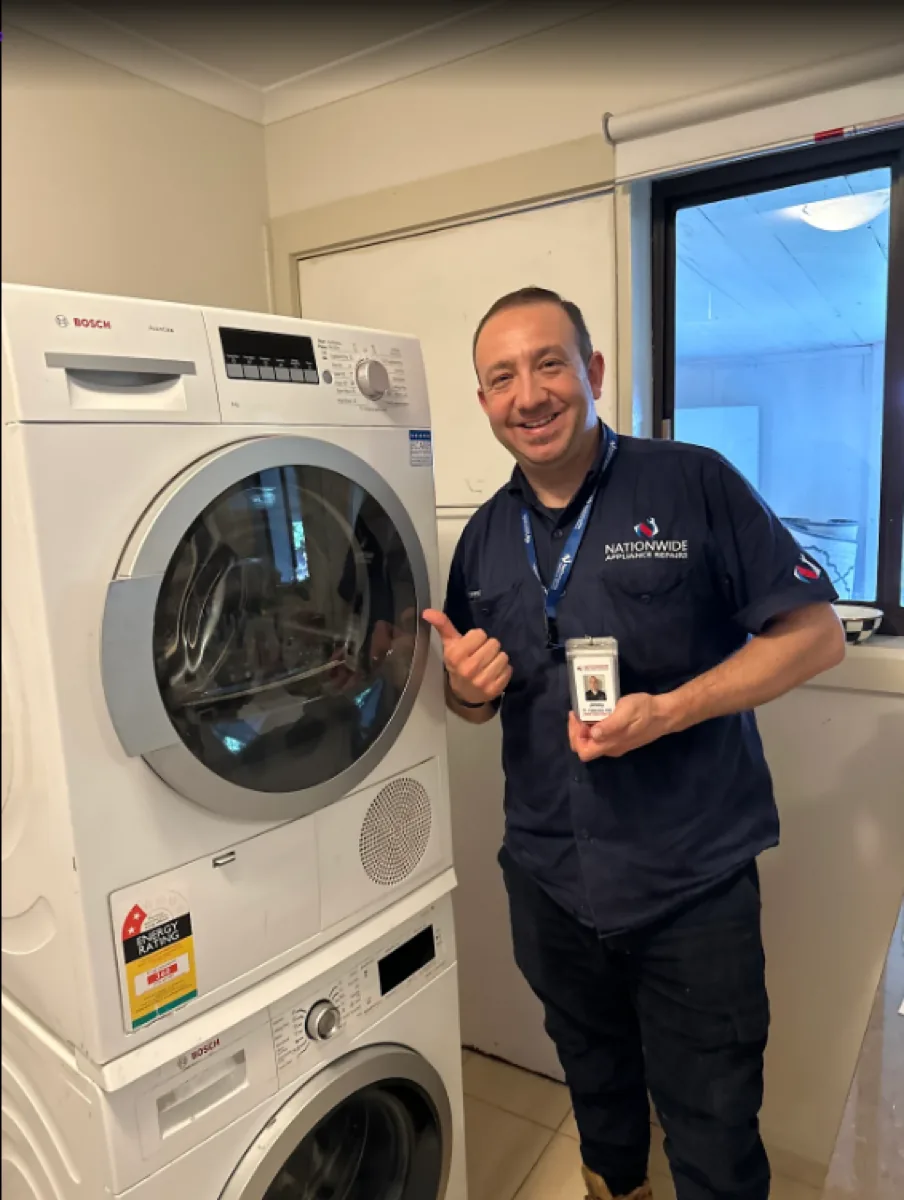
- Stackable: A matching condenser or heat pump dryer can sit on top, effectively doubling the appliance capacity without increasing the floor footprint
- Narrower depth options available: Some compact European front-loaders have a depth of around 460mm, which can make a meaningful difference in a tight space
- Door-opening direction: Front-loader doors open outward from the front. In a very narrow space, check whether there’s adequate clearance in front of the machine for the door to swing open fully and for you to load and unload comfortably
Top-loaders need a clear metre or more of space above the drum lid to allow the lid to open fully. In a terrace with a low skillion roof over the laundry, this is often simply not available. They also cannot be stacked under a dryer.
The Stacked vs Side-by-Side Question
| Layout | Best When | Watch Out For |
|---|---|---|
| Stacked (front-loader + dryer above) | Floor space is very limited; ceiling height is sufficient | Confirm ceiling height allows dryer clearance with door open |
| Side-by-side | Wider space available; bench desired above machines | Takes up more floor area; check depth of both machines match |
| Combo washer-dryer unit | Truly minimal space; no room for two appliances | Longer cycle times; lower capacity per wash than separate machines |
| European laundry (concealed behind doors) | Aesthetic priority; space can be closed off | Requires adequate ventilation behind doors for dryer exhaust |
For stacked configurations, ensure the combined height of washer plus dryer (typically 1,700mm or more) clears the ceiling and any overhead cabinetry. Stacking kits from the same brand are the safest option — they secure the dryer and include anti-vibration components that matter more than they sound in a narrow space.
Ventilation: The Overlooked Problem
Condenser dryers and heat pump dryers don’t require an external vent — they manage moisture internally. Vented dryers do require an exhaust path to the outside, which in a terrace lean-to may mean routing flexible ducting through a wall or window, adding complexity and potential heat buildup if not done properly.
In Melbourne’s internal terrace laundries without natural airflow, a condenser or heat pump dryer is usually the better option. Heat pump dryers are more energy-efficient and gentler on fabrics, though they tend to run longer per cycle and require more depth than condenser models.
Whatever type you choose, some level of ventilation in the space itself is important for managing moisture. A small exhaust fan or a louvred panel in the door keeps humidity in check and protects your cabinetry and walls over time.
When the Appliance Breaks in a Tight Space
The same constraints that make installation tricky in a Melbourne terrace laundry also affect repair access. Our technicians regularly work in spaces where pulling a machine out requires disconnecting hoses, moving cabinetry, or working at angles that a standard appliance service call doesn’t prepare for.
A few things that help when you call for a washing machine repair in a terrace:
- Let us know it’s a terrace with a narrow or difficult laundry when you book — we’ll come prepared with the right tools and allocate appropriate time
- Clear any items stored on or immediately around the machine before the technician arrives
- Know where your water shutoff valve is; in older terrace homes it can be in unexpected locations
FAQ
Can a standard 600mm washing machine fit through a 600mm doorway?
Only just, and in practice no — you need a few millimetres of clearance to manoeuvre. If the doorway opening is exactly 600mm, a 600mm-wide machine won’t go through without damaging the door frame. Consider a compact European front-loader (typically 450–480mm deep with a similar width) or measure whether the machine can be angled through. Removal of the door may create just enough clearance.
What is the minimum laundry size for two appliances in a Melbourne terrace?
A stacked front-loader and dryer can fit in a footprint of approximately 650mm wide by 700mm deep, making it viable in very compact spaces. Side-by-side placement typically requires at least 1,200mm of width. In either case, you also need working clearance in front — at least 1,000–1,200mm to load and unload without obstruction.
Can I install a washing machine where there’s no existing plumbing?
Yes, but it requires a licensed plumber to extend the hot and cold water supply and install a drainage point. In a period home with solid brick walls or original timber floors, this is a more involved job than in newer construction. Get a quote from a plumber before committing to a layout that requires new connections.
Why does my dryer take much longer to dry in a small internal laundry?
Poor ventilation is usually the cause. If the laundry is sealed and humid, the dryer has to work harder against the ambient moisture in the air. Opening a window or installing a small exhaust fan significantly improves drying times.
My washing machine worked fine until I moved it into a new terrace. Now it vibrates excessively — why?
Uneven flooring is the most common cause in period homes. Timber floors in older terraces can flex under the machine’s spin cycle. Adjustable anti-vibration feet, a rubber mat under the machine, and ensuring all four feet are level and in firm contact with the floor usually resolve this. If vibration persists, it can also indicate drum bearing wear, which is worth having checked by a technician.
Conclusion
Fitting a modern laundry into a Melbourne terrace takes more planning than a standard renovation, but it’s entirely achievable with the right measurements, the right appliance choices, and a realistic view of what the space can accommodate. The front-loader plus stacked dryer combination, in a compact European format if necessary, is the go-to solution for most inner-city terrace laundries — and it can look genuinely good behind bi-fold or cavity-sliding doors.
If your terrace washing machine or dryer develops a fault, we at National Appliance Repairs service all major brands across Melbourne, including in the tight spaces that come with period homes. Call 1300 434 380 and let us know what you’re working with.
Call Us:
or leave a message using the form below